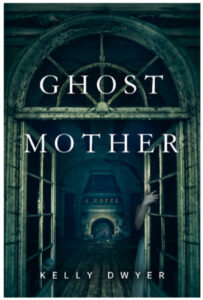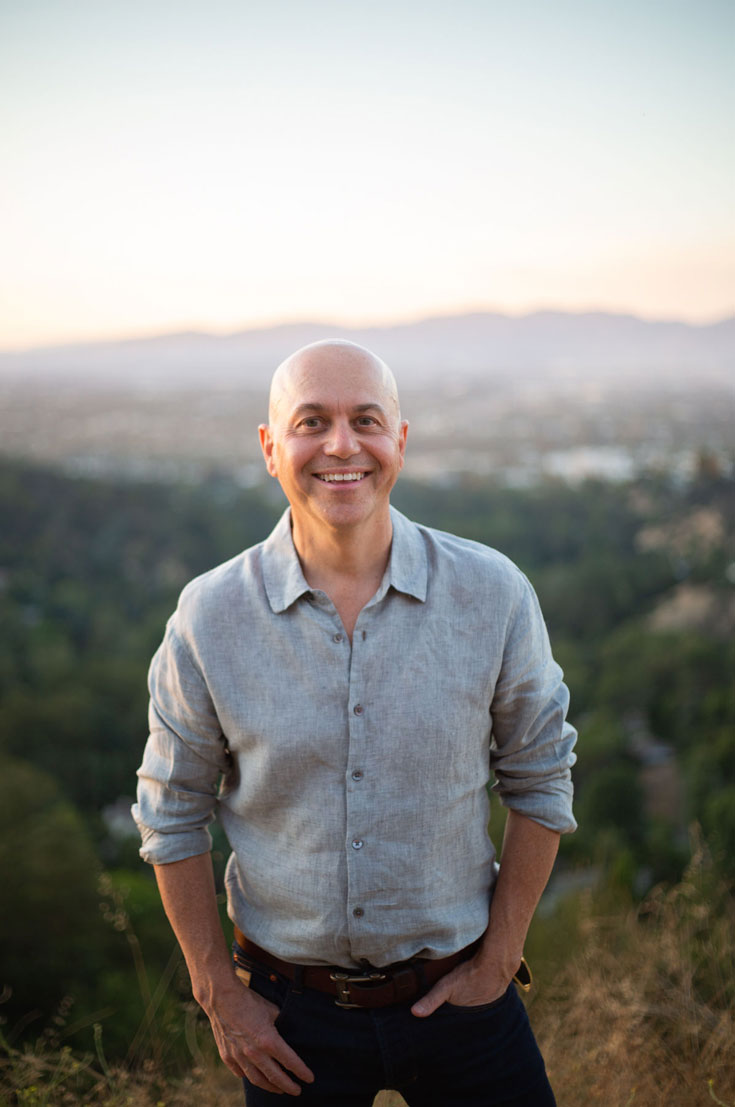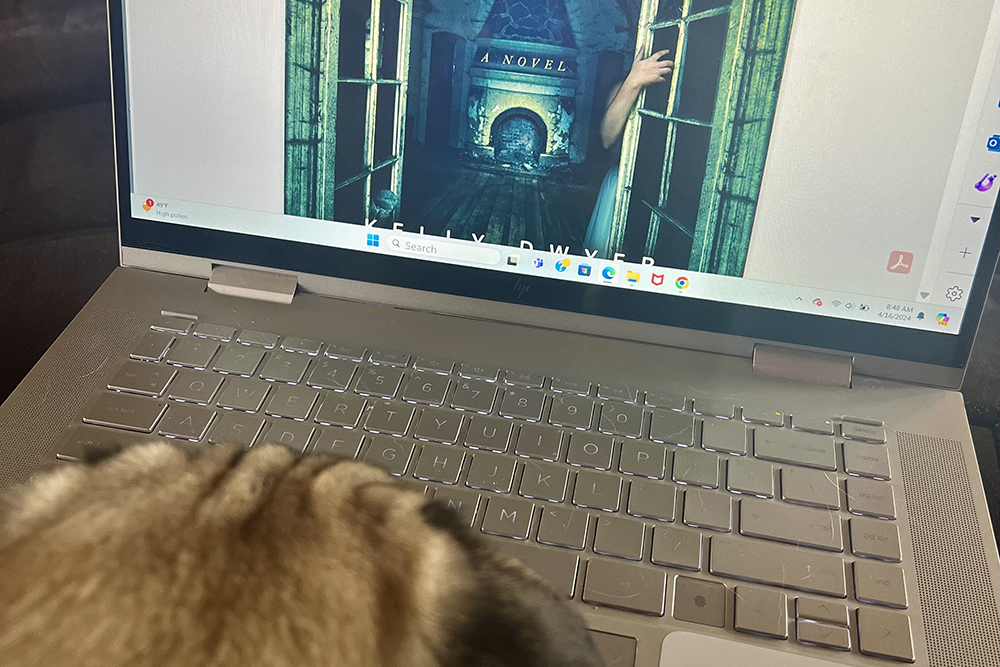


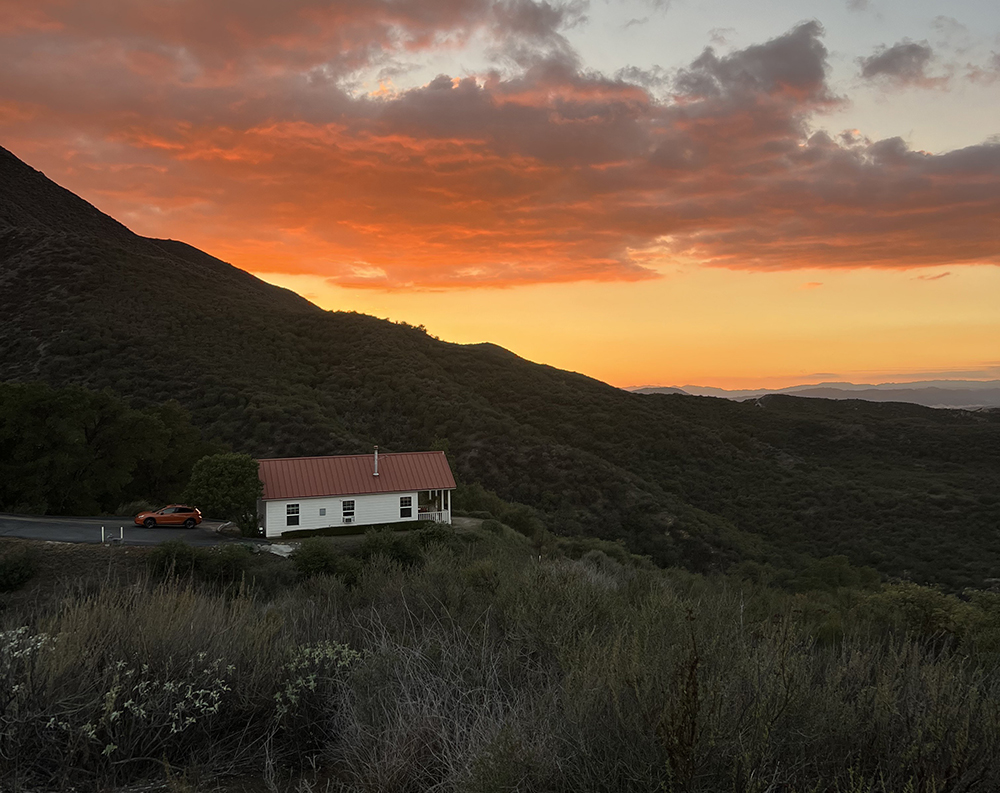
Dorland Mountain Arts Colony is a tranquil retreat for writers, artists, and musicians in the mountains of Temecula, California. The first time I went there, in November 2024, my most recent novel, Ghost Mother, had just been published, and I had spent the fall peddling my wares. Now, I told myself, I was going to start my new novel.
Initial concept
Some months before, I had come up with the idea for it by making a list of everything I liked:
- Fairy tales and fairy tale objects (slippers, mirrors, apples)
- Hollywood, Los Angeles, palm trees, Greystone Mansion
- Movies, especially horror movies
- Edgy/dark literature
- Feminine rage/“Good for her” fiction
- The colors pink and blue (like the sky at sunset)
- Shadow selves/doppelgangers
- Mysterious settings that serve as characters
I looked over my list and thought, “Cinderella meets the Orson Welles of horror.”
That was my concept. That was pretty much all I knew about my book. I went to Dorland to figure out the rest and begin to write.
My first breakthrough
I arrived on a Saturday. On Sunday, I began to work on an outline, but I realized I knew nothing about my story. I couldn’t make an outline because I had no idea who my character was, what she wanted, and how she was going to transform over the course of the book.
At first, I panicked. I only had two weeks! But Nature is a great teacher. I went for a hike. I walked the labyrinth. I listened to the wind rustling through leaves as the sun set. By the time I went to bed, I still didn’t know what I was doing, but I felt calm.

In the morning, I made myself coffee and opened Alan Watt’s book, The 90-Day Novel, and came across Alan’s idea that your character doesn’t have a problem — they have a dilemma, which consists of a great desire (“I want to be loved and accepted,” for example) with a false belief (“I can only be loved and accepted if I am pious and good,” for example).
A problem can be solved. A dilemma can only be resolved through a shift in perspective (such as, “I don’t need to be perfect to be loved”). The plot is made up of the scenes that help the character arrive at that shift in their perspective.
I am not new to writing. I studied creative writing at Oberlin College and received my MFA in fiction from the Iowa Writers’ Workshop at the University of Iowa. I published my first novel when I was twenty-nine. I began teaching at the college level when I was a grad student and taught creative writing to college students in the University of Wisconsin system for many years, and adult students through the University of Iowa’s Iowa Summer Writing Festival for twenty-six years before the dean closed the program this past summer. (Now I teach adult writers on my own.)
In other words, I am educated in the craft of novel writing and have decades of teaching experience under my belt — but my understanding of novel writing shifted when I understood Watt’s idea of “the dilemma at the heart of your story.” I had known (and taught) that a character has a want and a need, and that the character needs to get what they need (or not); it was the “shift in perspective” that was new to me, and, I’m not exaggerating when I say, life changing.
I began to do the exercises in Watt’s book, exploring my character’s dilemma. When I left Dorland, two weeks later, I had seventy-five pages of notes and hadn’t written a word of the actual novel. And yet, I left feeling with a major sense of accomplishment and hope. I was beginning to understand my character and my story.
Finding meaningful resolution
My second “dilemma” breakthrough came this November, again at Dorland, when I realized there was too much I didn’t understand about my character and her transformation to continue on the path I was on. So I went back to Alan Watt, to “the dilemma at the heart of my story,” and wrote a sixty-eight-page plot outline/character arc which included major plot points of my character’s transformation. (I use the words “plot outline” and “character arc” interchangeably as I believe that, ideally, they’re the same thing.)
Even with a sixty-eight-page outline, I didn’t have an ending. I had a climax — but what happened after the climax, I didn’t know. This didn’t bother me. I am a plotter by experience (I’ve found outlines incredibly useful), but a pantser by nature. My impulse is to write first, figure things out later. Still, I know that the ending is the most important part of any story, and I would have loved to have had a sense of some final image or feeling I was writing toward.
Enter Alan Watt’s one-day class over Zoom called Story Day, which I took this January. One of the insights and breakthroughs I had that day came through this exercise: We were to explore a powerful metaphor for our story, the equivalent of Dorothy’s ruby slippers.
In The Wizard of Oz, the slippers symbolize Dorothy’s power. She always had the power to get what she needed, which is to go home. In this exercise, we were to draw a picture (stick-figures being fine) of the closing image of our story.
Anyone who has ever taught or taken a good creative writing class knows that breakthroughs happen that wouldn’t have happened if you were just alone in your room. There is a collective energy — a synergy — that is created when writers are together, in a physical space or over Zoom, that brings forth ideas we wouldn’t otherwise have.
This is why and how, even though I had been thinking about slippers and birds and dresses in my story up until now, during the class, what I drew was my character wielding (that’s the word I thought) a camera. And with that image, I understood that my character, who had been the object of the camera and the male gaze throughout the story, would now wield the camera herself.

I am grateful to Alan Watt for all of the breakthroughs I’ve had in my writing and my own teaching this past fourteen months or so due to his writing, his insights, and his teaching. I highly recommend The 90-Day Novel and Alan’s classes to all writers — from aspiring authors who haven’t yet written a novel to ones with MFAs and published books.
I didn’t know the details, but I knew: I had my ending. It would foment inside of me until I needed it.
I now think of myself as needing three things to write: my laptop, my coffee, and — thanks to Alan Watt — my character’s Dilemma.
I wish you all the same. Happy writing, all!
Ghost Mother: A Novel by Kelly Dwyer is available for purchase here.