

There’s probably no film technique that is both more misused and overused simultaneously than the montage sequence. One of the biggest challenges in filmmaking is keeping the story within a set time frame. Montages allow the action to flow without slowing down the narrative.
But, like any other screenwriting technique, there are pitfalls to consider if you want to do it well.
Maintaining the audience’s attention and immersion is paramount to creating an effective screenplay. The difference between a good montage and a bad one comes down to this: How do you understand the montage itself?
In this article, I’ll take a look at what a montage is, and go over the best ways to employ it. Lastly, I’ll offer you a Story Weapon to instill purpose in your montage sequences.
Learn how to write a montage in a screenplay — a powerful tool used to condense time and showcase character development or parallel action without slowing down the story’s narrative flow. To be truly effective, a montage should go beyond a simple “passage of time” and serve a deeper thematic purpose, visually illustrating a character’s internal transformation or setting the emotional tone for the next act.
What is a montage?
A montage is a sequence where several events are shown in quick succession. This is often done to shorten the time needed to showcase development or to pass on information in a film.
Rather than tackling something in real time, the montage allows the clock to take a back seat and for you as a screenwriter to focus on the fun part. This is also true for the viewer, who is now allowed to enjoy progression and change without having to sit through potentially tedious exposition.
Here are some specific examples of what montages can be used for:
- Show passage of time – From something big like changing of seasons to something small like sitting through a class.
- Showcasing a character’s emotional state – Quickly convey how a character’s day to day is affected after something significant occurs, such as falling in love, losing their job, having a baby, or becoming depressed.
- Characters in parallel action – This works in situations with multiple characters involved, such as a team preparing for a heist or switching shifts at work.
There might be a voice-over with dialogue from one or more characters, or the montage might move in sync with a specific piece of music to further enhance the impact of the quickly changing images.
An effective montage does more than just show
The best montages do more than one thing at a time. You have to look beyond what it is, and see what it can do to enhance both your characters and your theme.
Let’s take a look at one of cinema’s most classic montage examples in Rocky (1976). I’m sure if you know about Rocky, you know how the training montage is part of its heritage and legend. This montage sequence was able to do a number of things that illustrate how multilayered a montage can actually be.
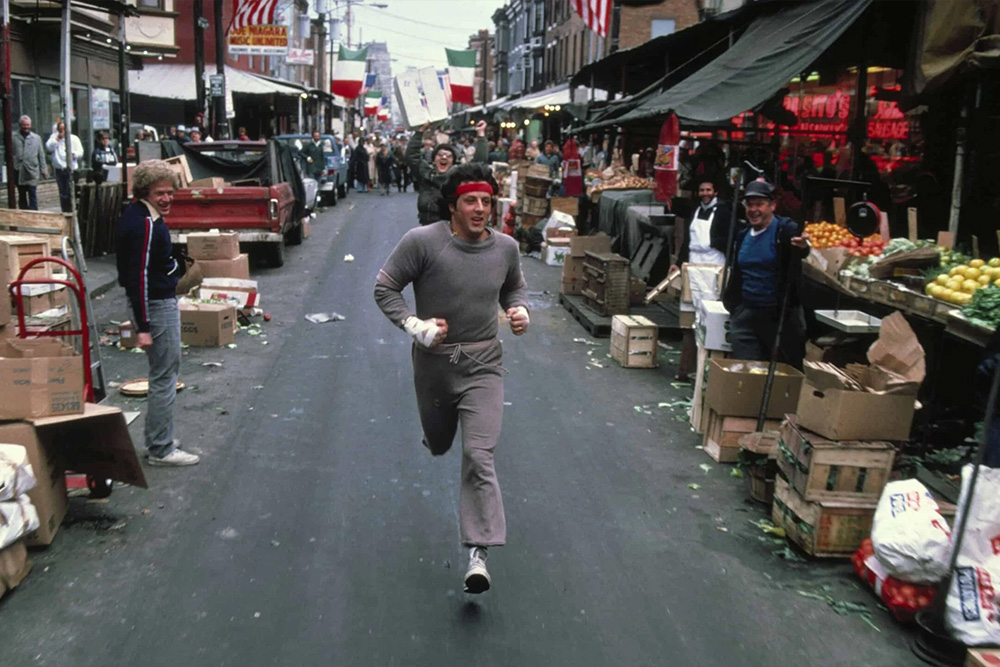
A few seconds into the training montage, there’s a moment where Rocky Balboa runs through the streets of the Italian Market. It’s easy to overlook as the montage itself acts as a way to show the passage of time while Rocky works on his physical training for the fight ahead, but this moment is also a physical manifestation of Rocky’s journey as a character.
In a way, this can even be considered a key moment in showing his transformation, the moment when a washed up fighter chooses to go above and beyond his station to stand toe to toe with the world champion. The story soon moves to another scene shortly after where Rocky shares with Adrian that he doesn’t want to be just another bum from the neighborhood.
The montage eventually ends with the famous scene of Rocky reaching the top of the steps in front of the Philadelphia Museum of Art. As the song goes, this montage sequence isn’t just about getting stronger, but also reaching higher. Rather than focusing only on the progression of his physical ability, this montage shows greatness in how it rounds up Rocky’s transformation throughout the story.
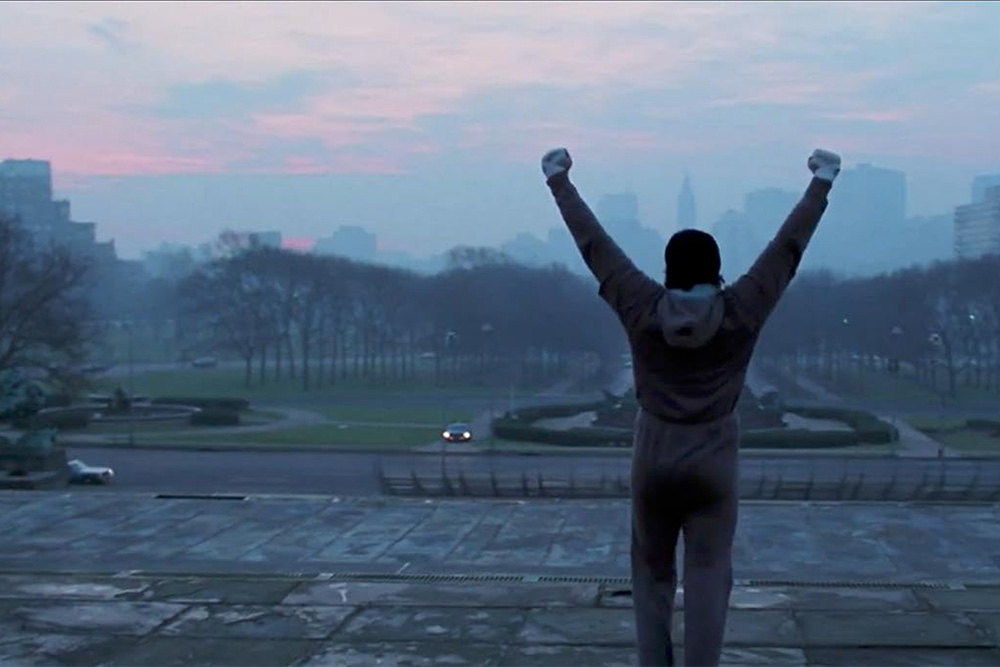
And, that isn’t all. On top of everything else, the training montage also allows the format of the narrative to transform even after passing the middle point of the film.
The drama is over, and now the action will begin.
The montage does more than pass the time. It also works to warm up the audience for the coming fight and the more physical conclusion of this character’s journey.
How to write a montage
Let’s see what the montage would actually look like on paper.
Just like the rest of the screenplay, what’s important above all else is that you provide clarity for anyone reading the script. Remember, the screenplay is meant to be a blueprint.
In fact, going back to the example of Rocky (1976), the montage sequence isn’t even an explicit part of the original script.
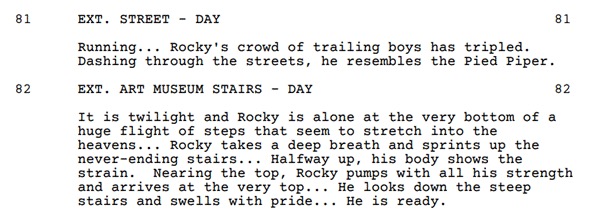
Without any specific labeling in this example, the montage here is just two scenes back to back of Rocky running down a street, then climbing the stairs.
The idea of Rocky running through the Italian market itself wasn’t born on the page. It was a spontaneous moment added in by the director and film crew getting footage where they could.
So what do you do as the screenwriter? Leave it all up to the director? While ultimately the interpretation of the montage will be up to the director, you would include the story elements at play along with the tone, pacing, and essential imagery. That’s part of the beauty of collaboration in filmmaking.
Montage format examples
There isn’t a strictly rigid format you need to follow. You can use the label of MONTAGE, BEGIN MONTAGE, or SERIES OF SHOTS as you write your script and include some scene descriptions. Here’s an example of how that could be formatted:
If you have less of an idea about the specifics of your scene, you can even forgo the headings altogether and jump straight into a list format detailing what you’re imagining for the story.
Here’s another example:
– Rocky is beginning a brisk jog, moving through the street as many onlookers look in curiosity.
– Rocky is doing one handed push ups as Mickey watches over him
– As the crowd begins to form behind Rocky, he takes up an image almost akin to the Pied Piper.
Your story weapon: Using montages with purpose
While pacing and chronology is a big part of a montage’s identity, the ultimate goal is to show a condensed character experience. Sure, many have used montages to some degree of success solely for the coolness factor, and inserting some famous artist’s music. However, if you want a montage that will consistently stick in your audience’s mind, then it’s better to have all the bases covered.
Rather than treating a montage as a mere moment in between the many beats of your story, it should be connected to your characters and the theme.
As much as possible, do not start out writing your screenplay with a specific “cool” montage in mind. It’s only after you have a solid idea about your screenplay’s structure and overall story arc that you can begin to get an idea about what to include in a good montage. Just like any other good beat in your story, it has to move things forward to the climax and resolution.
Before you write a montage in your next screenplay consider this question: Does my scene need this sequence? If so, is it for more than just saving time?
If the answer is yes to both, then montage on! Keep in mind what you’ve learned here and let your ideas flow.
Tools of the craft, like a montage, are useful in reminding us how to make the personal into something universal. Learn how to further elevate your audience’s experience in one of my next workshops: The 90-Day Novel, The 90-Day Memoir, Story Day.