



If your narrative drive is stalling, your protagonist could be missing the most vital engine for character transformation: a powerful internal conflict.
We often see conflict externalized — a corrupt official, a looming deadline, an approaching tornado. True dramatic tension, however, comes from the dissonance between the external and the internal. To create this tension, we must look at the protagonist’s dilemma. There are two ingredients to a dilemma: 1) a powerful desire, and 2) a false belief.
I’ve covered the foundational mechanics of how a dilemma works in internal conflict here. In this article, I will explore three distinct ways internal conflict manifests in storytelling through examples. And lastly, I’ll give you a Story Weapon to test the psychological tension in your own manuscript.
The most powerful internal conflict examples in storytelling share a common structure: a protagonist caught between a powerful desire and a false belief that prevents them from achieving it. Whether a character masks a dark desire behind a noble excuse like Walter White, sabotages what they need most like Will Hunting, or is forced to choose between two incompatible values like Michael Corleone, the internal conflict is what transforms a sequence of events into a story that costs the protagonist something real and stays with the reader long after it ends.
Internal conflict example #1: Masking a dark desire with a noble excuse
One of the most dramatically rich forms of internal conflict is the character who has buried a selfish or destructive want so deeply beneath a legitimate-sounding excuse that they have even convinced themselves.
The gap between what they tell the world and what is actually driving them is where the story lives. And the best version of this conflict is the one where the character’s self-deception is so complete that the audience sees the truth long before the character does.
Breaking Bad (2008-2013)
Walter White is the definitive example. For most of Breaking Bad, Walter operates from the story he has constructed about himself: that he is a dying man doing what he must to secure his family’s future. It is a story that has just enough truth in it to be convincing, to Walter and occasionally to the audience. But the story keeps developing cracks.
The moment that makes it irreversible is the scene where Walter watches Jane choking beside Jesse and does nothing. He does not pull back in horror. He watches. And then he rationalizes, quietly, efficiently, the way a man does who has had a lot of practice. The internal conflict here is between the man Walter is and the story Walter needs to tell about himself to keep going.

By the time he finally says it out loud, “I did it for me. I liked it,” the confession lands not as a revelation but as a confirmation of what the audience has known for a long time and Walter has been the last to admit.
Toy Story (1995)

The same conflict appears in considerably less threatening form in Toy Story, which is worth examining precisely because it shows how universal the pattern is. Woody is Andy’s favorite toy and has been for years. Then Buzz Lightyear arrives and the hierarchy shifts. What Woody feels is straightforward: jealousy, fear of replacement, the particular panic of someone who has built their identity around being needed. What Woody says is something else entirely. His objections to Buzz are framed as concern for Andy’s wellbeing, for the proper order of things, for everyone’s benefit but his own.
When his plan to knock Buzz behind the desk goes wrong and Buzz falls out of the window, Woody calls it an accident. And here is what makes the writing precise: Woody is not entirely lying. He did not mean for it to go that far. But he is also not telling the truth, and somewhere underneath the excuse he knows it.
What both characters share is the mechanism that makes this form of internal conflict so compelling to watch. The noble excuse is not simply a lie the character tells others. It is a lie they have told themselves so many times that they believe it.
Remove the lie, and the whole structure of who they believe themselves to be comes down with it. That is the dilemma underneath the conflict. And that is why, when the truth finally surfaces, it does not feel like a plot twist. It feels like an inevitability the story has been building toward all along.
Exercise: Unmasking the lie
Ask yourself: What is the noble cause I think my character will use to explain their actions?
What is their motivation? What is the dark, selfish, or ego-driven desire they are secretly fulfilling while hiding behind that excuse?
Internal conflict example #2: Sabotaging the goal to protect the ego
Sometimes a character’s inner conflict drives them to harmfully destroy something they really need. They are afraid of being psychologically exposed if they achieve their true desires. Therefore, they panic and self-destructively damage the path leading to their own salvation.
Good Will Hunting (1997)

Will is an example of a character who has a strong desire to experience real connections and achieve his full intellectual capacity. Yet, he believes a lie about himself: that anybody who truly understands him will ultimately hurt or desert him, and that fulfilling his potential will mean deserting his friends who are the only ones he trusts.
Will’s internal conflict comes out through his actions as self-sabotage. The apex of Will’s internal conflict occurs when his girlfriend, Skylar, invites him to go to California with her. Rather than accept the love he so desperately craves, Will lets his false beliefs dominate him. He uses his intelligence to belittle her and tell lies. He tells her he does not have feelings for her, and chases her away before she can choose to walk out on him. Will thinks of vulnerability as a threat and actively fights against the people trying to help him.
Fleabag (2016-2019)

We see this same level of self-sabotage in the character of Fleabag. She has a deep-seated desire to be forgiven and loved, but also harbors a false belief that she is inherently destructive and responsible for the death of her closest friend. Any time she gets emotionally close enough to another person (Hot Priest), she quickly distances herself.
Her internal conflict is shown through her use of gross humour, provocative sex play, or breaking the fourth wall to directly address the audience. They’re all ways to create chaos on purpose. She creates chaos as a defense mechanism to avoid her grief, guilt, and fear of intimacy.
Exercise: The self-sabotage trigger
Give your protagonist everything they believe they want in the middle of your story. Now, write a scene where they totally blow it.
Go!
What negative qualities did they utilize to repel successful relationships and/or opportunities, simply so they could remain safe and comfortably contained in their comfort zone?
Internal conflict example #3: Forcing a clash between two incompatible values
Internal conflict isn’t always a battle between good and evil. Often, it is a psychological war between two fiercely held, but completely incompatible, values. To honor one, the protagonist must betray the other.
The Godfather (1972)
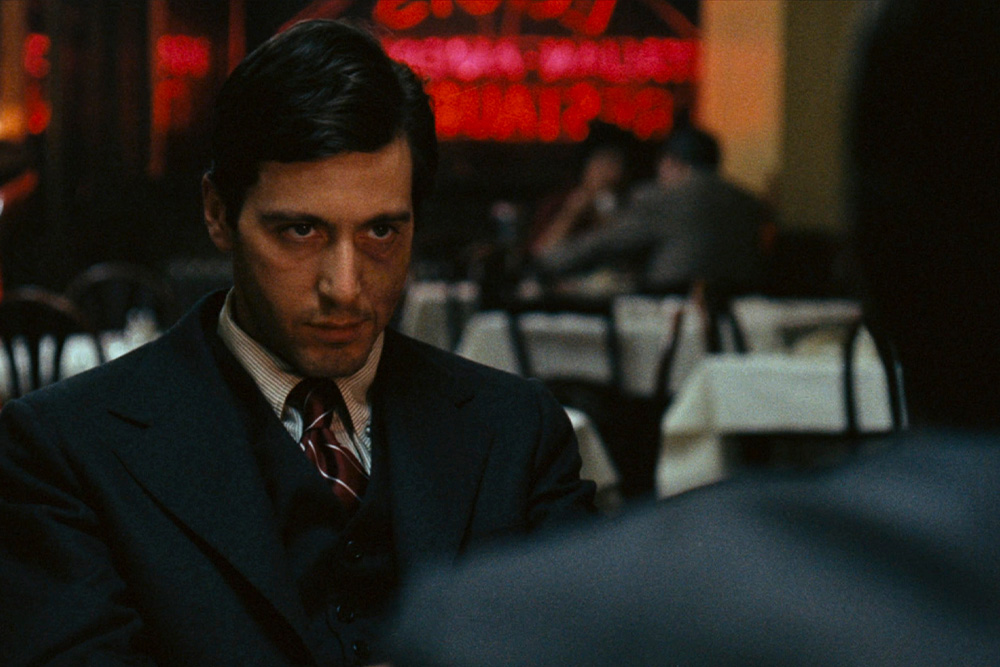
Michael Corleone is a perfect example. He desperately wants to live as a moral and law-abiding citizen, independent of his family’s crime organisation. On the other hand, he is loyal to his father. Michael believes he can protect his family and at the same time save his own soul.
However, when his father is assaulted, Michael’s internal struggle comes to a boiling point. His internal struggle is dramatically portrayed in the Italian restaurant scene. Michael retrieves a pistol from the bathroom to shoot the police captain involved in assaulting his father. When Michael approaches the captain with the gun, he knows that if he shoots the captain, he will have lost his moral conscience, but if he does nothing, his father will be killed. There is no way for Michael to solve this problem. He must fundamentally alter how he perceives reality. He must betray his own moral identity to protect those he loves. And in doing so, he crosses a threshold, a point of no return.
The Hunger Games (2012)

Katniss Everdeen has a powerful desire to protect her sister and maintain her humanity. However, she has a false belief that she can just stay quiet and get through the games run by the Capitol without being turned into part of their violence machine.
The games create an unresolvable internal struggle: she must become a murderer to survive the games and go back to her sister, or else she will be killed herself. The internal struggle leaves Katniss no choice. She is placed in a position where she is forced to betray one of her most basic values.
Exercise: The impossible compromise
Look at your climactic scene and ask an honest question: Does your protagonist get what they want without giving something up that genuinely matters to them? If the answer is yes, that scene may not be doing its deepest work yet.
The most psychologically true moments in a story are not the ones where a character overcomes an external obstacle through cleverness or courage alone. They are the ones where a character is forced to choose between two things they cannot bear to lose. Not a choice between something good and something bad, which is not really a choice at all, but between two things the character holds with equal conviction. Their loyalty to another person against their loyalty to the truth. Their need for safety against their need to be known. Their love for someone against their knowledge of what that person actually is.
This is where the internal conflict that has been building through the entire story finally becomes unavoidable. Your protagonist can no longer negotiate between their two incompatible values or find a way to serve both. The story has backed them into a corner where only one can survive, and the choice they make in that corner is the choice that tells us who they really are.
It is also the choice that determines whether they transform or whether they remain who they were on page one. A climax that lets your protagonist keep everything they came in with is not really a climax. It is a resolution in disguise. The choice must come at an enormous cost.
Your story weapon: The dilemma pressure test
For your character to undergo a real transformation, you must place them in a difficult spot. Taking out the external antagonist isn’t enough. Your story has no psychological risk if your character survives the climax while continuing to cling to their heroic rationalization or false belief.
Follow these three simple steps to test whether you’ve made your climactic moment psychologically challenging.
Step 1: Identify your dilemma.
Write down your character’s powerful desire and their false belief on a piece of paper.
Step 2: Dramatize the trap.
Take a look at your climactic scene. Have you set up a scenario where they are attaining their physical objective (saving the town, obtaining the job, winning the battle) is impossible unless they give up the false belief?
Step 3: Force them to choose.
Remove all their protection. Place them in a terrible circumstance where they are forced to stare into the mirror and tell the truth about why they have been lying to themselves since page one. This is the only way they can transform.
Movies and books aren’t memorable based solely on how difficult it was for the protagonist to reach the climax and find a resolution. They will remember how your protagonist’s journey comes at a serious cost. Push them to confront their deepest fears.
This process transforms a straightforward series of events into an in-depth study of human nature. You are not merely moving chess pieces around on a board. Rather, you are placing a flawed individual within the line of fire for the opportunity to transform and gain a new perspective.
Consider internal conflict examples from other great works similar to your own story, and pressure test your manuscript. Push your protagonist into impossible corners where their false beliefs will shatter, and you will create a powerful ending that offers a real catharsis for your reader.
Strong internal conflict is what transforms a story from a sequence of events into a meaningful character journey. To deepen your understanding of dilemma, character transformation, and psychological storytelling, join one of my next workshops: The 90-Day Novel, The 90-Day Memoir, Story Day, where you’ll learn how to build protagonists whose choices resonate long after the final page.