




When you read a line spoken in formal diction such as, “I regret to inform you that your services are no longer required, ” compared to “You’re fired,” you can feel the social distance between them. It’s the same message delivered with completely different weight.
Higher levels of speech patterns and vocabulary like this are used to convey a sense of precision, control, and some abstractness from casual dialogue. You can use formal diction to develop your characters and a story’s atmosphere before they take any actions. If it’s misused, however, it can make a story feel distant and lifeless.
In this article, I’ll explain what formal diction is, go through a few well-known examples, and discuss some of the common pitfalls that can make your words stiffen, rather than come to life. Lastly, I’ll provide you with a Story Weapon to test your own diction and see if it’s working on the page.
Formal diction uses precise, controlled vocabulary and sentence structure — avoiding contractions and casual shortcuts — to reveal character, atmosphere, or social distance rather than simply sound sophisticated. Examples like The Remains of the Day and Frankenstein show it working best when it hides emotion, exposes vanity, or builds dread, while misuse without purpose leaves prose feeling hollow. The strongest formal diction hints at something the character is holding back beneath the controlled surface.
What sets formal diction apart?
Informal diction is more conversational, using contractions, sentence fragments, and slang. It sounds like two friends talking with each other casually.
Formal diction does not use contractions or any casual shortcuts, but rather a more rigid structure with full sentences and concise or more technical phrasing.
Using one or the other isn’t more “right” or “wrong” in writing a story. What matters is whether or not the level of formality you’re using supports the story you’re telling. When a character’s dialogue is elevated or their speech is carefully controlled, that’s telling the reader something. It’s not merely decoration.
Formal diction offers clues about who a character is, what they might be hiding, or the kind of world in which the story takes place.

The level of formality can vary from one scene to another to reflect changes within the character. Perhaps they’ve put their trust in someone, or chosen to drop their mask due to fatigue.
Examples of formal diction in action
Some writers use formal diction to such an extent that it’s a part of the story itself, rather than merely a stylistic choice.
The Remains of the Day
Kazuo Ishiguro’s novel is narrated by Stevens, a butler whose voice never once slips into casual language, even in his own private thoughts. Every sentence remains measured, polite, and controlled — regardless of what emotions might be sitting underneath it.
That formality isn’t just characterization. It’s the entire engine of the book. Stevens has spent his life suppressing his own feelings in service of professional duty. His careful, restrained language mirrors that suppression sentence by sentence. When something painful happens, the reader has to look past the formal surface to sense what Stevens won’t reveal himself. The diction becomes a kind of armor around him. Waiting and watching for it to crack is where the novel’s real power lives.
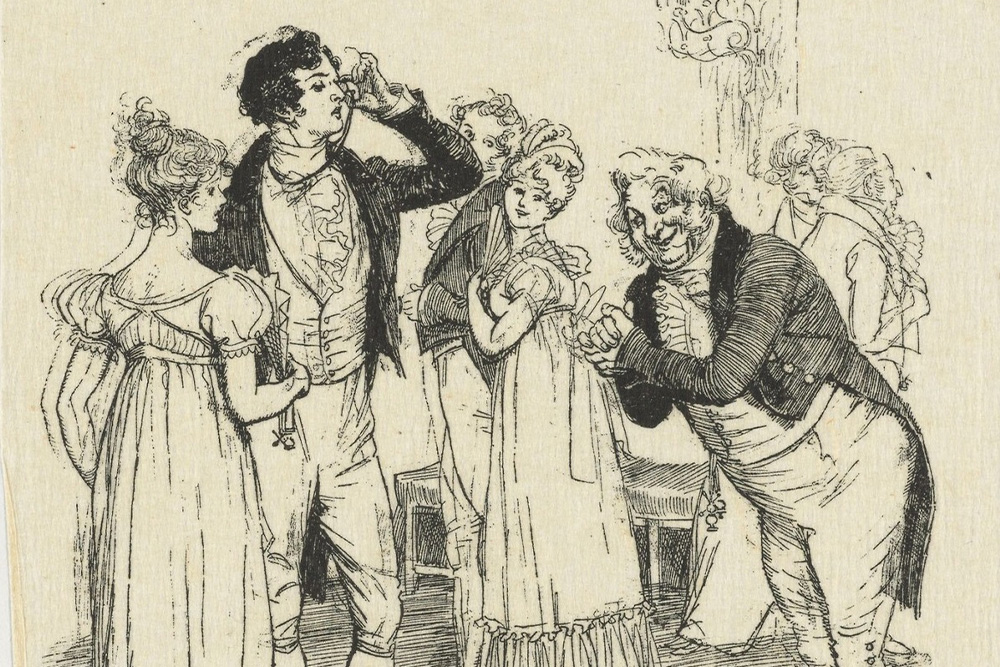
Pride and Prejudice
Jane Austen uses formal diction throughout her narration, matching the manners and social codes of the world her characters live in. She also uses it for sharper purposes, particularly through Mr. Collins, whose overblown, excessively formal manner of speech becomes a source of constant comedy.
Mr. Collins speaks in long, ornate, deeply formal sentences even when a simple statement would do. That mismatch between his self-importance and the actual substance of what he’s saying is where much of his humor comes from. Austen isn’t using this elevated register to elevate him. She’s using it to expose him, to show a character so consumed with propriety that his language has become a kind of costume that reveals more than it hides.
Frankenstein
Mary Shelley uses a formal register throughout Victor Frankenstein’s narrations, characterized by long sentences and heightened language in the Gothic tradition to which the novel belongs.
The formal diction does real work beyond simply sounding old-fashioned. It reflects Victor’s own self-image, a man who sees himself as operating on a grand, almost mythic scale, even as his choices spiral into disaster. The gap between his elevated language and the horror of what he’s actually done becomes part of the novel’s tension. The formal diction is a warning sign, the sound of someone still convinced of his own grandeur long after he should have stopped believing it.

2001: A Space Odyssey
The ship’s computer, HAL 9000, has an uncanny ability to converse in a calm, precise, and formal manner, even when deciding on life-and-death matters during emergencies. The slow, measured voice is what makes HAL so unsettling.
A villain who screams or rages feels human, even in their cruelty. HAL’s careful, controlled way of speaking strips any inkling of humanity away entirely, replacing it with something too calm, too logical, and impossible to read emotionally. There’s no crack in the voice to signal danger or something routine for the astronauts.
Why formal diction works when it’s earned

In every one of these examples, the word choice at play is doing something specific: hiding emotion, exposing vanity, building dread, revealing social pretension. The diction and themes work together to build the narrative.
This is the real test for whether this kind of language belongs in a piece of writing. It should be answering a question about character or atmosphere, not just signaling that the writing is serious or attempting to be more “literary.” Without that underlying purpose, formal diction tends to feel hollow. It’s impressive on the surface, but empty.
Common mistakes writers make with formal diction

Formality without a reason
The most common mistake is using elevated language simply because it sounds more sophisticated. If it’s not related to your character development, or connected to a deeper meaning in the story, you should question whether it really belongs there. Readers can usually sense when the diction is decoration rather than serving a function.
Inconsistent register
If a character uses precise and elevated diction in one sentence and slang in the next without any logical explanation for changing styles, it just baffles readers more than it illuminates anything about the person. It is important that your writing be consistent or if you’re breaking from it, that you do so for a good reason.
Mistaking complexity for formality
Long words and sentences don’t necessarily make something formal. It’s not a consideration of density, but precision and restraint. It takes care in curating the quality over quantity. Formality can be achieved in a short sentence, as Stevens’s clipped, careful lines often do in The Remains of the Day.
Your story weapon: The silence behind the words
Look at one of your characters who speaks in this kind of elevated register, or a scene where you’re considering using it. Write down, privately, what that character is actually feeling underneath their careful, controlled language. Don’t spell it out in the scene. Just name it for yourself.
Now reread the formal dialogue or narration with that hidden feeling in mind. Does the language feel like it’s holding something back? Or does it just feel like set dressing, with nothing real underneath it?
If you can’t name what the formality is hiding, proclaiming, controlling, or protecting, it probably isn’t earning its place yet. But once you know exactly what’s sitting underneath those careful, restrained sentences, formal diction stops being a stylistic flourish.
Formal diction can become a kind of pressure point where the reader senses everything the character refuses to say directly, which is often more powerful than if that character had simply said it plainly in the first place.
Developing greater control with diction will better serve your characters and help develop subtext rather than simply making your prose sound more sophisticated. To deepen your understanding of diction and other storytelling choices, learn more about storytelling craft in The 90-Day Novel, The 90-Day Memoir, or The 90-Day Rewrite.