
Some stories drop you straight into the middle of chaos in the first scene, giving little to no explanation. This might feel disorienting to the reader at first glance. And if it’s too confusing they might put the book back down. When it’s done well, however, curiosity pulls them in and they’re hooked.
In medias res, a Latin phrase meaning “in the midst of things,” is a literary technique that throws readers into the action, conflict, or tension. Usually, this is done in the first scene. By starting where something important is already taking off, you can grab your reader’s attention instantly. This quickly turns curiosity into momentum, and invites them to piece together the past as the story unfolds.
In this article, I will explore the purpose and characteristics of in medias res, give some examples, and offer you a Story Weapon to take off running in your own manuscript.
In medias res is a storytelling technique that begins in the middle of action or a conflict to hook readers immediately, creating curiosity by withholding context and revealing it gradually. When done well, this method builds momentum and suspense. It pays off by letting readers deduce how events unfolded as the story progresses.
Purpose of in medias res in storytelling
In medias res breaks the conventional linear story format, making for a more explosive and engaging start as it delays exposition. It does this through:
- Immediate engagement: Grabs your audience’s attention by starting with a high stakes situation or mystery.
- Building suspense: Makes them curious about events that led to the opening scene and what is happening.
- Cutting exposition: Avoids a slow, chronological beginning, getting straight to the heart of the plot and theme.
Readers will need some context for the story to make sense, of course. But even when you begin in medias res, you can still subtly weave background information into the dialogue and action. Once you’ve grabbed your reader’s attention, you can gradually add more exposition, making them increasingly invested in the emotional stakes of your story.
In medias res works by leaving the reader with unanswered questions that they’ll have to dig to find the answers for. This technique has been used successfully across different genres, including epic poetry, thrillers, crime fiction, fantasy, sci-fi, horror, and modernist literature.

Key elements to include
To perfectly execute an in medias res opening, you must first consider the following elements.
- A critical scene: The scene you choose to open with should be a pivotal part of the story. It should be dramatic and emotionally charged. It will also set the tone for the rest of the story.
- Minimal context: In medias res openings provide audiences with just enough context for the scene to make sense, but should still have a lot of unanswered questions. This approach grounds the readers while imbuing the narrative with an air of mystery.
- Smooth transitions: Once the readers are hooked, the scene should transition to the main narrative, avoiding abrupt shifts if possible. Keep your audience immersed.
- The payoff: In medias res can only work if there is a strong and satisfactory payoff. The opening essentially makes a promise to the reader to answer the questions it raises, and you must do your best to provide meaningful answers by the end.
A “flashforward” is a technique that can be used to build an in medias res opening. It shows your audience a future event in your story, usually from the climax, to build intrigue before flashing back again to move through the build up to that point. Not all in medias res moments will be in the flashforward format, however.
“. . . our play leaps o’er the vaunt and firstlings of these broils, beginning in the middle . . .”
– Prologue, Troilus and Cressida by William Shakespeare
Examples from books and films
In medias res has been used across the ages in different formats. Let’s look at some examples.
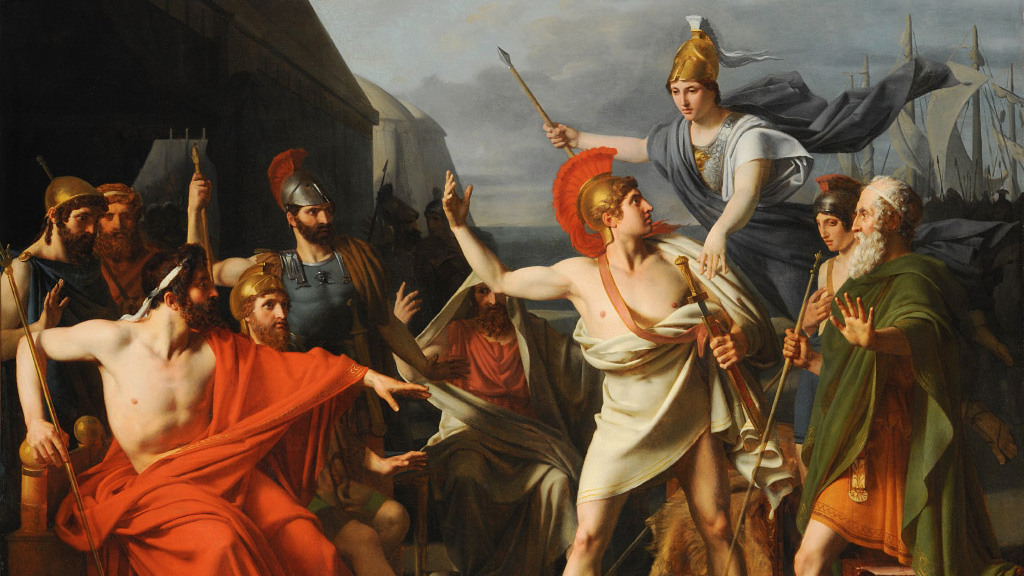
The Iliad by Homer
Sing, goddess, the anger of Peleus’ son Achilles and its devastation, which put pains thousandfold upon the Achaeans, hurled in their multitudes to the house of Hades strong souls of heroes . . .
Instead of going into a chronological telling of what started the war, here the reader (or listener) is dropped directly into the conflict between Achilles and Agamemnon during the siege of Troy.
The Trial by Franz Kafka
Someone must have slandered Josef K., for one morning, without having done anything wrong, he was arrested.
The questions only continue to build for Josef K. from there. The lack of explanation immerses the reader in the same confusion and helplessness that he experiences when two men show up in his room and only tell him procedures are under way, and he’ll learn everything in due course.
The Virgin Suicides by Jeffrey Eugenides
On the morning the last Lisbon daughter took her turn at suicide — it was Mary this time, and with sleeping pills, like Therese — the two paramedics arrived at the house knowing exactly where the knife drawer was, and the gas oven, and the beam in the basement from which it was possible to tie a rope.
This coming-of-age thriller novel is told from the perspective of a group of boys obsessed with the lives and shocking deaths of five sisters in a Detroit suburb. We know from this opening that all five of them are doomed to die, but the mystery of what led to this point creates immediate intrigue.
Breaking Bad

Vince Gilligan’s Breaking Bad pilot episode opens with an iconic first scene where viewers find themselves in the middle of the New Mexico desert with Walter White, dressed only in his underwear, recklessly driving an RV. He crashes the vehicle, hastily throws on a shirt, and raises his gun at the approaching sound of sirens. This is an action-packed opening that instantly raises a lot of questions. As the episode progresses, they are answered masterfully.
Star Wars: Episode IV – A New Hope
The Star Wars saga infamously opens right in the middle of a space chase. Imperial troopers and Darth Vader seize a ship carrying the plans of their secret superweapon, the Death Star. It’s a chaotic and action-packed opening that sets the stage perfectly.
Your story weapon: How to enhance your story with in medias res
If you are planning to use this technique for your own story, here is some advice.
1. To start off, create a chronological order of events. They should all be linked together through cause and effect. This will help you identify the perfect place to start and ensure you are able to raise the stakes and provide a satisfying conclusion to your audience.
2. Resist the urge to overwhelm the reader with exposition immediately after the start. Make sure you are purposefully leaving some questions unanswered. Unravel the narrative slowly and gracefully.
3. Use a framing device. For instance, you can begin the story with a character retelling the tale in their own style. This creates an easy-to-follow opening that is simple to write.
4. End the scene on a cliffhanger. The goal of in medias res is to create anticipation. Your opening should offer the promise that a major question will be answered if we continue reading.
Ready to drop your readers straight into the fire? Join one of my next workshops: The 90-Day Novel, The 90-Day Memoir, Story Day and learn how to craft in medias res openings that hook instantly, sustain tension, and deliver a powerful payoff.