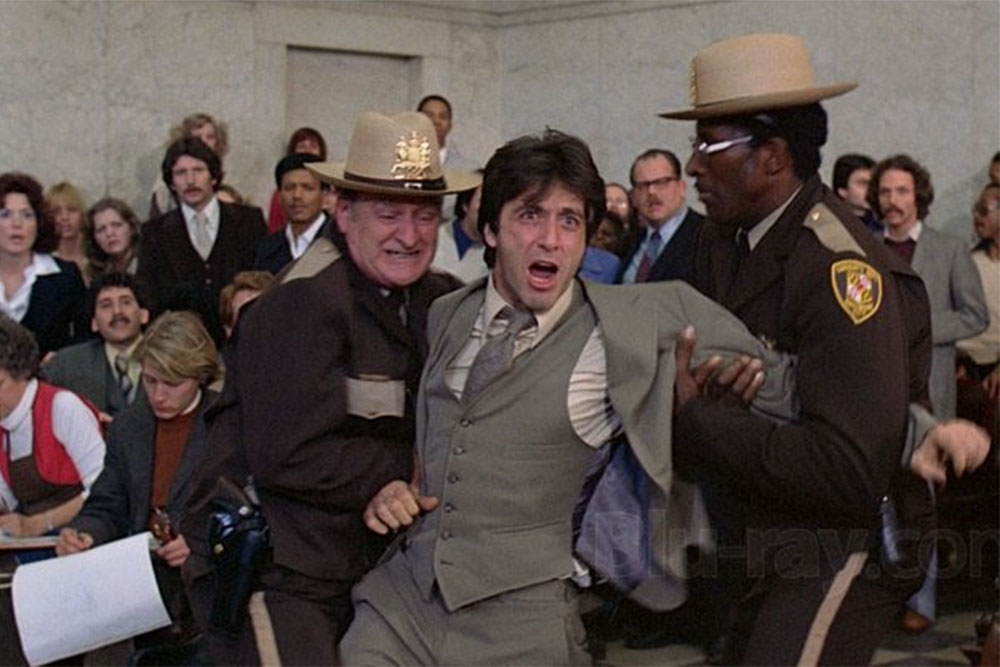
(Image from And Justice for All, 1979)
You can’t have story without conflict. As writers, it is important to investigate and become conscious of what we feel strongly about. Find those issues that inflame your passion. Be curious about your ideas of justice, authenticity, self-authority, the need for community, people who gossip, and the lost rights of the left-handed. It is through investigation of things we feel strongly about that we come to discover a deeper truth.
We are on a mission for transformation, for greater understanding through conflict.
Investigating that which we feel strongly about is where the seed of innumerable stories lies. Writers often revisit what they feel strongly about throughout their lives, examining these issues from different angles. But what we feel strongly about is necessarily subjective. It is important for us to become conscious of what we are passionate about, and begin to explore its opposing or contrary argument. There always is one.
We only feel strongly about something that is arguable. For example, I don’t feel strongly about this desk I’m writing on being a desk, or that cat over there being a cat. The necessity of getting cats spayed or neutered, however, now that’s a different story. It’s a firm stance on an issue that evokes a response. And because we live in a world of limited resources, some people would say, “We need to focus our time and money on education instead.”
Conflict and the birth of a story emerge.
As writers, we search for and explore as yet undiscovered truths.
In the film, And Justice For All, Arthur Kirkland (played by Al Pacino) is asked to defend a man whom he loathes: a judge, who is accused of rape. Kirkland is an upright, perhaps even idealistic lawyer who deeply believes that everyone deserves a fair trial. He also realizes that if he refuses to defend the judge, he could lose his lawyer’s license. When he learns that the judge in fact did commit the crime, he faces a dilemma. The question of justice suddenly takes on great and urgent meaning. We are no longer standing on the sidelines. The question of how justice will be meted out fairly without consequence to Kirkland hooks our interest.
It is through this story that we discover there is a price for justice. Kirkland comes to a point where he must confront his self-righteous ideas of what justice is, and, in doing so, make a sacrifice that inexorably alters his future.
Do you see where conflict lives in your work?
Learn more about marrying the wildness of your imagination to the rigor of structure in The 90-Day Novel, The 90-Day Memoir, or The 90-Day Screenplay workshops.