
A novel’s story structure is an essential aspect to creating a compelling narrative. While the beginnings of a story emerge from the wildness of the author’s imagination, without implementing the rigor of structure, the whole can never be greater than the sum of its parts.
In this article, I’ll explore what novel structure is, give you a breakdown of key story beats, and offer you a Story Weapon to build meaning into your tale.
Novel structure is the intentional order of events that guides a reader through a protagonist’s journey in a novel, shaping meaning and emotional impact. At its core, every strong story follows a cycle of Desire, Conflict, Surrender, and Transformation, where a character confronts a false belief, lets it go, and emerges changed.
What is novel structure?
In its simplest definition, novel structure is the order in which you present your narrative to the audience. It is the path you create that shapes the flow of events within your story.
A novel’s story structure guides your audience from beginning to end, introducing the characters and settings to eventually resolve a dilemma as you follow them on a journey to the end. Structure is the essential component to all stories.
If you’ve been writing for any amount of time, you’ve probably seen the image of a classic story structure in Freytag’s Pyramid.
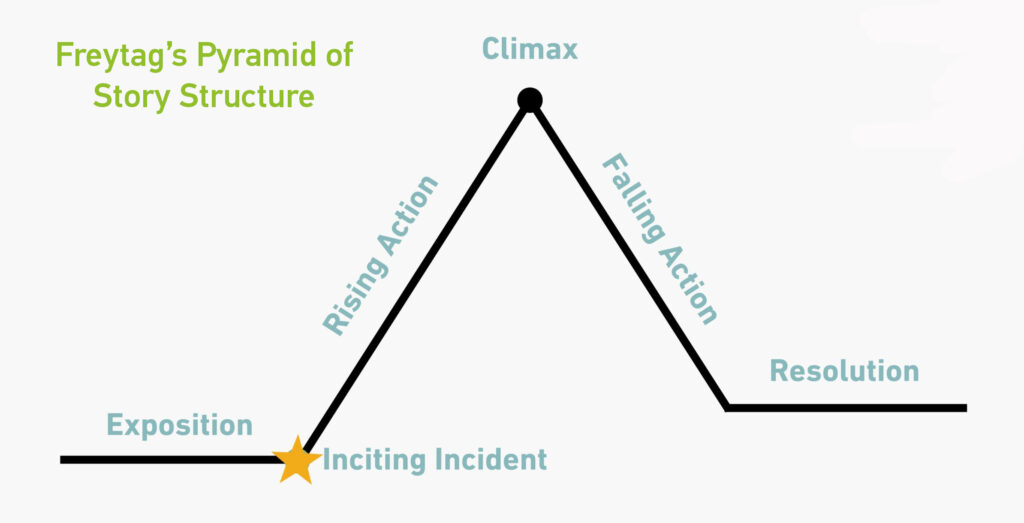
This is the fundamental structure typically taught in an English classroom, including the stages of exposition, inciting incident, rising action, climax, falling action, and resolution.
While nothing in this novel structure model is wrong, there are many ways for a story to play out. Authors deploy multiple different kinds of story structure to tell their narratives. In the end, they are all more similar than you may think.
4 key elements to novel structure
At their core, stories involve four essential elements: Desire, Conflict, Surrender, Transformation.
While this concept is often filed under “Three Act structure,” the principle reveals itself in every good story.
- Desire: Your protagonist wants something.
- Conflict: Your protagonist encounters obstacles to this goal
- Surrender: Your protagonist lets go of the meaning they make out of their goal.
- Transformation: Your protagonist reframes their goal, seeing it in a new way.
Let’s dive into each of these stages to learn more.

Desire
The engine that drives your story is your protagonist’s primal desire. They must want something, and the stakes must be life and death, ie: “If I don’t get ____, my life will be unimaginable.”
It’s the revelation of your protagonist’s desire that introduces the dilemma at the core of your story. Dilemma is essentially a problem that can’t be solved without creating another problem. It has two sides to it – a powerful desire and a false belief.
Let’s say that the powerful desire of your protagonist is the need to belong. Your protagonist may live out this desire in their pursuit of a romantic relationship or maybe their efforts to stand out and be a “cool kid” at their new school. Whatever the plot may be, their search to belong is the dilemma driving them from the beginning to the end.
As the events of the story play out, they become aware of the false belief they were holding that belonging is not everything they thought it was. Perhaps they realize that in order to belong it will cost them their true identity – they will be required to betray some essential aspect of themselves. It’s this realization of their dilemma that guides us to the next phase…
Conflict
The three-act story structure can be broken down into these three parts:
- Act One: Thesis (the dramatic question is stated.)
- Act Two: Antithesis (the dramatic question is played out.)
- Act Three: Synthesis (The dramatic question is resolved.)
In Act Two we explore the escalating conflict that allows the dramatist to explore the central argument (or dramatic question.) The ace that the storyteller has up their sleeve is that they know the protagonist cannot get what they want based on their current approach or current identity. Cyrano can never win Roxanne as long as he continues to hide. He must risk rejection and proclaim his love directly in order to be worthy of her love.

The circumstances besetting the protagonist force them to grow or change in some fundamental way in order to be transformed. And it is through this escalating argument that the protagonist comes to a moment of surrender.
Surrender
At some point your protagonist will experience a dark night of the soul, where they surrender the false belief they built around their primal desire. They begin to realize that appearance is not always reality.
- In appearance: “I don’t belong”
- In reality: To truly belong, I must first belong to and accept myself.
This is when the protagonist surrenders to the theme. They realize that all their attempts to belong only led them into isolation. Therefore, they must surrender the meaning they made out of belonging and accept the truth which is they first have to be true to themself.
The act of surrendering is a coin with two sides: despair and a new understanding. At first this realization is crushing to the protagonist. They experience this dark night of the soul where all seems lost and fulfilling their desire seems impossible. But then, as they let go of the appearance of their desire for the reality of their situation, they begin to reframe the relationship to their desire.
They are now forced to make a choice between what they want and what they need.
This difficult choice builds tension in your story, creating drama in the transition to transformation.

Transformation
The transformation is the betrayal of the lie. It’s when your protagonist turns away from the false beliefs they built up about themselves or the world. They reframe their view, understanding the difference between their want and their need. Choosing one’s need over their desire is often a painful transition.
The stakes rise in Act Three because the audience doesn’t know if they will succeed in this transformation or if they will even let go enough to begin it.
In these scenes, your protagonist begins to see that this desire to belong, for example, cannot trump the need to belong to themselves. But letting go of their striving to attain the original desire is not an easy decision. They don’t know if they’ll ever get what they want but the true transformation is their new understanding that things can’t keep going the way they have been.
When the protagonist steps into their true power, they let go of the bondage the original desire held on them.
Your story weapon: Connecting to meaning
The goal is for your novel’s story to build in meaning as it progresses. With each scene, there is a cumulative effect that transcends the quality of your prose. There is that mysterious marriage of plot and theme working in harmony that pulls your reader into this fictive world and carries them through.
This simple four-word novel structure, Desire, Conflict, Surrender, and Transformation, contains the entire DNA (the inner structure) of any well told story. Your protagonist encounters obstacles that change them in some life-altering way and they emerge in the end as if reborn.
FREE STORY STRUCTURE GUIDE! Are you struggling with your outline and looking for support?
My FREE Story Structure Guide will lead you through the process of marrying the wildness of your imagination to the rigor of structure to unlock your story within.
You can also find out more in my next 90-Day Novel workshop.