


Getting your screenplay format down right matters more than you might think. You could write the most brilliant story ever conceived, with dialogue that sings and a plot twist that rivals The Sixth Sense, and it could still end up being unread. Now, this isn’t because your story isn’t good enough, but because you didn’t follow the proper screenplay format.
Screenplay format isn’t arbitrary. It’s not something you learn on day one and throw away a dozen or so screenplays later. In this particular case, the fundamentals are there for a reason and should never be forgotten, even if your last name’s Nolan or Tarantino.
The format exists to serve your story and the plethora of people who will see it and help bring it to life. When you submit a screenplay that follows the industry-standard format, you’re making your story accessible to directors, actors, and crew members who need to extract specific information quickly and efficiently. In basic terms, you’re ensuring that nothing stands between your story and the person reading it.
In this article, I’ll cover what screenplay format is, the essential elements you need to know, and how to make sure your formatting supports the story you are telling.
Screenplay format is the industry-standard language that makes your story readable, professional, and producible. This helps ensure it can move smoothly from the page to the screen. Mastering these formatting fundamentals removes barriers for readers and production teams so your story takes center stage.
What is screenplay format?
To put it simply, screenplay format is the industry-standard formatting style used when writing screenplays.
What is a screenplay? Think of it as a story designed to be told visually. Because of the medium involved, there’s a lot of detail needed in a screenplay’s conception. Formatting then contains a specific set of rules when it comes to the technical side of your story’s presentation.
In essence, the screenplay format is the language by which screenwriters are able to communicate their vision to a film production. It acts as the blueprint by which every other member of a production can absorb your story for the purpose of bringing it to life.
The technical side of things
Let’s get into a couple non-negotiables up front when talking about a screenplay’s format.
Font type
- Keep it in a Courier font, size 12pt. (Courier Prime is its modern, better looking cousin.)
Margins
- 1-inch margins all around, except for the left side. Make sure that’s set for 1.5 inches. This accounts for the space taken up when you get the screenplay printed and bound.
Spacing
- Always set the document to be single-spaced.
- We’ll get into this more later, but the main purpose is to maintain the estimation of one page of script for 1 minute of screentime.
Essential elements of screenplay format
Let’s take a look at more of the key components you need to know. This isn’t an exhaustive formatting manual, but these are essential elements that make for a properly formatted screenplay.
Scene Headings (Sluglines)
Every scene starts with a scene heading. It tells us three things, whether we’re inside or outside, where we are, and what time of day it is.
Example:
INT. COFFEE SHOP – DAY
or
EXT. CITY STREET – NIGHT
Scene headings are always capitalized all the way through, always left aligned, and always following the pattern, INT. or EXT., then the location, followed by the time of day.
When a production team breaks down your script, they need to quickly identify how many day shoots versus night shoots you have, how many interior locations versus exterior ones. All those decisions and moving parts are supported and made easier depending on whether this little header is written properly in your scene or not.
Action Lines
Action lines describe what we see and hear on screen. These are written in present tense, left aligned, and focused on what’s observable.
Good action lines in screenplay format are crisp and to the point. They show us what the camera sees, nothing more, nothing less. They’re best done in small digestible chunks. Try and keep action lines to no more than 3-4 lines before a break.
Dense paragraphs slow down the script read. If the page looks heavy, the readability will suffer. Here’s an example from an early draft of Saving Private Ryan (1998):
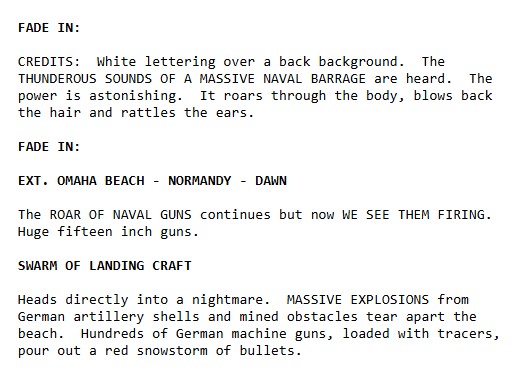
Action lines are not prose. You aren’t here to write a novel. More than likely, unless you direct your screenplay as well, you’ll never even see the people producing it. Be sure to stay on track and keep things clear.
Transitional Phrases
Transitions like CUT TO:, FADE TO:, and DISSOLVE TO: are largely outdated in modern screenplay format. Don’t use them unless you have a specific creative reason.
Now the FADE IN and FADE OUT transition is still used in standard practice (as you can see in the above example). Famously, this includes the slight rendition of FADE TO BLACK.
Character Names and Dialogue
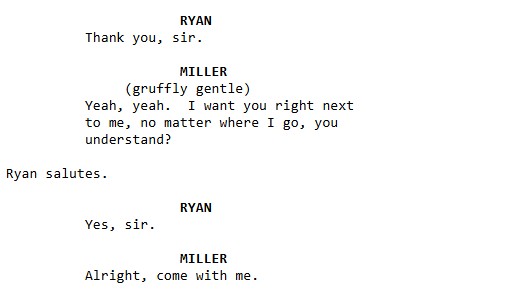
When a character speaks, their name appears in ALL CAPS, centered above their dialogue.
The margins for character names and dialogue are narrower than action lines. This creates that distinctive screenplay format look where dialogue sits in the middle of the page.
Why center it? Visual clarity. An actor can immediately find their lines and smoothly read them out. The same applies for anyone else trying to enjoy your screenplay where the dialogue is the backbone.
Parentheticals
Often, screenwriters indicate the tone, emotion, or action going on inside a parentheses between the character name and their dialogue. You can also use this to mark regional accents required for different characters in their first lines of dialogue, or if certain lines are being addressed to specific people in a scene.
Most of the time, your dialogue should convey the emotion or intention without spelling it out.
Lesson #1 of screenwriting is show don’t tell. You don’t need to add (angrily) to indicate a line is said in such a way.
Use parentheticals only when necessary. A specific example for this is when the line could be genuinely misread without context, such as if it’s said in a sarcastic tone or something else to that degree.
The difference between screenplay format and script format
While you may instinctually know the difference between a screenplay and a script, the specifics do matter all the more when we get into formatting. Whether you’re a novice screenwriter, or a seasoned veteran, knowing where the clear line lies can mean the difference between getting your work read or getting it tossed in the bin.
All screenplays are scripts. But, not all scripts are screenplays.
When you’re talking about a script in the writing world, it’s pretty much anything under the sun that deals with something produced and performed. The difference from prose is that a script’s main goal is to be a guide for a team to bring it to life for an audience. This includes stage plays, audio dramas, podcasts, and more.
Screenplays fall under that umbrella, acting as a specific type of guide for film production. TV scripts are by nature screenplays as well since they do appear on screen and are handled by production teams. That being said, there are slight changes in how they look in a macro lens as, of course, it entails a lot more screen time than a singular feature film if the series does well and runs for multiple seasons.
The line is much more clear, however, when you talk about things like stage plays or radio plays. Because of their smaller scale, the script format doesn’t have to be as precise.
I’ve covered some other script format guidelines here. For now, let’s keep our focus on screenplays, and why getting it right matters so much.
Why screenplay format matters
Readability
Executives, producers, and script readers go through dozens, sometimes hundreds of scripts. When your screenplay follows proper formatting, it becomes instantly familiar. They can move through it smoothly, focusing on your story instead of fighting with your presentation.
If your formatting is off, it takes away valuable time they could have spent immersed in your story, making it all the more likely nobody else will get the chance to.
Function
Proper screenplay format serves the production process. When a script is formatted correctly, the production designer can quickly identify locations to start scouting for, the actors can find their blocking and dialogue, and everyone overall saves time because the information is exactly where they expect it.
Timing
The “one page equals one minute” rule is crucial for budgeting and scheduling. Producers estimate costs based on your page count. If your screenplay format is off, their estimates are off. Dense paragraphs of action might make your 90-page script actually turn into a 120-minute film. If there’s not enough budget, it probably won’t get made.
Professionalism
When you submit a properly formatted screenplay, you demonstrate that you understand industry standards. This shows that you respect the people who will read your work. And, for the big wigs that’ll be reading, it’ll tell them you’re a reliable person to send a call to next time a clean screenplay is needed.
Common screenplay format mistakes
Just to get a quick rundown of everything we’ve gone through, let’s see some common mistakes less experienced screenwriters make.
- Using the wrong font: Courier 12pt. That’s the standard for screenplay format. Not Times New Roman, not Arial, and not Calibri. The font choice is part of what makes the page-per-minute pacing work.
- Dense action paragraphs: If you’ve got a half-page block of description, break it up. Don’t waste time on the prose and focus on the pose. Write only the essentials to the action.
- Camera directions: Unless you’re also directing, leave the camera work to the director. Sure, it could be seen as helpful, but you’re taking away the agency of the person actually doing their job. If it’s essential to the picture you could add some directions, but for the most part you need to stay in your lane.
- Overusing parentheticals: Every parenthetical signals you’re not trusting your own dialogue. Use them only when truly needed. Just like camera directions, overuse of this can signal inexperience.
- Incorrect margins: The margins in the screenplay format are also part of what establishes the one-page-per-minute timing. If your margins are off, your page count becomes meaningless. You can use proper screenwriting software tools to handle these details if you want to.
- Too much formatting flair: Underlining, bold text, and excessive italics don’t belong in screenplay format. If you need these tools to convey your message, then you aren’t being clear, and you aren’t being direct. Again, you’re here to lay a blueprint, not a poem.
Your story weapon: The format serves the story
Screenplay format is not the enemy of creativity. It’s a tool that makes your vision accessible to everyone who needs to help you realize it.
When you master screenplay format, it becomes invisible. You stop thinking about margins and spacing and whether that scene heading is correct. It becomes second nature. The format fades into the background and your story takes center stage. It can be troublesome at first, but you can’t become a master without first becoming a student.
The format exists to get to the fun part easier; to let your characters breathe, your dialogue sing, and your action flow. To make sure that when someone picks up your script, they’re reading your vision and your story, not decoding some puzzling prose to talk about in their next book club meeting.
Learn the rules. Follow the screenplay format. The format is the container. Your story is the juicy content that fills it which needs to be supported.
Get the screenplay format right, and you remove every obstacle between your story and the people who need or want to read it. You’re building a bridge between your vision and the reader’s experience.
Before you know it, you’ll be one step closer to having your vision up on the screen.
Lastly, the most commonly used screenwriting software in Hollywood is called Final Draft. There are others, but this is the industry standard. I highly recommend purchasing it as it will do almost all of the formatting for you.
FREE STORY STRUCTURE GUIDE! Are you struggling with your outline and looking for support? My FREE Story Structure Guide will lead you through the process of marrying the wildness of your imagination to the rigor of structure to unlock your story within.