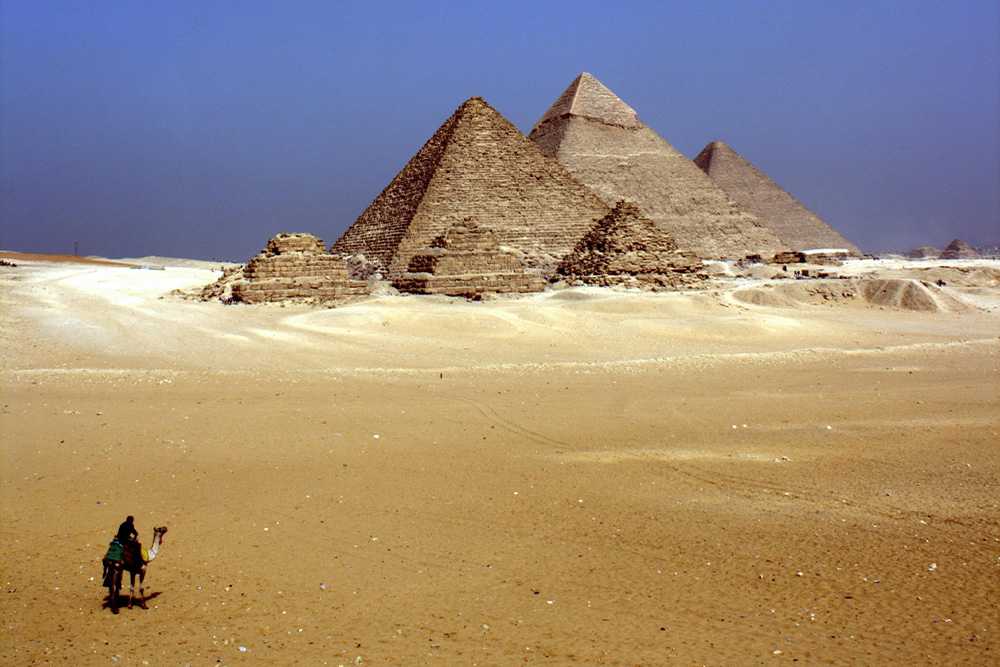



From The Hero’s Journey to Save the Cat, there are many different ideas and templates for how a story can be structured, each with its own unique insights and limitations. In this article, I will explore one of the oldest and most enduring models: Freytag’s Pyramid, developed by the 19th century German writer Gustav Freytag, who structures a story into five main components: exposition, rising action, climax, falling action, and resolution.
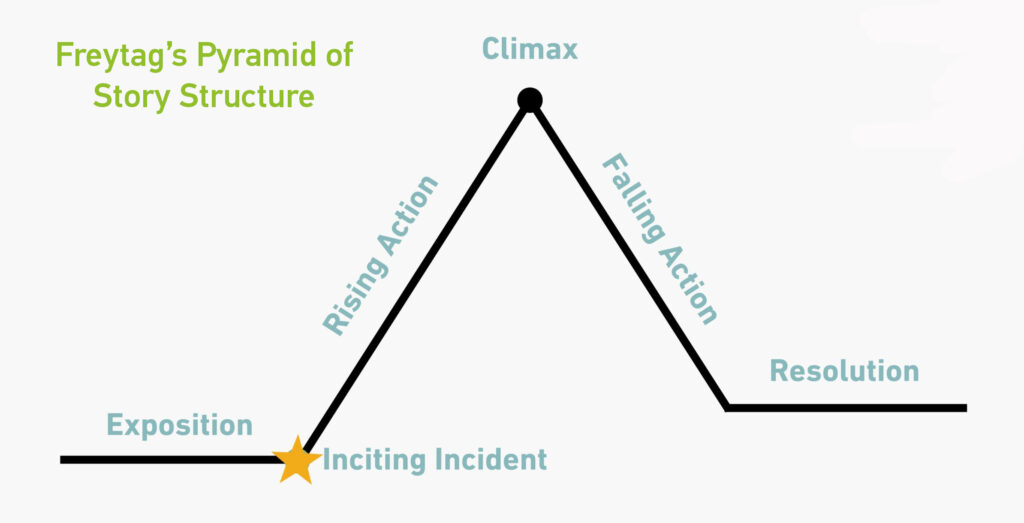
Freytag’s Pyramid is utilized effectively by hitting the five key structure points in a timely manner and was crafted in order to create a sense of inevitability in a story’s resolution. Any writer adhering to this timeless method of story structure can shape a compelling narrative.
Historical context
Freytag’s notions were originally based on the plays and theatrical dramas of his time. In particular, his pyramid outlines the format of a classical tragedy, which is why you might sometimes see the final component marked as “Catastrophe” rather than a “Resolution” in other writing guides. This is the point where the story can burn up in flames.
Analyzing Romeo and Juliet with Freytag’s Pyramid
Shakespeare’s tragic love story is a perfect example of how Freytag’s Pyramid often works.
Let’s break it down:
Exposition
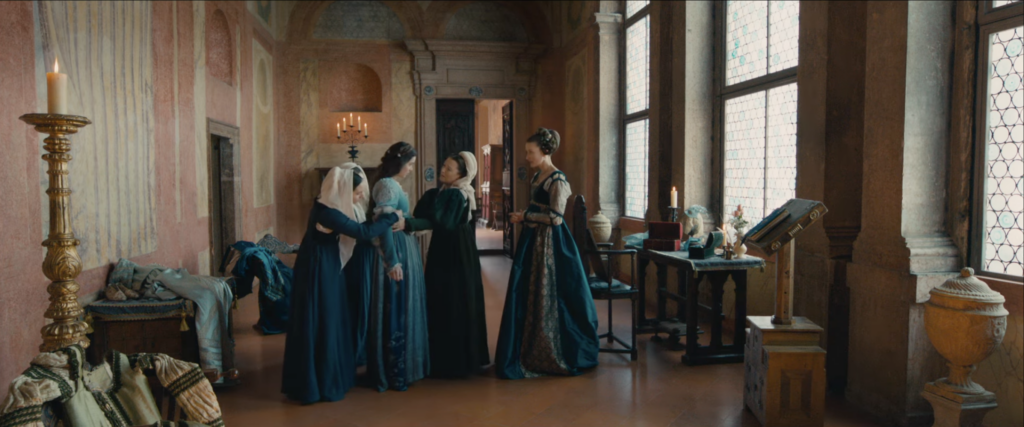
This is also termed the ‘Introduction,’ where the world of the story, its characters, and their relationships are first established.
Throughout Act I, Shakespeare offers context for the upcoming conflict: there are two feuding families, and a son and daughter from opposite ends of the divide. Other characters are also introduced to support the story of their ill-fated romance.
Versions of the pyramid often include an ‘Inciting Incident’ at the end of Act I. This is the point where the story truly begins — when Romeo first meets Juliet at a Capulet masquerade — and the tragedy starts to unfold.
Rising Action

As depicted by the pyramid, tension ‘ramps up’ during this portion of the story. The conflict gains gravity as Romeo and Juliet fall madly in love, and, despite warnings that their relationship can only end in disaster, secretly marry with the help of Friar Lawrence.
However, despite the forces rising in opposition, nothing is forcing the conflict to its resolution just yet. This is where the tragic element emerges: for Romeo and Juliet cannot sense that the situation they have created is unsustainable. Only the audience can see that the rising action must come to a head — that the roller coaster is reaching its peak, and will soon come crashing down.
The Climax
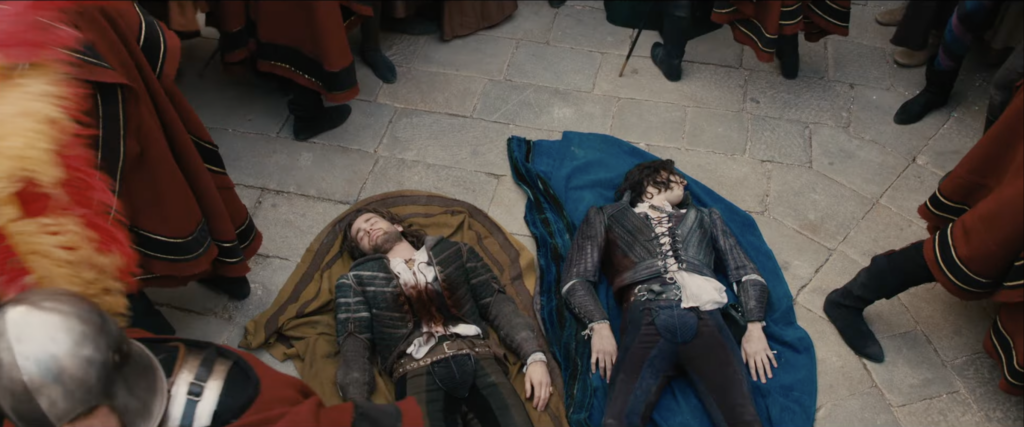
In Freytag’s framework, opposing forces collide at the ‘Climax,’ the moment when the story’s tension fully culminates.
This is the point where the play’s dramatic energy is at its greatest, and the conflict finally erupts. In Romeo and Juliet, it occurs in the fiery duel between Tybalt and Mercutio, resulting in both their deaths.
The Climax can also be understood as the story’s ‘turning point’. From this moment on, Romeo and Juliet are no longer growing closer together. Instead, the direction of the plot reverses, and the forces of the story begin to pull them apart.
Falling Action
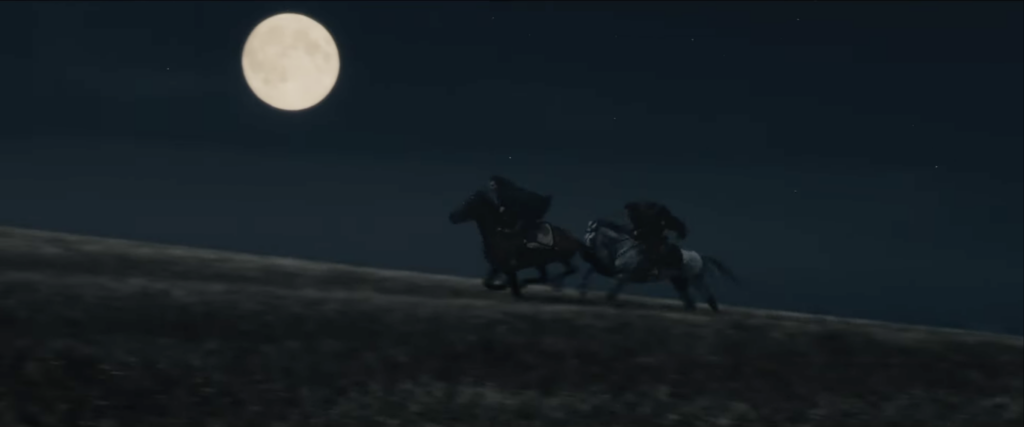
Writers may consider this the “hard part,” where the story moves toward its conclusion, and the ending must be carefully arranged.
Shakespeare orchestrates the finale as follows: Romeo is banished from Verona, while Juliet is forced to marry Count Paris — separating the two lovers in reversal of the Rising Action portion of the story.
Resolution
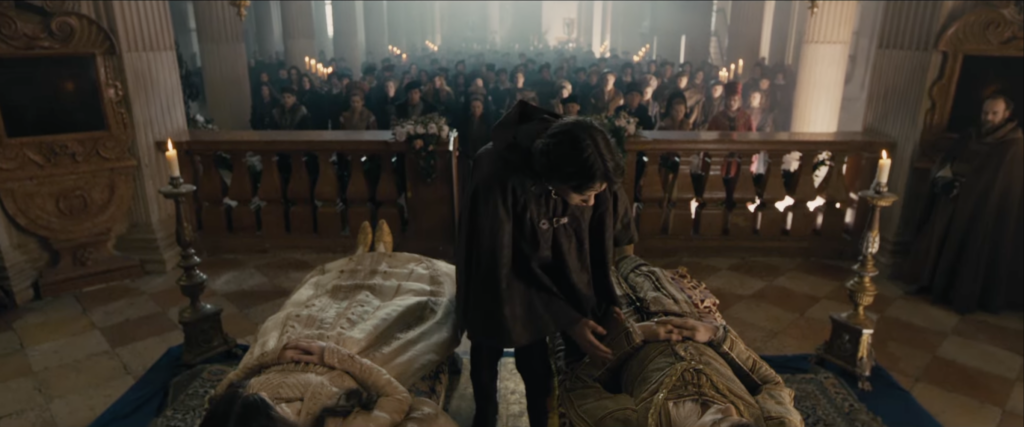
In order to escape this forced marriage, Juliet fakes her own death to be reunited with Romeo.
However, a tragic miscommunication leads Romeo to believe Juliet is truly dead, and he takes his own life in response. In line with the “Catastrophic” version of Freytag’s Pyramid, Juliet wakes to discover Romeo has died, and takes her own life as well.
The catastrophe also brings catharsis. With the deaths of Romeo and Juliet, their families finally end their longstanding feud, allowing the conflict to achieve a broader resolution.
Although the ending is where the tragedy is realized, it is also the final result of the lovers’ first encounter — where Romeo decides to pursue Juliet, despite the enmity of their families. In this sense, their fates were sealed from the first kiss — and Freytag’s pyramid becomes understood as not just a series of story beats, but a chain of irreversible decisions.
Irreversible decisions
One of the most enduring aspects of Freytag’s Pyramid is its sense of the inevitable. Some analyses describe an ‘Irreversible Decision’ between each of the five points: Romeo’s decision to pursue Juliet, the inciting incident that carries the story from Introduction to Rising Action — and later, his decision to avenge Mercutio, which brings the story to its Climax.
It all culminates in the lovers’ final decision to take their own lives out of heartbreak. Their deaths (and the story’s conclusion) are the natural result of their preceding choices. Each decision, arising from the characters’ emotions, propels the story from start to finish.
Your story weapon: Get to the heart of the dilemma
Designed for the five-act tragic play, Freytag’s Pyramid could be argued to be obsolete in its original format. Modern audiences expect stories to end in climax, and may not tolerate a long falling action. Do you remember feeling a little restless watching The Return of the King for the first time?
In modern storytelling, the falling action typically takes up approximately the final 5% or so of the narrative before the conclusion.
Nonetheless, the pyramid framework remains relevant, despite shifting audience expectations, because it captures timeless elements which make a story truly compelling. For instance, the treatment of the story as a natural unfolding of events from the initial, inciting incident.
Equally enduring is the pyramid’s emphasis on rising tension, which — when executed well — keeps audiences exactly where you want them: on the edges of their seats.
Finally, Freytag’s pyramid captures the transformation arc which has long shaped our understanding of narrative. This idea also appears in the Three Act Structure — both having descended from Aristotle’s 4th-century BC observation in Poetics: that every story must have a Beginning, Middle, and End.
Ultimately, the pyramid survives because it recognizes a fundamental truth of storytelling: the writer does not propel the plot forward — the characters do.
Like many other story structure ideas, the pyramid is perhaps most helpful when taken with a grain of salt. Concepts such as story beats, inciting incidents, and rising tension can all be gainfully incorporated into one’s writing process, but need not be treated as a strict blueprint.
For instance, a climax might occur in the middle of the story, or near the end — there may be multiple climaxes. A story could unfold in three acts, two parts, or however many that it needs to feel fulfilling and complete. There are no right answers, which is why we love writing — and understand it, not as a math problem, but an art form.
For those who want to understand the art form further, here’s a free guide to get you started.
FREE DOWNLOAD—OUTLINE YOUR STORY! Are you struggling with your outline and looking for support? My FREE GUIDE will lead you through the process of marrying the wildness of your imagination to the rigor of story structure to unlock your story within.