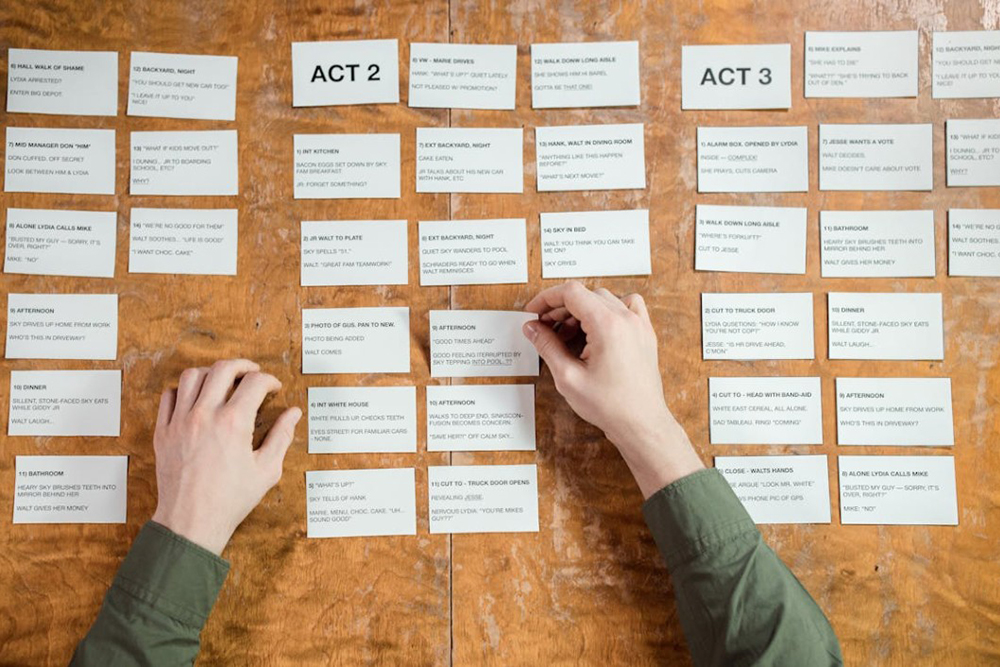

One thing that has been coming up a lot in my classes is the tendency for writers to “figure out” their plot. This is due, at least in part, to story structure being taught by story analysts as a formula, which can lead to frustration and interminable rewrites. The process of creating a story is akin to a Polaroid coming into focus. When we think it’s our job to figure it all out from the start, we get stuck. When we place our attention on the protagonist’s internal struggle, their central dilemma, the story begins to reveal itself in surprising and dynamic ways.
A dilemma is a problem that can’t be solved without creating another problem. You know you’ve got a story when your protagonist wants something that is impossible to achieve based on their current approach, or their current identity, necessitating a shift in perception, i.e., “When George Bailey leaves Bedford Falls, he will have a wonderful life.”
Remember, problems are solved, while dilemmas are resolved through a shift in perception. Our story only becomes interesting when we identify the underlying dilemma. Problems are not interesting: I’m in the desert. I get a flat tire, I call AAA and the guy comes and fixes my tire. Boring.
Dilemmas are interesting. I have a flat tire in the desert. I call AAA. The guy who comes to fix it is the guy sleeping with my wife. Now we have a story.
If you simply focus on how your protagonist will solve their problem, you are, on some level, controlling the process. Solving the problem is not what the story is about. We care less about whether or not your protagonist gets what they want, and more about how they will get what they need.
This process requires acknowledging that we are not in control of the process. Our job is not to figure it out, but to ask the right questions.
The brain is good at doing one thing: it answers the questions we ask it. When we ask neurotic questions like, “Why is this so difficult for me,” our brain provides us with neurotic answers like, “Because you are a hopeless, unlovable oaf.” Not helpful. But when we place our focus on character and theme our story comes to life. The question we should be asking is “What is this thing about?” Make it primal. Is it about connection, revenge, ambition, freedom, forgiveness, loss, abandonment, isolation, obsession . . . ? What is about? Over and over again, ask yourself “What is it about?”
Your protagonist is an extreme through which you explore your theme. This just means that we want our protagonist to have a dynamic arc, in order to convey meaning. If our protagonist is seeking connection, we must look for ways to show the challenges they must overcome, otherwise there is no dilemma.
So, to recap:
1. What is my story about thematically? Make it primal.
2. What is my protagonist’s dilemma?
3. How is my protagonist an extreme through which I can explore the theme?
Learn more about marrying the wildness of your imagination to the rigor of structure in The 90-Day Novel, The 90-Day Memoir, or The 90-Day Screenplay workshops.