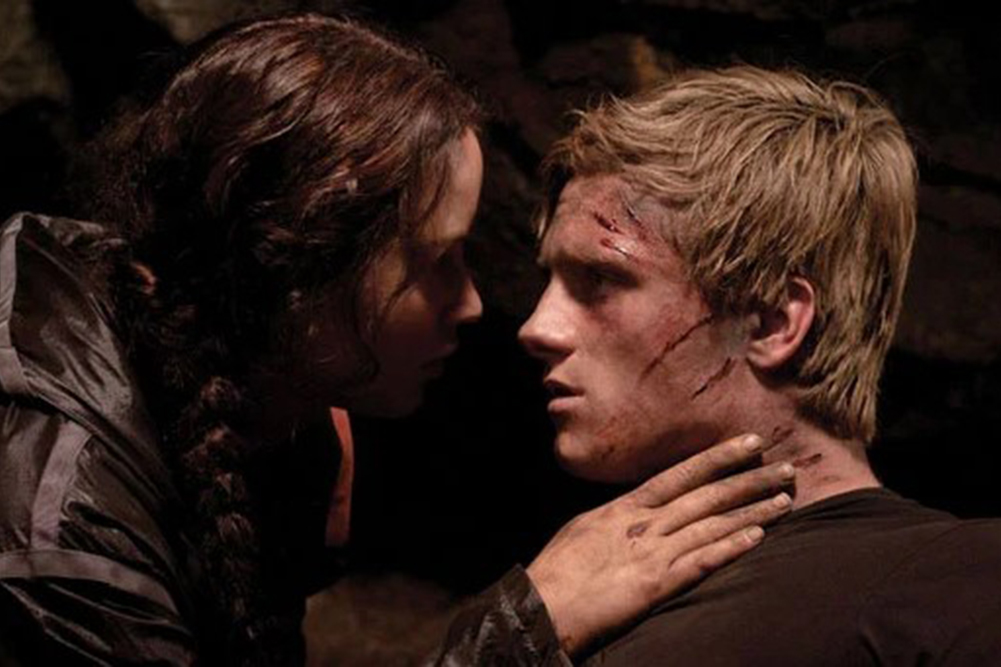



(Image from The Hunger Games, 2012)
“The moment we want to believe something, we suddenly see all the arguments for it, and become blind to the arguments against it.” – George Bernard Shaw
Every story is essentially an argument that relates directly to the protagonist‘s dilemma. Remember that a dilemma is a combination of a powerful desire and a false belief.
In Suzanne Collin’s The Hunger Games, the author presents a dystopian universe where each day is a desperate struggle to survive and, according to the protagonist Katniss, love does not exist. The story begins with a lottery in which two children from each province are selected to participate in the Hunger Games, a competition to the death. Katniss watches as her younger sister is selected for this Darwinian nightmare. Because this means certain death for the young girl, Katniss bravely volunteers to replace her.
The boy, Peeta, is also selected. We later learn that he has been in love with Katniss all of his life. Suddenly the story’s central dilemma becomes apparent. “Can love trump survival?” It is important to note that the theme of our story informs the plot, but that plot and theme are separate from each other. The theme is the throughline. The plot comes through the events that arise to reveal the theme in all of its manifestations.
These children are thrust into a dystopian world. What better environment to explore the question of love versus survival? If true love can exist in the world of the Hunger Games, then certainly it can exist anywhere. The Hunger Games are a metaphor for the worst part of ourselves. These games play out for the citizens of the Capital, a bloodthirsty yet overly sentimental mob.
Through this journey, Katniss struggles with the question, “Is Peeta’s love true or is it a ruse?” The inciting incident raises the question of true love – through showing and not telling. The act of replacing her sister shows us that it does exist. But now we must explore the opposing argument: “Will Peeta sacrifice his life so that Katniss can live? Just how quixotic is this kid?”
Exploring the opposing argument does not imply some formulaic relationship to structure. In fact, it is not even about story. This is a valuable tool in developing a more specific relationship to our theme. It applies whether we are writing a poem, essay, memoir, or theater piece.
The opposing argument is important because it gives the reader a visceral understanding of the protagonist’s dilemma. This understanding is vital, because without it, the reader will not understand specifically what is at stake.
Every plot point builds upon the previous plot point. Without a clear sense of the opposing argument, the tension (or reluctance) surrounding the protagonist’s decision at the end of Act One may not be clear.
Whether we are writing a richly nuanced human drama or straight-ahead genre fiction, the principle of opposing argument still holds true. Do not fret that you might not have an opposing argument in your story. You do! It is not a matter of getting this right. Rather, it is a matter of developing the most specific relationship to it so that what you are saying rings like a bell. The opposing argument is not something to figure out. There is a rigor to this work, but it is not strictly a left-brain rigor.
Learn more about marrying the wildness of your imagination to the rigor of structure in The 90-Day Novel, The 90-Day Memoir, or The 90-Day Screenplay workshops.