
Ever since humans have been able to communicate, we share stories, weaving the tapestry of our shared existence. These stories differ wildly between cultures as various civilizations have risen and fallen, but they share a common foundation: story arcs.
A story arc gives shape to a narrative. It traces change over time: conflicts and resolutions, becoming and loss. Whether it is an old myth or legend preserved on an ancient stone tablet, or the latest fiction novel by Stephen King, these tales follow recognizable arcs in their characters’ journeys.
In this article, I’ll go over what a story arc is, give examples of different types of story arcs, and I’ll give you a Story Weapon on how to approach story arcs in your own writing.
A story arc is the underlying structure that shapes a narrative’s progression from conflict to resolution, giving meaning to events and showing how a character changes over time. Understanding different story arc models can help you control pacing, tension, and the emotional payoff.
Definition of a story arc
A well-told story not only shows a series of events, usually in chronological sequence, that unfold as you read — it should also build in meaning as it progresses.
A story arc is a plot structure that defines how a narrative builds to a crisis and finally a resolution.
Story arc vs plot or character arcs
As a writer, you will have heard of similar terms such as plot and character arcs. While these are both similar to story arcs, there are some key differences that you should consider.
While a story arc is the path your story follows in a definite beginning, middle, and end, the plot refers to individual events that make up your story. It is basically “what happens” in a story.
Likewise, while the story arc is the external path of the overall narrative, a character arc is the internal journey a particular character takes during the story. Each character arc is unique to that particular character.
These two are deeply intertwined. The story arc provides the obstacles that force the character to change, while the character’s internal growth drives the story arc forward.

Purpose of a story arc
A story arc’s role is to move your characters from one state to another, and to effect change in events. It helps to create a structured and focused progression that makes it easier for the audience to understand what’s happening. It incentivizes them to continue reading or watching your story.
As a storytelling tool, many authors have used story arcs to create memorable characters, unforgettable stories, and capture the imaginations of millions.
For instance, the struggle between fate and free will appears in stories as old as Oedipus Rex and as recent as The Matrix. This shows how humanity has long wrestled with the question of whether we shape our lives or merely fulfill them.
Story arcs, like all storytelling tools, help writers present their ideas in a creative and imaginative way, in order to strike a chord with their readers and better present their perspectives. We are drawn to dramatic journeys. A story arc where characters develop and change due to external and internal conflicts helps us see and develop ourselves in turn.
Main types of story arcs
In both literature and film, there are a multitude of story arc models. Let’s examine a few of them and see how they progress.
The Hero’s Journey
The Hero’s Journey is one of the more well-known story arcs today. It was popularized by Joseph Campbell in his book, The Hero with a Thousand Faces. He described the “monomyth” arc involving a character who embarks on a journey, contending with challenges and setbacks, and returning home changed from their adventures.
The concept of self-discovery plays a pivotal role in these types of stories, and they typically follow a pattern of departure, initiation, and return.
The story of Simba in The Lion King perfectly follows this story arc format as Simba is forced to leave home, goes on a journey until he’s confronted with his true purpose, and finally returns home to take his rightful place on the throne. It all comes full circle.

The Three-Act Structure
The three-act structure is another reliable model for story arcs, dividing a narrative into three sections: the setup, confrontation, and resolution. One well-known example of the three-act structure can be seen in The Matrix.
The setup introduces Neo as a disaffected office worker who senses that something is wrong with the world but can’t quite name it.
Confrontation begins when Neo meets Morpheus and chooses to take the red pill, leaving his familiar world behind. He learns the truth about reality and is forced to survive inside the Matrix while being hunted by Agents. As his training progresses, Neo repeatedly struggles with doubt, fear, and belief in his own potential.
The resolution comes when Neo fully accepts his role as “The One.” After confronting and defeating Agent Smith, he transcends the rules of the Matrix and embraces his newfound power. By the end of the story, Neo is no longer searching for meaning. He has become the catalyst for change in a broken world.

Rags to Riches
The Rags to Riches story arc follows an aspirational approach where the narrative is on a continuous upward momentum towards a happy ending. The protagonist typically begins the story in dire straits, but over time, is able to reach a high position of wealth, affluence, and satisfaction.
In Disney’s Tangled, both Rapunzel and Flynn Rider find themselves in difficult circumstances. The former is a prisoner while the latter is a thief on the run. At the end, Rapunzel is able to find her way back to the kingdom and take her place as princess. Flynn, too, is able to lead a life of riches by marrying Rapunzel and becoming the prince of the kingdom.
Riches to Rags
This story arc is a downward spiral. It is the stark opposite of the last arc we discussed and typically involves the protagonist losing their wealth, status, loved ones, or something else important to them. The Riches to Rags arc thrives on tragedy and loss.
It is heavily used in stories that deal with addiction or loss of sanity. The Picture of Dorian Gray by Oscar Wilde follows this arc perfectly. It starts with a beautiful young man who tragically makes a Faustian bargain in order to maintain his youth. This beauty comes at the cost of his soul, and it leads him towards moral and emotional corruption, with the tale ending in his downfall and destruction.
The Icarus
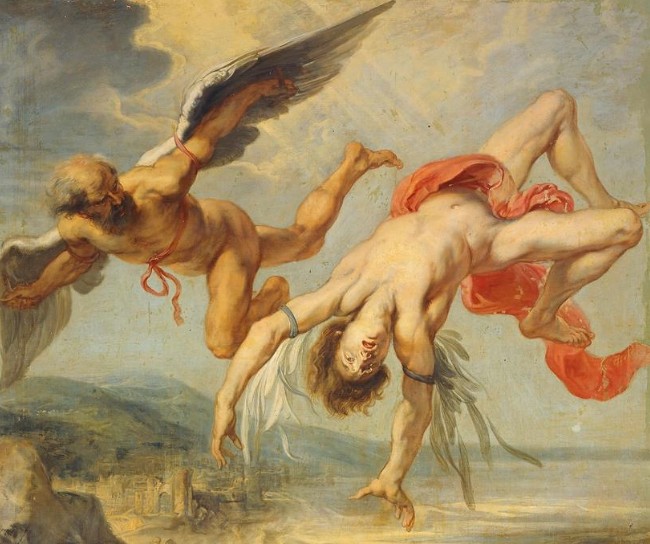
The Icarus story arc is named after the eponymous Greek hero who escapes imprisonment on an island after his father constructs wings of wax and feathers. As they escape, Icarus begins to enjoy soaring high, but ultimately flies too close to the sun. The heat melts his wings, and he plummets to his death below.
This example perfectly illustrates the story arc as it starts with the protagonist in less than favorable circumstances. He is able to escape that fate and attain great success, although it does not last. These stories always end with the protagonist losing everything again.
Key Elements of a Story Arc
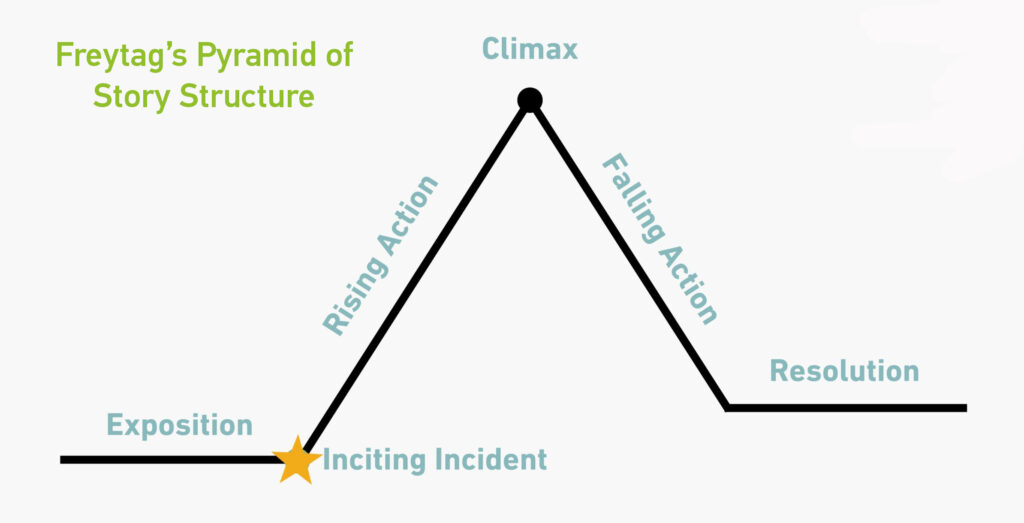
Most story arcs have the following elements found in Freytag’s Pyramid.
Exposition
This is the introduction and offers background information to prepare the audience for the rest of the story. It introduces characters, settings, and sets the stage.
Rising Action
This is the moment where the conflict begins to ramp up, triggered by an inciting incident. The main events of the story are set into motion as a result.
Climax
This is the highest point of tension in the story and is what all the choices made have led up to. It often involves a monumental choice or major action taken by the protagonist.
Falling Action
Due to the actions of the protagonist, the conflict begins to die down. At this stage, the tension dissipates and loose ends are tied up.
Resolution
This is how the story ends, and demonstrates how the characters have changed as a result of their journey.
Your story weapon: Why story arcs endure
We experience the world through change: beginnings that feel stable, disruptions to our sense of normality, and endings that leave us altered in ways we didn’t anticipate. A well-crafted story arc mirrors those patterns, allowing readers to recognize themselves inside the structure of your story.
Story arcs are not rigid formulas meant to stifle creativity. They are tools — flexible frameworks to help transform your wild imaginings into universal experiences. You can bend them, subvert them, or combine them, but understanding how they work gives you control over pacing, tension, and the emotional payoff.
Mastery comes not from following a story arc model blindly, but from knowing why you’re using it and what effect it will have on your readers.
Whether you’re writing an epic quest, a quiet character study, or a fast-paced action film, the arc beneath your story helps give it shape and staying power.
If you’re looking for support or additional resources, here’s my FREE Story Structure Guide which will help you create a story outline for your novel, memoir or screenplay.