
There is a structure to the universe. From the smallest atom to the forces that move the planets, there is a universal law. We live in a state of surrendered acceptance to it (whether consciously or not). Structure is an intrinsic aspect of our daily lives. It’s not some rigid formula that exists somewhere out there demanding that we conform. Although every blade of grass may share a fundamental structure, each one is unique.
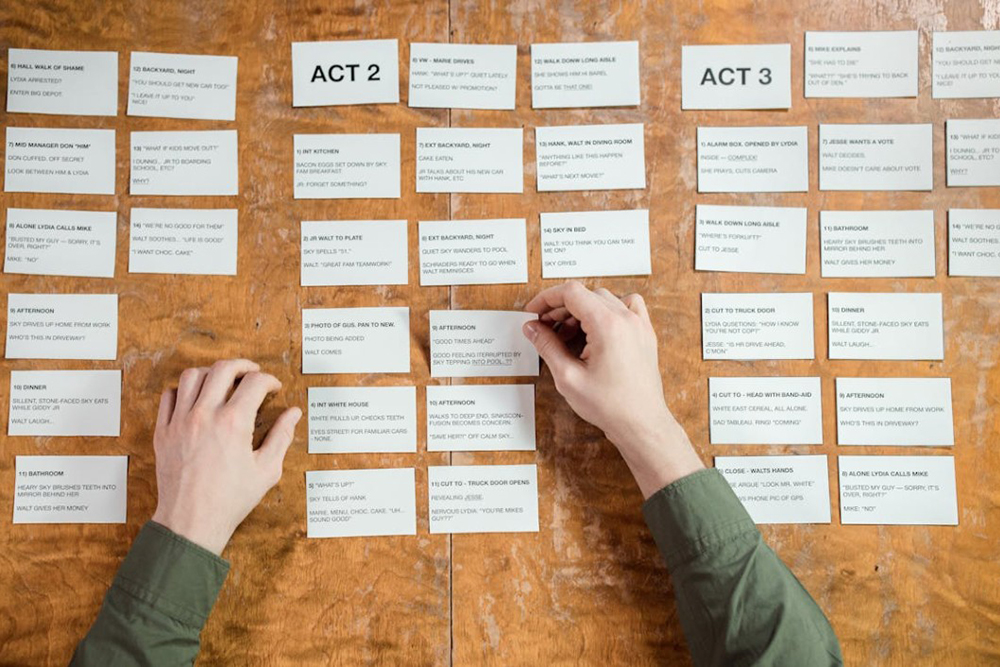
Creative people sometimes balk at the notion of structure. It seems so formulaic. No creative person wants to waste their time doing something that has been done before. Except that nothing could be further from the truth. A working relationship to structure will not hamper our imagination: in fact, it will set it free. Once we begin to understand that our story lives fully and completely within us, and that our job is simply to inquire into its “nature”, our imagination begins to stretch far beyond our initial idea. And yet, there is a rigor to structure, which is not the same as formula. It is the rigor that allows us to stay connected to that initial impulse, that central issue at the heart of our story. This is where the through-line springs from, the underlying structure that supports our plot.
Everything we need to know about our story, we already know. I don’t mean specific research, such as “Do Canadians measure temperature in Fahrenheit or Celsius?” (It’s Celsius). I mean that the “nature” of the relationships, the themes we are consciously or unconsciously wishing to explore, already live within us. There is a simple process that allows our story to emerge in a clear through-line that leads to a transformation. We are going to allow it to be made conscious, without mucking it up by imposing our “ideas” of where we think the story should go.
Our desire to write our particular story is not an accident. In fact, we are uniquely qualified to tell it. All of the experiences in our life — the thoughts, ideas, feelings, images, hopes, and fears — have conspired to lead us to this place. We are now ready to tell this story.
Learn more about marrying the wildness of your imagination to the rigor of structure in The 90-Day Novel, The 90-Day Memoir, or The 90-Day Screenplay workshops.