



It’s a tale as old as time. The protagonist is torn from their ordinary life and sets off to face a challenge. In every step of their adventure, they undergo inner and outer transformation. There’s a reason this story structure seems so familiar; we see this pattern across cultures, eras, and genres in many of the most popular and enduring tales. If you’re lost in a manuscript that just keeps getting bigger, using this sequence in your own writing can help give you a clearer sense of direction for your story structure.
In this article, I will share the steps of the hero’s journey, why it’s such a powerful structural tool, and then I will show some quintessential examples. At the end, I’ll give you a Story Weapon to craft your own compelling hero’s journey and bring your protagonist to a satisfying conclusion.
The Hero’s Journey is a timeless narrative pattern in which a protagonist leaves their ordinary world, confronts challenges that transform them, and returns changed. This article breaks down the structure into its core stages and steps, offering examples and tools to help you shape your own protagonist’s arc.
What is the hero’s journey?
The hero’s journey is a narrative arc that takes a character out of their comfort zone and transforms them in some way. They face new challenges or obstacles in a series of stages that tend to follow a specific pattern.
Joseph Campbell’s analysis of this fundamental structure, which he calls the “monomyth” in The Hero with a Thousand Faces, includes several possible steps. As a mythologist, Campbell tracked these different repeated beats as they pop up in various ways across several cultures in their diverse mythologies. This hero’s journey is a universal pattern that humans have tapped into across the ages in both storytelling and how we approach challenges in our lives.
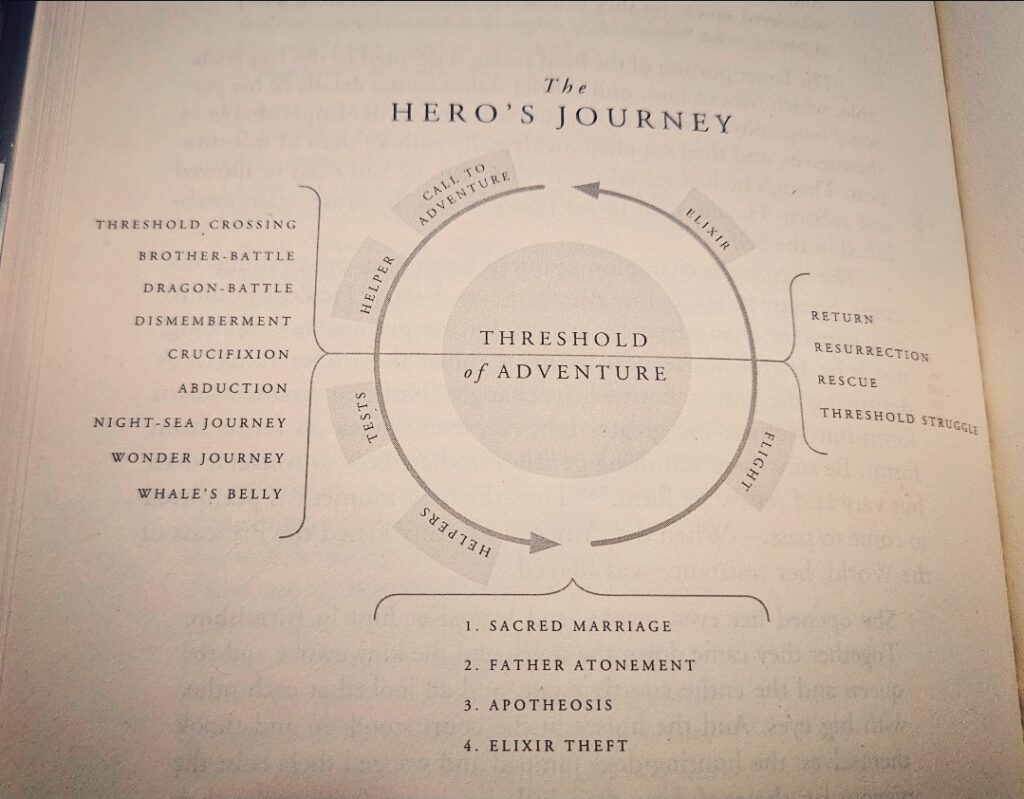
The monomyth does not follow the same steps every time, but generally follows three overall stages. As Campbell puts it: “The standard path of the mythological adventure of the hero is a magnification of the formula represented in the rites of passage: separation — initiation — return: which might be named the nuclear unit of the monomyth.”
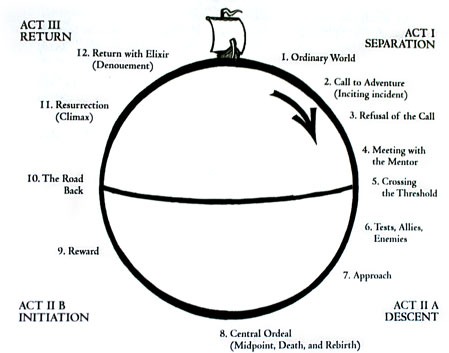
Inspired by Campbell’s work, in The Writer’s Journey screenwriter Christopher Vogler breaks the three stages down into a simpler, more easily digestible form with 12 steps which I’ll explore here.
Many people actually often conflate the two templates and ascribe Vogler’s 12-step method to Campbell.
Before we dive in, it should be noted that Vogler himself warns against using the hero’s journey as a strict template for all stories. He says, “It should be used as a form, not a formula, a reference point and a source of inspiration, not a dictatorial mandate.” If your story doesn’t follow these exact beats, don’t sweat it!
The 3 overall stages of the hero’s journey
The three stages of this narrative pattern follow this sequence:
- Departure or Separation | We meet our hero in their “ordinary world.” They’re called to adventure, initially refuse the call, and then meet a mentor figure who helps them accept the adventure.
- Descent and Initiation | Leaving their usual world, the protagonist faces new surroundings, tasks, and adversity. All of this leads up to an encounter with the main obstacle, where the hero faces their greatest fear. They gain something, be it a reward or understanding.
- Return | Our hero faces the road back and recommits to the journey, in the climax they go through a personal transformation, and return with the spoils of their journey.
12 steps of the hero’s journey with examples
The three overarching stages break down into twelve steps. Let your imagination run. Consider how these steps can open possibilities in your own story to build creative, impactful plot points.
This model most easily applies to mythic or epic tales, but we can see the steps in other stories as well. Here is each step distilled to its essence with examples.
Step 1: Ordinary World
Here we are introduced to the protagonist and their everyday life. Starting here is key to laying a solid foundation; we need to relate to the normalcy of the main character and see their ordinary reality to create contrast in later stages. Set your story up to show significant change between the beginning and the end.
The Adventures of Huckleberry Finn by Mark Twain
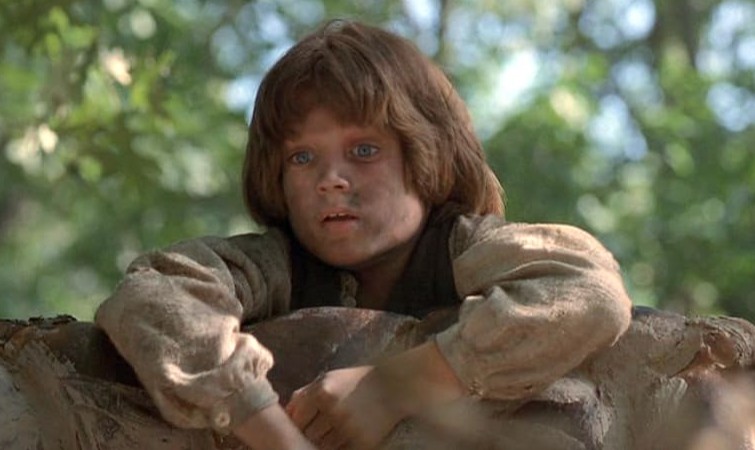
The beginning of the novel introduces us to Huck Finn, a playful, inventive, and often naughty young boy in a complex family situation. His ordinary world is the home of his guardians in an 1840s Missouri town.
Step 2: Call to Adventure
This is where the excitement starts. Your story is getting moving! The hero encounters a challenge that they can’t look away from. Think of your character — will they react with enthusiasm, nerves, or apathy? Think of the vehicle for the call, too. It might be a family matter, a natural disaster, a long-lost friend, high-stakes personal circumstances, or even something supernatural in nature.
Life of Pi by Yann Martel
Pi’s father announces their family’s move to Canada.
Step 3: Refusal of the Call
Many protagonists pull this move. In the face of major difficulties and dire consequences, the hero refuses to face the challenge. This can be a very relatable point for your audience.
Spider-Man (2002)
When Peter Parker is bitten by the genetically engineered spider, he gains new powers that he doesn’t understand. Instead of using his powers against the thief who swindles him out of his betting winnings, however, he lets the thief get away.
Step 4: Meeting the Mentor
The mentor you choose should have wisdom, experience, and skills that the hero needs to learn. In this step, the protagonist and mentor meet, and this meeting leads to the hero ultimately accepting the call. Your choice of mentor is meaningful for the lessons your hero will ultimately learn. A mentor can’t teach a hero something they themselves are incapable of doing or seeing.
The Secret Life of Walter Mitty (2013)
Walter has to prepare the photo for LIFE magazine’s final print issue. He receives a roll of negatives from famous photojournalist Sean O’Connell, but the key photo is missing. He meets O’Connell not in person, but through his notes, telegram, and photo clues

Step 5: Crossing the First Threshold
The hero finally steps out of their normal world and into the new one, officially embarking on the adventure. They could be nervous, excited, reluctant, angry, etc. Your choice of threshold should say something about your protagonist. Craft a threshold that holds meaning for the theme of your story.
WALL-E (2008)
Infatuated with EVE, WALL-E clings to the spacecraft that takes her back to the mothership. He flies through the atmosphere, bursting through a layer of satellites, and marvels at the cosmos as he travels to the ship. He breaks through a literal threshold in the form of leaving Earth, and an emotional one as he leaves his monotonous existence.
Step 6: Tests, Allies, Enemies
Our protagonist has completely left their comfort zone. They face a series of new situations, completing difficult tasks, meeting new characters, and learning who to trust. Here, the hero’s mettle is tested.
Moby Dick by Herman Melville
The crew of the Pequod fail at hunting whales off the southern tip of Africa, meet the stowaway harpooners, and process the oil of the whales they finally catch.
Step 7: Approach to the Inmost Cave
It’s the last leg of the race to the overarching goal, and setbacks force the hero to adapt.
Fahrenheit 451 by Ray Bradbury
After Guy Montag endangers his own life by revealing his stash of hidden books, he returns to the belly of the beast: his job at the “fire department” in charge of burning books.

Step 8: Ordeal
The Ordeal is a major crisis point, but not quite the climax yet. Our hero comes face to face with their greatest fear, be it in a physical fight, emotional interaction, or embracing of truth. They hang on the brink of failure. This step often involves a beat of symbolic death and rebirth, but the hero may not have fully integrated what they learned yet as they journey on toward the end.
The Incredibles (2004)
The Incredibles family fights Syndrome’s goons on their secluded island. The action forces Bob and Ellen to work together after months of growing distance, and the kids learn how to use their powers for good.
Step 9: Reward
After the battle of the Ordeal, the hero earns a Reward. This could take the form of a material prize or something intangible like newfound confidence, wisdom, or truth that will help them on their journey. The hero has a short respite before continuing on toward the climax and resolution.
The Lion King (1994)
Simba sees a vision of his father’s ghost who tells him to remember who he is and return to the pride lands to take his rightful place in the circle of life.
Step 10: The Road Back
On The Road Back, our protagonist sees the difficulty of returning to the normal world. Temptations and even last-minute enemies can crop up.
Star Wars: A New Hope (1977)
Han Solo offers Luke a way out of the Yavin rebel base before the Death Star gets there. Luke adamantly refuses, choosing to help fight the Empire.
Step 11: Resurrection
Resurrection means transformation. This final struggle at the climax puts our hero through a rebirth. Physical and emotional conflicts meet their resolution in a usually inspiring moment.
The Karate Kid (1984)
Mr. Miyagi guides Daniel through a pain suppression technique that enables him to continue in the tournament. Daniel faces Johnny, his rival, and is victorious.
Step 12: Return with the Elixir
It’s the last step—the Return with the Elixir. Our protagonist returns forever changed. Remaining conflicts with ordinary world characters get resolved, and the hero demonstrates the change they’ve gone through. Here is where you tie up loose ends, show the effect of the journey on your character, and place them in the ordinary world that they now see through a new lens.
Annie (1982)
Warbucks and Grace adopt Annie and throw her a party where she receives the gift of a new locket and the surety of a real family.

Your story weapon: The power of the hero’s journey
This story structure’s power is transformation. It’s a dynamic way to show the growth of a character over the course of a series of circumstances, which makes for a captivating story. It reveals a character’s true nature and motivation as you see how they react to new scenarios, difficult tasks, and the need or opportunity to change. Keeping that in mind, don’t see the hero’s journey as a strict tutorial. Rather, see it as an overarching path you can adapt to your needs.
Push your character to grow and change. What is their motivation and inner struggle? How will this manifest in the scenarios they’ll encounter along the way? Envisioning the bigger picture of the full character arc will inform what exact trials you take your protagonist through in their own hero’s journey.
FREE STORY STRUCTURE GUIDE! Are you struggling with your outline and/or seeking to deepen your relationship to structure? My FREE Story Structure Guide will help you through the process of marrying the wildness of your imagination to the rigor of structure to unlock your story within.