Creative writing invites writers to move beyond facts and formulas, using imagination and craft to shape ideas into compelling stories.
Even though all writing is, in some way, an act of creation, it’s helpful to split up different types of writing so we can better understand them.
- Academic writing is a style that employs language to express the merits of a studied idea or concept.
- Legal and technical writing offers language at the altar of logic, maximizing precision and clarity over flow or style.
- Creative writing is a form of writing defined by imagination and expressing unique perspectives. Here poetic and literary techniques are employed to entertain, absolve, and communicate ideas too rich to be stated plainly.
In this article, I’ll explore the different forms of creative writing, and I’ll give you a Story Weapon to help you find the one that excites you most.
Creative writing uses imagination, voice, and literary technique to express ideas and experiences in ways that go beyond purely informational writing. By exploring different forms of creative writing, you can discover the structure that best supports your own creative vision.
Choosing a form
For your writing to function well, it needs a proper form. Think of it as a sandbox; you’re limiting yourself to a square pocket of sand rather than having an endless beach to roam. With these constraints of length and style, you’ll have finite ways to state an idea. That can be a great boon for creativity.
Let’s take a look at a few of the main forms of creative writing and how you can explore them. As we go along, keep in mind that the “best” form of writing is the one that excites you the most. You won’t have to think too hard about it; your gut will inform you.
Poetry
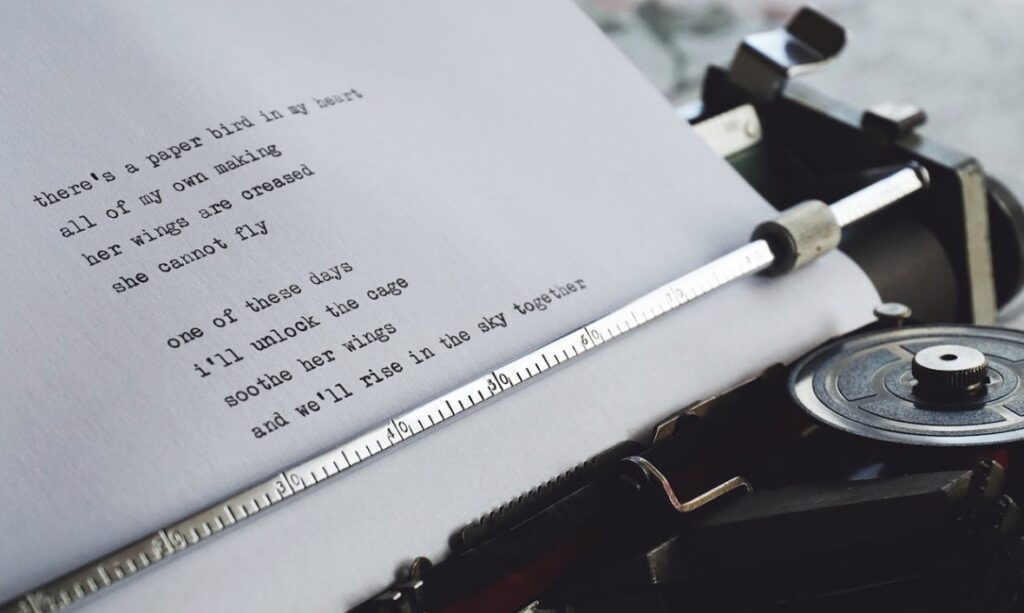
As the most concentrated form of creative writing, poetry is a great way to learn the art of distillation.
There are many types of poems; the simplest is the freeverse style. No rhymes, no structure. Just a flow of thoughts and feelings. Things get more complicated when you add meter and structural rules. You can even write poems specifically to perform them, which is called slam poetry.
Reading poetry is the best way to learn about it, rather than relying on theoretical study. See how different writers play with the form in the musicality of rhythm and emotion to create meaning.
Here’s an example called “Separation” by W.S. Merwin. It’s a masterclass on how a small sandbox can still border an ocean:
Your absence has gone through me
Like thread through a needle.
Everything I do is stitched with its color.

Plays
The dramatic (as in to be dramatized) form of writing is playwriting. This is a style of creative writing meant to be read only by the actors and production team working on the play. The audience sees and hears the work through the artistry of the direction and the performance of the actors.
This is a great art form to pursue if you enjoy writing dialogue. Most of the action is delivered in conversation and there’s a wonderful conceit in having an audience for your characters to report to. Writing works for the stage will help you develop a sense of drama and pacing. The form splits up your story into scenes, all of which have to happen in some clear order. I recommend you check out the works of Neil Simon, Lillian Hellman, Oscar Wilde, and Samuel Beckett for dramatic works that are particularly readable. And of course, there’s always Shakespeare.
If you need help getting started, here’s a trick of the trade derived from Georges Feydeau–a French playwright of the Belle Époque period:
Character A: My life is perfect as long as I don’t see Character B.
Knock Knock.
Enter Character B.
Short stories
The charming younger sibling of the novel, short stories are a rich field of literary greatness. Works 7,500 words or shorter are generally considered short stories.
Having so few words to work with is a great sandbox. You have to clarify your characters to be able to express their actions in such a concise format. Something has to happen in the plot and rather quickly too. It’s a great way to work up to writing longer pieces, if that’s a goal of yours. You’re in great company when you write short stories. You join the ranks of writers like Flannery O’Connor, Ray Bradbury and Jorge Luis Borges, who thrived in that form.
Novels
The most popular form of writing, novels are what we think of when we say something is literature. Books can span fifty pages to several thousand – these are the stories like the Harry Potter series and the works of Dostoevsky. If you want to learn more about novel-writing, I have several articles here on the subject!
Writing your first novel is an intimidating prospect, but it’s more than possible. The desire to approach a project like this is deeply connected to our desire to evolve. There may be some catharsis waiting for you in the pages of your novel.
While there are many other forms of creative writing, like screenplays and memoirs, this should give you a sense of how many possible forms of writing are available to you. Pick the one that you like most and let it rip!
Who inspires you?
If you want to grow as a creative writer, it is essential that you read. What authors do you enjoy? Make a list. It’s helpful to write out specifically what draws you to each writer you’ve chosen. Maybe you like the way they structure their prose or their rich characters. Maybe the plot is particularly juicy and the twists are shocking. Whatever it is, there’s something in there for you. Don’t be concerned about copying their style, at least in the beginning. Every writer starts out by trying to emulate their favorite writer, and somewhere along the way, they discover their own voice.
As you approach a new piece of writing, try to find a few works or writers who have played in that style before. This is a great way to focus your imagination. Which world resembles the world you’re creating? Which characters are a little like the ones you want to write about? See what comes out of the hodge-podge of influences you put together. Here’s Ray Bradbury on the subject of his favorite writers, and how deeply the greats care about the greats they admire:
I have scribbled poems about librarians, taken night trains with my favorite authors across the continental wilderness, staying up all night gabbling and drinking, drinking and chatting. I warned Melville, in one poem, to stay away from land (it never was his stuff!) and turned Bernard Shaw into a robot, so as to conveniently stow him aboard a rocket and wake him on the long journey to Alpha Centauri to hear his Prefaces piped off his tongue and into my delighted ear. I have written a Time Machine story in which I hum back to sit at the deathbeds of Wilde, Melville, and Poe to tell of my love and warm their bones in their last hours…
Your story weapon: Learn the rules so you can break them
You don’t need a formal education in writing to write something worth reading. An education can certainly help and be a great joy, but it’s not for everyone.
Even if you don’t attend a school to learn creative writing, it’s important to know the “rules” of the medium in which you are writing. Every genre has conventions. That doesn’t mean you have to adhere to them, it just means you need to be aware of when you’re breaking them, and why.
For example, if you’re writing a romantic comedy and the couple don’t end up together in the end, then you are breaking with convention, and if you are going to subvert your readers’ expectations, then you want to make sure you do this with intention. The film, 500 Days of Summer is an example of a story that presents itself as a romantic comedy, but by the end of the story, it becomes something else. The ending is satisfying, but it is also an utter surprise.

Convention simply means that, over the centuries, the art of writing has evolved, and we’ve learned some methods that seem to work. Stories tend to be a certain length because of people’s attention spans. Poems often rhyme because our ears find that symphony of sound pleasing. Try to learn the rules of writing in your chosen form. Keep track of the common tropes you’ve noticed and think about why they’re there.
Once you have a sense for the rules of your chosen form of writing, try them out to see what works. If you find a “rule” that just doesn’t work for the story you’re trying to tell, experiment with writing it in a different way.
There’s a big difference between breaking a writing convention because you don’t want to put in the effort and consciously breaking it as a stylistic choice, like E.E. Cummings occasionally throwing capitalization out the window for emphasis in his poetry. This means you’ve thought about what you’re doing and the choice to experiment is a conscious one.
If you’re not sure where to start in writing longer works, you might try looking at some structure models, like the Hero’s Journey or the Three-Act Structure (my personal favorite). These guidelines are intended to make it easier to write, not harder. They can be roadmaps to help direct your story.
“Fill your paper with the breathings of your heart.”
– William Wordsworth
In a world where the blank page can be filled with any combination of words, creative writing techniques that help you specify your creativity are a gift.
The only thing left now is to write! There’s no substitute for time spent with the page.
To deepen your understanding of creative writing and develop your skills within a supportive environment, I’d like to invite you to participate in one of my next writing workshops: The 90-Day Novel, The 90-Day Memoir, Story Day. Through guided exercises, discussion, and practical instruction, you will learn techniques that help transform ideas into compelling written work.