

Foreshadowing is a key element in creating a satisfying conclusion to a story.
This is the craft of planting quiet promises in your story—small clues, images, or moments that prepare your readers for what’s coming without giving the game away. When used well, foreshadowing creates an uncanny sense of inevitability that the ending had to happen, transforming plot twists from arbitrary surprises into deeply satisfying revelations. In this article, I will explore three different forms of foreshadowing, and offer you a story weapon to bring your foreshadowing clues to fruition.
Foreshadowing is the art of planting subtle or overt clues that prepare your audience for future events, creating a sense of inevitability and satisfaction when the story’s climax arrives. Whether through prophecy, Chekhov’s gun, or implicit hints, it deepens tension, engages readers, and ensures plot twists feel earned rather than arbitrary.
Definition of foreshadowing
To foreshadow the events in a plot is basically to hint at future events by laying clues along the way. Your audience may sense what’s up on the way to the ending, or it might only become apparent on a second readthrough. Foreshadowing prevents the sudden plot twists in your tale from feeling random or contrived.
A lack of foreshadowing can lead to something called a deus ex machina. The term translates to “God from the machine” and refers to a practice in ancient Greek theater in which a god would enter the stage to save the protagonist or resolve a complex plot. Resolving a story in this way is deeply unsatisfying, because the ending is not germane to the theme that was established with the dramatic question.
To better understand foreshadowing, let’s consider it on a spectrum of subtlety.
Foreshadowing through prophecy
It doesn’t get more direct than presenting a prophecy to your audience. You get to tell them what’ll happen, cloaked in a bit of vagueness, and let them spend some time wondering who the prophecy might include. Two of the most famous examples of prophecy come from the works of William Shakespeare.
Julius Caesar
Here, the titular character is warned of his impending doom by a soothsayer. The soothsayer repeatedly tells Caesar to “beware the Ides of March,” which refers to March 15th. Caesar, doomed to his fate, dismisses the diviner and says “He is a dreamer; let us leave him.” He could hardly appreciate the gift; how often are you told the exact date you should beef up your security? Caesar is murdered on that exact date.
Macbeth
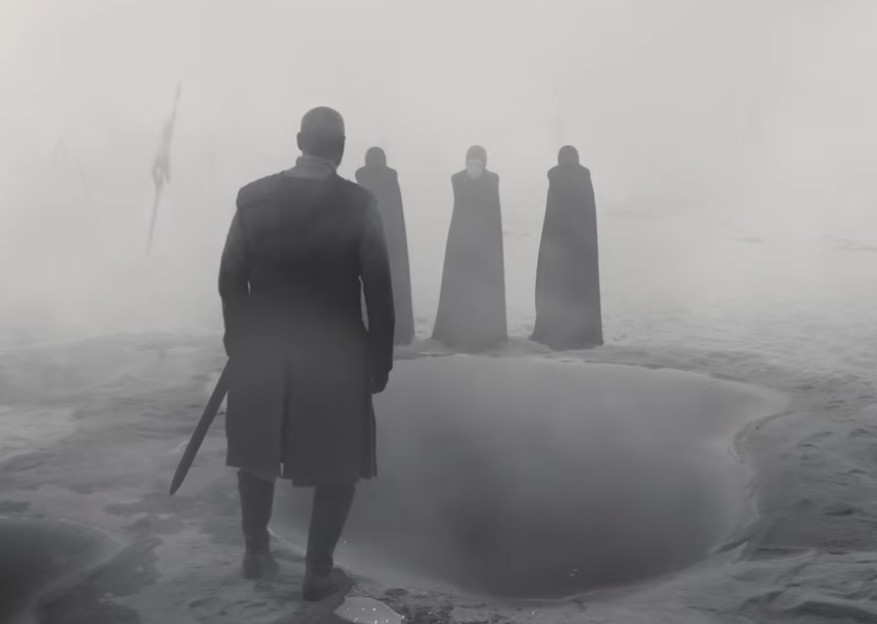
The play opens with the witches foreshadowing the events of the plot, telling of a battle and the later meeting with Macbeth. They show up again with the titular character, telling him “All hail, Macbeth, thou shalt be king hereafter!” Unlike Julius Caesar, for whom the prophecy serves only to increase the audience’s tension and sense of fate, Macbeth is encouraged by this prophecy and directly acts in response to it. It doesn’t get much more clear than both your audience and characters knowing of the future events in the plot.
In most cases, the prophecy serves to obfuscate or confuse the characters. The characters are left wondering who, exactly, will be the Chosen One and their actions may end up fulfilling the prophecy to their gain or their detriment.
When might your story employ prophecy?
You want your audience to feel involved in the mystery at the center of your story. It’s great fun to be guessing as a story unfolds and it might entice your readers to stick with the tale just to find out how the prophecy applies.
You may reveal the prophecy to your characters and see how they react to it. This ties the end of a story to the beginning and ensures that the plot isn’t a random sequence of “happenings” but things that must happen.
Foreshadowing through Chekhov’s Gun
“If there’s a gun on the wall in act one, scene one, you must fire the gun by act three, scene two. If you fire a gun in act three, scene two, you must see the gun on the wall in act one, scene one.”
– Anton Chekhov
“Chekhov’s gun” — which arises from the advice of the playwright Anton Chekhov — is a type of foreshadowing in which the events of the plot are not outlined so much as the tools with which they will occur.
The audience still gets a hint of things to come without a description of the ending. The most obvious of these is the murder weapon, introduced early in a story only to serve up the ending. You can think of this in James Bond terms; why show the audience a cool gadget if we don’t get to see him use it on the villain?
No Country for Old Men
A great example of Chekhov’s gun takes place in the opening scene of No Country for Old Men, written and directed by the Coen brothers. The audience is treated to a scene of a man with dark hair being arrested and put in a police car, while Tommy Lee Jones’ character delivers these lines in a voiceover: “The crime you see now, it’s hard to even take its measure. It’s not that I’m afraid of it. I always knew you had to be willing to die to even do this job. But I don’t want to push my chips forward and go out and meet something I don’t understand.”
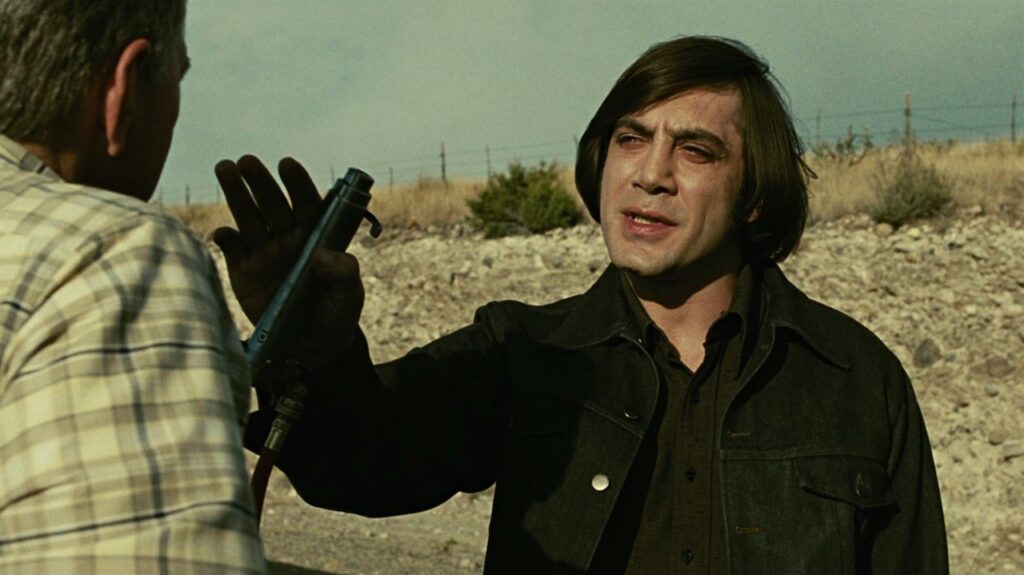
This final sentence is paired with a shot of the villain’s odd weapon, an oxygen tank with some sort of tube attached to it. Right there, at the start of the movie, we see the antagonist and his Chekhov’s gun. We don’t even know that it’s a weapon and we know nothing about that character, but that gives the audience something to look forward to.
Immediately, there’s an unanswered question. We want to know what the oxygen tank is and how it’s used in the story. When we do see the gruesome way in which the murderer uses the weapon, there’s a satisfying payoff and it only leads to another question. How will the protagonist react to or outwit the weapon?
This is a different sort of tension than the one created by prophecy. Your audience is less involved in a guessing game. (How could we guess the creative way that the villain in No Country for Old Men uses the oxygen tank?) Instead, the audience is filled with apprehension and quiet expectation. The tension arises when the weapon or mysterious character appears again.
Modern audiences are used to foreshadowing and are ready to see how it pays off. That’s an expectation you can play with. Maybe the mystery person and mystery weapon appear again but don’t yet do anything. That might heighten the expectation. Maybe their silhouette shows up in the background of important scenes and you increase the audience’s curiosity.
Chekhov’s gun represents a beautiful middle ground in the spectrum of subtlety. By using it, you add to the setting and aesthetic of your story. After all, you get to decide if the Chekhov’s gun is a dusty old revolver or that teleport device your characters keep mentioning. It also allows you to connect the beginning and end of your story without tying yourself to the language of a prophecy. The audience gets to be curious without guessing, and you may want them to feel that way.
Foreshadowing through implicit clues
Harry Potter
There’s an example of this form of prophecy in the third and fourth books in the Harry Potter series. In a scene where the characters are studying divination, Harry and Ron halfheartedly make up a series of predictions to get through the class. They claim that “on Monday, I will be in danger of—er—burns. On Tuesday, I will lose a treasured possession. On Wednesday, I think I’ll come off worse in a fight.” These end up paying off in the following book, in which the Triwizard Tournament involves retrieving a golden egg from a fire-breathing dragon, recovering something stolen by the merpeople, and eventually culminates in a fight with Voldemort, leaving Cedric Diggory dead.
This sort of hint might be impossible to decipher the first time you read a story. However, there is a value to making your story worth reading several times over. The feeling of discovery there is incredibly exciting and can show your readers the care with which you crafted your story. It shows that there is a world there, not just a plot.
Three Colors: Red
Foreshadowing may also be employed without the reader having to consciously pick up the hints. As an example, let’s look at the brilliant work of Krzysztof Kieślowski, the Polish screenwriter and director. His movie Three Colors: Red explores the idea of fate and cyclical stories, which necessitates that the audience feel some sort of deja vu. This happens literally, when the old man in the story tells the protagonist about something that happened to him in his youth. Another character experiences the exact same thing later in the story.
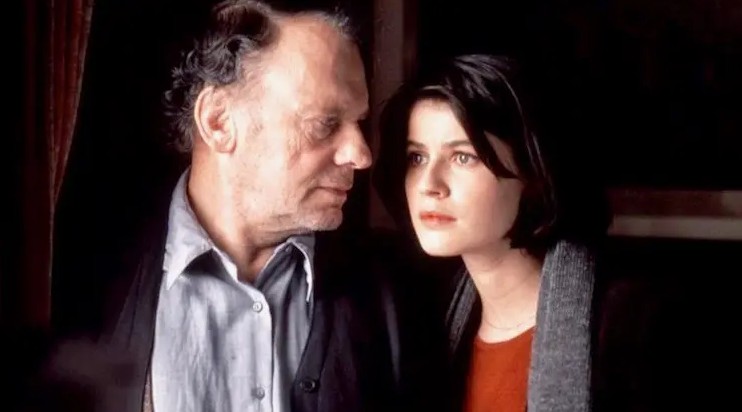
The more interesting use of this tool occurs outside of the audience’s conscious perception. In many points of the movie, Kieślowski shoots separate scenes in the same locations. He uses the reverse of the location; if a scene takes place in a church, another scene that takes place in the street is actually right outside that same church. Kieślowski admits that there’s no way to recognize this, even after many viewings of the movie. However, he argues:
I tried to accumulate those signs, especially in Red, so that the audience can realize that what they see, they have seen before and stored somewhere in their subconscious. Many of these signs do not reach the audience. It’s obvious. But as the signs keep piling up, the audience will get some of them and finally understand the rule.
This translates to a feeling of apprehension in the reader or audience member, that funny feeling that something is about to happen or two characters are connected. They may never even be able to tell someone how the magic trick was pulled off, but the magic is felt. The feeling of predestination, that they have been there before, comes through marvelously.
Your story weapon: Trust the reader
Whether boldly stated or subtly implied, foreshadowing aligns your story’s conclusion with its earliest beats, ensuring that when the final moment arrives, it feels both unexpected and inevitable. It transforms your narrative from a simple sequence of events into a carefully woven tapestry, where every detail carries meaning and every moment contributes to the audience’s sense of discovery.
However you choose to lay the breadcrumbs, you must trust that your audience is paying attention. Subtlety can be as powerful as overt signals; the smallest hint—a line of dialogue, a repeated image, or a fleeting glance—can resonate deeply when the payoff arrives.
By foreshadowing your ending thoughtfully, you give your readers or viewers a sense of inevitability, a cathartic payoff, and a richer connection to your story. Done well, foreshadowing allows your audience to feel clever, engaged, and emotionally invested, transforming even a familiar narrative into a layered and rewarding experience.
Ultimately, foreshadowing bridges the gap between setup and payoff, lends weight to character choices, and ensures that when the climax hits, it lands with both clarity and impact.
Track the key experiences of your characters and learn how to write a satisfying conclusion in my next Story Day or 30-Day Outline workshop.