
Writing dialogue can be intimidating, even for the most experienced writers. Sometimes the words feel clumsy and unnatural, or we find ourselves trying to advance the narrative by hamfistedly verbalizing the subtext. Dialogue can be one of the easiest ways to strengthen or shatter the illusion of reality in your story.
In this article, I’ll go over guidelines for writing dialogue, what elements make for great interactions in books and scripts, and I’ll give you a Story Weapon to keep writing strong.
Strong dialogue treats speech as purposeful action driven by character intention, subtext, and conflict, filtering out small talk to reveal emotion and move the story forward. When dialogue grows from a character’s dilemma it gains rhythm, clarity, and meaning.
What is dialogue?
Dialogue is defined as lines expressing a verbal conversation between two or more characters. This is different from the monologue, which is language that stands on its own and doesn’t involve a response.
To better understand the art of writing dialogue, let’s start with some helpful pointers.
Guidelines to writing dialogue, regardless of medium
In our everyday lives, much of what we say wouldn’t fit on the page. We speak to fill silences, to comment on minutiae, to make small talk, and sometimes just to hear the sound of our own voices.
When a character speaks, your job is to filter out all the unnecessary sentences. Here are some ways you can do that.
Think of your dialogue as action
This can really help you separate useful dialogue from the noise. Just as a character wouldn’t take random actions, like running around the room or throwing the glass of water they’re holding, there shouldn’t be random dialogue. We can leave that in the real world.
Great dialogue is motivated by the same things that motivate the actions of your characters. Just as you can choreograph their movements, you can choreograph what they say.
A character might move swiftly from a teasing jab to a compliment. Will the recipient reply with a flirtatious comment, an expression of anger, or an earnest question? All of these, when thought of as actions, invite responses.

If a character says something inviting, does the other character accept the invitation or do they rebuff it? If a character is, say, trying to crack a joke in a tense situation, how does the other character feel about that? The answer to that question can be their next line of dialogue, which invites another response, and so on until you have a whole scene in front of you.
Dialogue is the child of intention
Great dialogue requires clear characters, who are pursuing their intentions as best they can, while struggling with a dilemma that often prevents them from speaking their truth. Their “want” can be as seemingly benign as wanting someone to pass the salt to trying to suss out whether or not their spouse is having an affair.
When you know who two characters are in a scene and what is driving them, you can connect to what they want, and the dilemma that might be preventing them from coming right out and saying it. If there’s an argument to be had, there has to be something at stake for both people.
Even in the works of Dostoevsky, where characters engage in grand theological arguments, those arguments are compelling because they mean something to the characters themselves. Winning or losing that argument, keeping or losing their temper; these interactions inform the worldview of the characters and change how they approach the next moment.
That doesn’t mean every piece of dialogue has to be serious or intense, but it does mean that even the quips and jokes carry weight as a result of the subtext. Asking yourself what the characters want from each other will connect you to the internal struggle that informs their dialogue.
“Dialogue is a lean language in which every word counts.”
– Sol Stein
Dialogue should move the story forward
The actions of your characters — like planning a bank heist, recruiting the team, and finally attempting it — occur in service of the story. We don’t have the time or inclination to watch characters meander about. In the same way, small talk and idle chatter aren’t useful when writing dialogue.
Dialogue allows for story development in particular ways: fleshing out the relationship between characters, uniting or dividing characters around a goal, and revealing information, to name a few. When you can map out your scenes like you map out the events of the story, your dialogue will be compelling.
Nailing character voices on the page
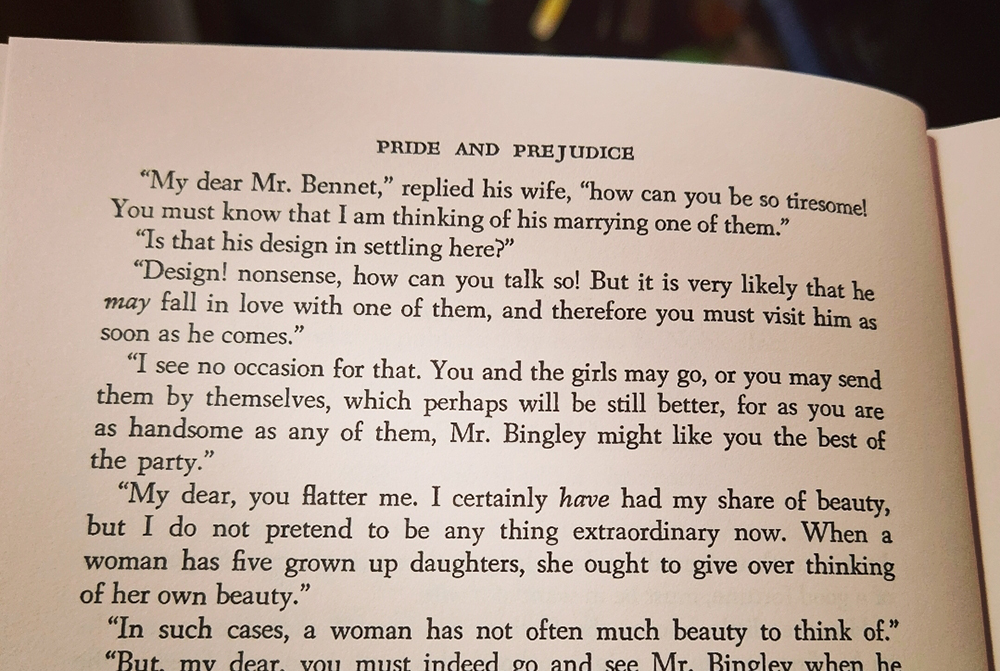
Writing dialogue in short stories or books has its own style. You don’t get any actors to do the heavy lifting for you; differentiating your characters is all up to a stroke of the pen (or keyboard). This means that character voice is particularly important.
For some writers, it’s helpful to make a short reference list for each character and make notes on what informs their dialogue patterns. Are they particularly formal when they speak, or do they use a lot of slang? Are they confident and eloquent, or do they find themselves stuttering and searching for the right words?
Having a reference sheet somewhere on your desk can be a good way to make sure the voice of a character is different from your own narrator’s voice as well.
One good test is to remove all the dialogue tags like “Martha said” or “Diana whispered.” Try reading the scene out loud without the text revealing which lines belong to which character. If you’ve done the work to flesh out the voice of your characters, you should be able to spot immediately which lines belong to Martha and which are Diana’s.
Let the dialogue reveal emotion
Rather than pointing to the emotion in how you describe the dialogue, it’s important to convey that emotion in the dialogue itself.
It’s one thing to write: “I hate you,” Patrick said angrily.
Because the line is a bit drab and can be read in any way, you would need the description to tell you how Patrick is feeling.
Showing and not telling through dialogue would look something more like:
“You have no idea–I swear to God–I’m done with you,” Patrick said.

With the character stumbling over their own words, you can deliver the message of “I hate you” and the fact that Patrick is saying that with anger without having to state the emotion outright.

It’s tempting to fill your writing with interesting dialogue tags like “Rue groaned” or “Raul screamed.” But it’s best to be sparing with this kind of description.
The phrase “[Character name] said” is a great gift to writers. When readers see that on the page, they speed right past it. Eventually, after your characters have exchanged a few lines of dialogue in a conversation, you can omit many of the dialogue tags. With strong character voices and clear intentions, your reader should have no issue knowing who is speaking and how they’re saying it. This is the art of showing without telling.
Just like we do in real life, emotion changes the words that the character chooses and their ability to speak gracefully. When you can write dialogue using mostly “said” as your dialogue tag, the occasional use of a more descriptive dialogue tag will stand out more and bring the impact you want.
Dialogue for the stage & screen
Writing plays and screenplays is a great way to work your dialogue muscles. In a way, you’ll have the gift of partners — actors to say the lines.
The beauty of this form of writing is that different actors will see different things in the dialogue and they’ll all bring something unique to the delivery. Your job here is to give them something to work with, then get out of the way. Though it’s still important to have distinct character voices, you have an advantage in the fact that it’s not all being read in someone’s head. In works for the stage, your focus should be on the intent of the lines and the need behind it. Trust that the actors can flesh out the character with their voice, their body, and their style.
One of the best things about plays and screenplays is the auditory aspect to dialogue. This is dialogue that’s meant to be heard and not seen. The gift you can give the audience is the gift of rhythm.
Though it’s important in all mediums, reading your dialogue out loud is particularly key here. Great dialogue has a flow and a cadence; the pace and energy of the rhythm tells us something about the relationships between the characters.
When you have a scene with two friends, we’d expect the rhythm to be smooth and energetic. These are characters that know each other well and they don’t have to struggle to hit the next note.
If you have a scene with two new lovers, the energy might be more cautious and slow. Each line has a heavier weight and it’s more common for something to be misunderstood. Breaks in rhythm like this, when characters accidentally speak over each other or repeat themselves, are a great way to keep things fresh.
In a scene with many people, we’d expect a symphony or a cacophony — depending on if they’re all on the same side of the plot’s conflict or not.

Writing in meter
Meter can be a helpful tool, but don’t let it be an obstacle. Writers like Shakespeare work in poetic meter — often iambic pentameter — because it sounds pleasant to the ears and gives them a helpful structure to keep the words flowing.
If that sounds exciting to you, there’s a wonderful world of meters for you to explore. Switching between meters is a great way to change the rhythm of the dialogue. On the other hand, if this sounds onerous and stressful to you, there’s absolutely no need to tie yourself to writing in meter.
We can borrow from David Mamet, a prolific writer for the stage and screen, who says this about Shakespeare’s use of iambic pentameter:
“‘Oh, what a rogue and peasant slave am I,’ is iambic pentameter. ‘I’ll see you Sunday if it doesn’t rain,’ that’s iambic pentameter. That’s the rhythm of natural English speech.”
Your story weapon: Subtext
Human beings only speak when they want something. They might just want you to pass the salt. They might want to know if you love them, or if you are keeping a secret, or if you can be trusted. But the thing to remember is that in drama, what makes dialogue spring to life is that the characters are always struggling with a dilemma. Yes, always.
I define a dilemma as a problem that cannot be solved without creating a new problem. And there are two ingredients to a dilemma: 1) a powerful want, and 2) a false belief.
When you recognize the dilemma besetting your characters in a scene, your dialogue will spring to life because you will begin to experience their internal struggle.
Let’s say, for example, you are writing a scene where Billy proposes marriage to Sally, and by the end of the scene Sally has accepted his proposal.
Here’s the scene with no dilemma, thus no subtext.
“Sally, will you marry me?”
“Yes, Billy. You have made me the happiest girl on earth.”
Do you find yourself wondering what the scene is about? So do I!
In other words, meaning only gets conveyed through conflict or tension. Now, don’t confuse conflict or tension as hostility necessarily; it is simply that your theme is dramatized as a dilemma for your characters, and that your dialogue is in service to this internal struggle.
Now, let’s explore the same scene with subtext.
“Sally, have you thought about what I asked?”
“Yup. Have you thought about what I asked?”
“I just can’t work for your father.”
“Then we can’t get married.”
“But he’s a . . .”
“I know . . .” (sighs) “It’s just . . . he won’t let me tie the knot unless you join the family business.”
“Okay fine, I’ll do it.”
“You’re going to make him very happy.”
Both scenes are about a proposal, but one has greater meaning while the other is shallow. Rather than trying to advance your scene through dialogue, focus on the dilemma besetting your characters and explore how they are both trying to get what they want. It is through this conflict or tension that the subtextual meaning of your dialogue will get conveyed.
Dialogue is not merely conversation; it is a precise narrative tool. Join one of my next workshops to develop your writing craft: The 90-Day Novel, The 90-Day Memoir, Story Day