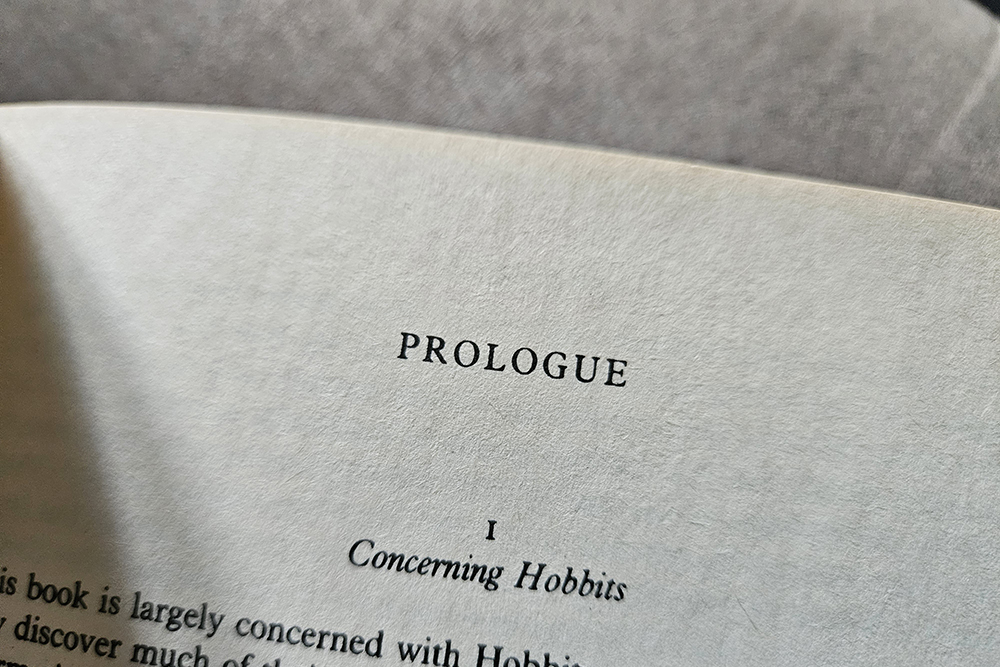

Occasionally, tucked somewhere between an introduction, epigraph, and dedication, a book might have a prologue. This is the story before the story.
In this article, I’ll explore the definition and purpose of a prologue, and offer you a Story Weapon to help you decide when you should include one.
A prologue is an opening scene that prepares the reader for the story ahead by establishing tone, context, or thematic direction rather than explaining plot. When used intentionally, it helps strengthen immersion and your story’s meaning.
Definition of prologue
A prologue is an introductory chapter or scene designed to set the stage for the main narrative. You can think of it as a textural piece to accomplish one or more of the following:
- establish the overall tone
- hint at some crucial backstory (perhaps a prophecy about your protagonist, for example)
- foreshadow the themes of your story
Don’t think of it as a place to info dump your exposition. A bad prologue explains, while a good prologue prepares. Your goal here is to prime the reader for the story that’s about to unfold.

To prologue, or not to prologue
You don’t have to look very hard to find the publishing industry’s view of a prologue. Most people in the publishing industry would advise you to err on the side of brevity. If you ask an agent or an editor, they might say: the best prologue is no prologue.
Especially for beginning writers and first-time authors, the attention of a reader is hard-won. After all, if what you have planned for a prologue isn’t part of the story, why delay the impact of your first few pages? The advice given for first-time authors is usually to start stories with a bang and do little to test the patience of their readers.
If you live by the rule “kill your darlings,” this might well be one of those darlings.
Conventional wisdom doesn’t have to dissuade you from writing a great prologue, however. If anything, you can think of it as extra encouragement to choose substance over style.
Plenty of great stories start with one. Books with prologues continue to be published all the time, and films include them occasionally as well.
So, when should you choose to buck the trend? For the same reason you do anything in writing: because the story demands it.
If you’re including a prologue just because you want to have one, take some time to really see if it’s what your story calls for. If you’re including a prologue because it’s a natural fit for the story, then it’s worth fighting for. Figuring out which of these two positions you’re in is a matter of self-reflection and a judgement call on your end.
Reasons to write a prologue
Bridge for the reader
The first reason to include a prologue is to help bridge the distance between the real world and the world of the story. If there’s something alien about where the story takes place or how the storytelling proceeds, it can be confusing to a reader when they first approach it.
One way to think about this is that the real world has a certain vibrational pattern that we join when we engage with it; this is the pace of daily life, of work, of the passage of time. Part of the joy of reading is that, when the real world becomes too heavy or hectic, we get to find a different pace of living in a text. If the way the world works in your book differs greatly from the real world, a prologue can be a great way to introduce the voice of the narrator or the themes of the text.
Imagine being dropped into a world where all the cars went the wrong way and backwards. The brochure should probably mention this ahead of time, so we know how to cross the street in that world.
Set the tone
Another good reason is if the mood of the book is a key part of understanding the story. Some stories have a clarity about them and work with premises that we’re familiar with. If you open a book and the first page has a knight in shining armor, you know something about the story already.
Other stories are less about the destination or even the journey, they’re about the smell of smoke in the waiting room and the weight of nostalgia. In a text like this, where it’s important that the reader sees the smoke and not the inside of their own living room, a well-written prologue can go a long way.
It’s also a promise to the reader that certain textural elements will be in the book, like mentioning the wallpaper to someone before they move in.
Foreshadowing
Finally, a prologue can add a lot to a story if it foreshadows certain elements.
There’s a reason so many movies and books start with a “flash forward” where we jump to a moment that becomes relevant once we hit the middle of the story. It might even be a scene that we encounter later in the story, but it actually ends up playing out differently with the context we’ve learned along the way. When this is done well, it’s a great sign to the reader that there are layers to the story and that it’ll be worth their time to revisit it.
Framing the story with a prologue like this, which might be a character recollecting the events of the story years after the fact or a seer prophesizing events to come, also offers some stylistic opportunities. Prologues can be written from a different point of view from the rest of the text, giving you the chance to introduce the narrator, and perhaps hint to the reader why they’re telling the story in the first place.
Examples of prologues in literature and film
Romeo and Juliet by William Shakespeare
The Chorus opens the play by telling the audience exactly how it will end: two lovers will die. Rather than spoiling the story, this prologue turns it into a tragedy about inevitability.
The Name of the Wind by Patrick Rothfuss
The book opens with “silence” — three types of it. This lyrical prologue doesn’t explain plot or history, but gives the reader a sense of tragedy. You know before page one truly begins that this is a story about loss and legend.
The Dark Knight (2008)
The opening bank heist introduces the Joker before Batman even appears. Through action alone, we learn about this villain’s cleverness, viciousness, and chaotic worldview.

Mad Max: Fury Road (2015)
With the opening narration from Max, whispers from the dead, and the following chase sequence, the audience is dropped into a world of scarcity, madness, and brutality.
Your story weapon: Give your prologue meaning
If you still want to include a prologue (and there are certainly great ones out there), remember that this is your story to tell and your gut will give you the answer you’re looking for. A prologue is a great opportunity to walk your reader into the world of your story, drop hints about the horrors or excitement to come, and signal the aesthetic features of your style.
Do your best to make sure the prologue is load-bearing. Knock it down and see if the story still stands. Add it back in and see if the story’s stronger for it. If it helps keep up the structure of your story, you’ve got a good prologue on your hands.
Are you seeking to deepen your understanding of different narrative openings and how to structure your story? Join one of my upcoming workshops: The 90-Day Novel, The 90-Day Memoir, Story Day.