Like all things in life, the way we write requires balance. When you look back on your first attempts at writing, you may find some awkward places where your enthusiasm for language outstripped your ability to use it. Sentences can be too long; word choice can be too ambitious. In the literary world, this is called “purple prose” — a type of writing in which the extravagant style and use of language gets in the way of the narrative.
It’s the work of a writer lost in the form of language, leading them to neglect the function of language. You might have also heard the term “purple patches” of writing or “purple passages.” It’s likely that your whole draft isn’t purple prose; just the bits when you got lost in the sauce.
In this article, I’ll give an example of what purple prose is and how you can cut it down, explore different views from two great authors on prose, and I’ll offer you a Story Weapon to avoid misusing language in your own writing.
Purple prose happens when flashy language overwhelms meaning, distracting from the story instead of serving it. By trimming excess words and trusting clarity over ornamentation, writers can make their work more emotionally powerful and memorable.

How to trim purple prose
Let’s take a look at an example of purple prose first. Once we see how the language obscures the meaning of the passage, I’ll strip back the dross and see how it looks with just the essentials. This is also a fun writing exercise if you ever find yourself bored at the writing desk.
The last time Emily and I saw each other, we were ice-blocks in the tapestry of time. Our group’s voyage into the rancid swamp had ended. The ruddy blood had long since dried on my wrinkled clothes and we all smelled of thick sweat. The last of our surviving comrades, arms covered in the last of her endless Band-Aids, had just left on the steamship that would take her back to her port. The red sun was wet in the sky and the petty mosquitoes were eager to stay in our company. Then it was just us. Just me and Emily.
We didn’t bother to say goodbye, though we had only just met. We didn’t have to. With the rest of our friends, there had been promises of correspondence and tearful hugs. With Emily, there was only silence and the shared understanding that there was something significant about us having met. Our paths have crossed a few times since then, but we never saw each other like we did then. She may have glimpsed me, and I may have glimpsed her, but never at the same time and never in silence.
That’s a lot of words saying very little. This is an excellent time to use the trusty principle: “Kill your darlings.” You might even think of “kill your darlings” as the antidote to purple prose.
Let’s see what this passage looks like without all the adjectives and wandering imagery.
The last time Emily and I saw each other, we were frozen in time. Our group’s voyage into the swamp was over. There was some dry blood on my clothes and we both smelled of sweat. The sun was wet in the sky. It was just us; just me and Emily.
We didn’t bother to say goodbye, though we had only just met. We didn’t have to. With the rest of our friends, there had been hugs and promises to write. With Emily, there was only silence. Our paths have crossed a few times since then, but we never really saw each other again. She may have glimpsed me, and I may have glimpsed her, but never at the same time and never in silence.
The second version cuts about 70 words, but nothing essential is lost. In fact, it is the opposite. The meaning of the passage comes into stark relief by removing the unnecessary fluff. Here the focus closes in on the narrator and Emily. By removing words that were chosen just because they sounded good, we’re left with the words that exist to tell the story and nothing more.
Purple prose debate: Faulkner vs Hemingway
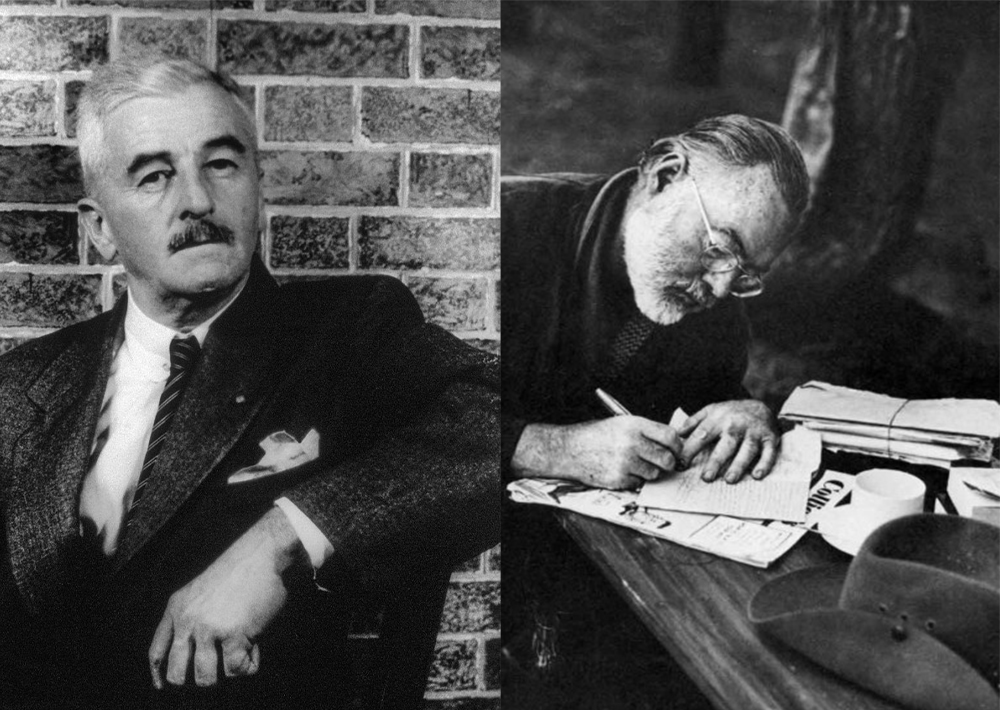
“Poor Faulkner. Does he really think big emotions come from big words?
– Ernest Hemingway
So is this really a rule of writing or a stylistic choice? After all, there are plenty of novels out there with a lot of purple prose. Some of the greats, especially Oscar Wilde and Charles Dickens, seem to have some flowery purple patches in their novels. The quote above from Hemingway references a small debate on that subject.
In 1947, William Faulkner was invited to visit the University of Mississippi. He took questions from students in a class on creative writing and his answers were published in The Western Review. Here’s the relevant excerpt:
Q. If you don’t think it too personal, how do you rank yourself with contemporary writers?
A. 1. Thomas Wolfe: he had much courage and wrote as if he didn’t have long to live; 2. William Faulkner; 3. Dos Passos; 4. Ernest Hemingway: he has no courage, has never crawled out on a limb. He has never been known to use a word that might cause the reader to check with a dictionary to see if it is properly used; 5. John Steinbeck: at one time I had great hopes for him — now I don’t know.
Clearly, something about Hemingway’s preference for brevity bothered Faulkner. This is the previous century’s version of a diss track. Three years later, in 1950, The New Yorker magazine published an interview with Hemingway:
The test of a book is how much good stuff you can throw away. […] When I’m writing it, I’m just as proud as a goddam lion. I use the oldest words in the English language. People think I’m an ignorant bastard who doesn’t know the ten-dollar words. I know the ten-dollar words. There are older and better words which if you arrange them in the proper combination you make it stick. Remember, anybody who pulls his erudition or education on you hasn’t any.
Hemingway made a few other comments on the record in this spirit, but in the interest of keeping with the theme of this article, we’ll stick with just these excerpts.
There are a couple of things we can take from this exchange:
- Even some of history’s best writers were touchy about their work. That’s completely normal! Insecurity and letting comparison be the thief of joy are deeply human habits; don’t let it dissuade you from writing.
- What Hemingway would consider a purple passage is different from what Faulkner would consider a purple passage.
The choice of what is essential is up to you and your editor, if you have one. For Faulkner, whose work is more stylistically experimental, challenging the reader is a part of the function of language. For Hemingway, challenging the vocabulary of his readers was less important than them understanding what he was saying.
Your story weapon: Less is more
Remember that you are making art, not widgets; and so, editing your prose is about trusting yourself. Your gut will tell you when you’re writing in service to your story and when you’re writing to hear the sound of your own voice. The latter is a sign of purple prose. Rather than trying to sound like a writer, trust that you already are one. The gift of letting go of your writer’s ego is that you’ll discover there is so much more room in your draft.
When every sentence announces itself as a headline, there is nowhere for the reader’s eye to rest. By simplifying your prose, your work has a chance to be more emotionally complex rather than just complicated. Another metaphor or interesting adjective won’t stick in our memory, it may well just pull focus from what you want your reader to experience.
I’ll leave you with this from Mark Twain. Afterall, he says it in just two words: “Eschew surplusage.” Eliminate unnecessary words.
Are you looking for support in trimming your prose? My Rewrite Master Class will help make your prose sing by distilling your story to its nature.