



The Fichtean Curve takes a different approach from other story structure models. Most structure templates take a little time to establish the world and the protagonist’s home life before something happens to disrupt that. Not every story needs a slow build, however. Some stories take off at a gallop and never stop, pulling the reader through a series of escalating crises until the tension finally breaks at the climax. That is the logic of the Fichtean Curve, and for the right kind of story, it is one of the most propulsive structures you can use.
In this article, I’ll explain what makes this story structure unique and why you might want to give it a try. Lastly, I’ll give you a Story Weapon to help you set the curve.
Skip the slow build. The Fichtean Curve bypasses peaceful exposition to drop readers directly into in medias res action. By driving the plot forward through a rapid series of escalating crises, this propulsive structure builds relentless tension straight to the climax — making it the ultimate weapon for crafting high-momentum fiction.
Structure of the Curve
John Gardner taught the Fichtean Curve model in his writing classes and included it in his book, The Art of Fiction, which was published in 1984, shortly after he died. Interestingly, Gardener cites the structure model as if he’d heard it elsewhere, but makes no mention of such a source. In medias res stories that jump straight into the action are not a new concept, of course, but the origin of the Fichtean model itself is unclear even in its name.
“Fichtean” is a reference to Johann Gottlieb Fichte, a German philosopher who followed in the tradition of Descartes and Kant. It’s not entirely clear from Gardner’s description, however, why the Fichtean curve is named after Fichte. Perhaps Gardner was a big fan. Or it could be his interpretation of Fichte’s thesis-antithesis-synthesis discursive model where you have 1) a concept 2) contradicted by another concept, which then 3) forces a higher level concept as a resolution.
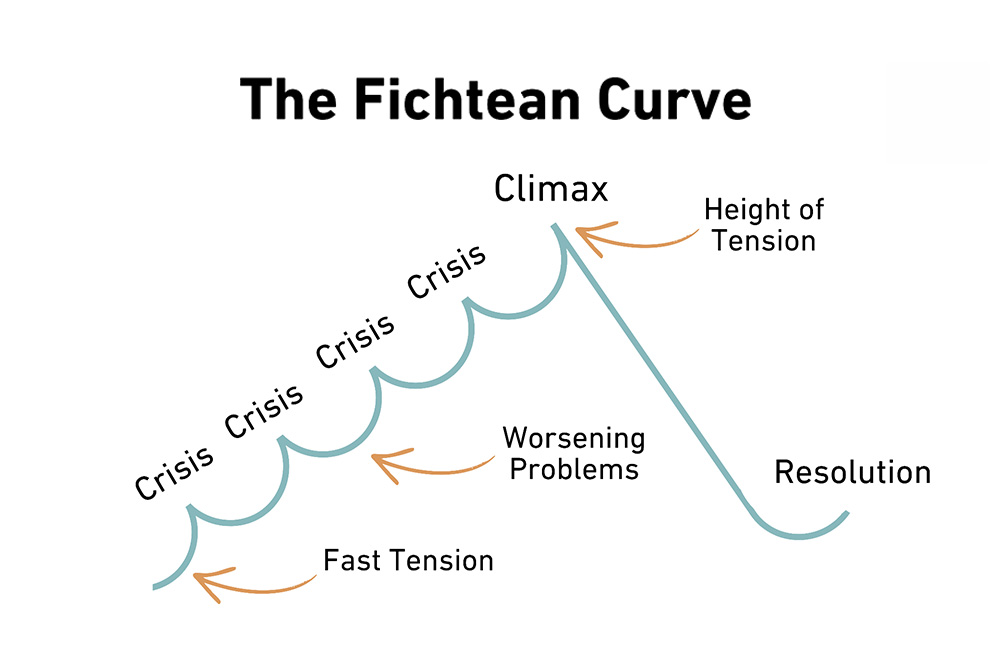
The Fichtean curve follows a rise and fall of tension, similar to the Three-Act Structure, Freytag’s Pyramid, and other models. Unlike those structures, however, this framework starts right in the rising action. There’s no peaceful exposition, where we see the world as it exists before the events of the plot. It plops us right into the middle of the action, demanding the reader or audience find their footing quickly. The tension rises rapidly as the obstacles escalate.
Gardner introduces the framework as:
A chart of the novel’s emotional development (our feeling of suspense, fascination, or anxiety as we read) is, then, Fichte’s curve… [The] ascending action is in fact not smooth but moves through a series of increasingly intense climaxes (the episodic rhythm of the novel).

Multiple crises punctuate the rising tension. You can interpret these as battles with the antagonist, tests of the protagonist’s mettle, or developments in a mystery case. The central dilemma intensifies during the ascending action.
The tension peaks with the main climax of the story. It’s the final confrontation against the antagonist or the final reveal in a case. This is a moment of painful transformation for the protagonist.
Then the tension finally breaks, and the climax gives way to a resolution. A new normal is found, showing the reader how the protagonist has changed as a result of the plot. The central dilemma has been resolved and the protagonist finally enjoys peace.
Or there’s a cliffhanger. That’s up to you.
“All true suspense, we have said, is a dramatic representation of the anguish of moral choice.”
– John Gardner
When to use it

This story structure is helpful for stories where tension is particularly important to drive the narrative forward.
You’ll find it frequently used in mystery books and pulpy adventures full of action. In stories like that, it isn’t as important that we have all the exposition you’d normally expect. Your readers learn about the protagonist and other characters through their actions in each crisis.
These genre stories also come with implicit exposition. We all have an image of a gritty city or a haunted mansion in our head already. Because these stories are more focused on the characters in the story and the world itself doesn’t change very much, we don’t need to spend much time with the world before the plot begins to unfold.
Example #1: World War Z by Max Brooks
This book is modelled after oral histories of World War II, telling the story through interviews and reports from different characters. We’re exposed in this way to the events that spell doom for the pre-apocalyptic world. After minor outbreaks, the zombie disease worsens and world governments have to take more drastic actions. Skirmishes become battles, then full wars. The guns are replaced by bombs, and eventually nuclear weapons. The tension builds steadily as the world reckons with the immensity of the zombie threat.
The climax occurs when the US military attempts to reclaim some public confidence by televising a battle in New York. The military is decimated as the world watches. The president suffers a nervous breakdown, forcing the vice president to assume the office. It’s the tipping point of the story; the world begins to accept that there will need to be a new world order. The nations of the world regroup and slowly take back their land. Humanity survives, though the world is a different place now.
Example #2: Gone Girl by Gillian Flynn

Gone Girl does not ease you in. From the first pages, something is wrong. The story opens on the morning of Nick and Amy Dunne’s fifth wedding anniversary, with Nick’s narration already carrying an unease he cannot quite name. Amy is missing. The police arrive. And the tension, rather than building toward a crisis, is already at crisis level before the reader has had time to get their bearings.
Flynn does not give you a period of calm establishment before the conflict begins. She drops the reader straight into the dilemma and then keeps intensifying it with complication after complication, revelation after revelation, each one reframing everything that came before. Every time the reader thinks they understand what kind of story this is, the ground shifts.
The structure mirrors the psychological experience of the story itself: the feeling that you are never quite standing on solid ground, that the truth is always one more chapter away. The catharsis, when it comes, is not a resolution in any conventional sense. It is a reckoning, and it lands with the weight of everything that has been building since page one.
Example #3: North by Northwest directed by Alfred Hitchcock

North by Northwest begins with a man who is already in the wrong place at the wrong time. He is mistaken for someone he’s not, and runs before he fully understands what he is running from. Roger Thornhill does not have the luxury of a calm first act. He is pulled into the crisis immediately, and we’re taken along with him. The film’s genius is how the mini-climaxes keep on escalating before anything gets resolved.
He is nearly killed at a United Nations building. He ends up on a train with a woman he cannot trust. He is chased across an open cornfield by a crop duster with no interest in crops. The tension accumulates, and the audience is kept in a state of forward momentum. The resolution arrives not because the danger diminishes but because Thornhill has finally changed enough to meet it. That earned transformation, delivered at the peak of a structure that never lets you rest, is precisely what makes the film feel so alive.
Your story weapon: Entertain your most petulant self
Some stories require patience to uncover their virtue; the Fichtean curve doesn’t ask that of readers. Imagine you’re telling the story to a version of you that is constantly bored, easily distracted, and not altogether interested in being told a story. That’s the most intimidating audience possible. With that reader in mind, you can think of your crises in the rising action as hooks to keep the story tense. With each scene, you make the situation more dire by continuing to turn the screw.
The Fichtean Curve leads to the type of story that you just can’t put down. Boredom isn’t an option; the story unfolds at a rapid pace and the reader races toward the climax. Without realizing it, they become attached to your characters and moved by your world.
As always, let the structure be a tool and not an obstacle or a cage. If you can use this framework to entertain yourself, the Fichtean curve will be another weapon in your writing arsenal.
Understanding structures like the Fichtean Curve can help you build stories that sustain momentum, deepen tension, and keep readers emotionally invested from the very first page. To strengthen your storytelling instincts and sharpen your narrative craft, join one of my next workshops: The 90-Day Novel, The 90-Day Memoir, Story Day.