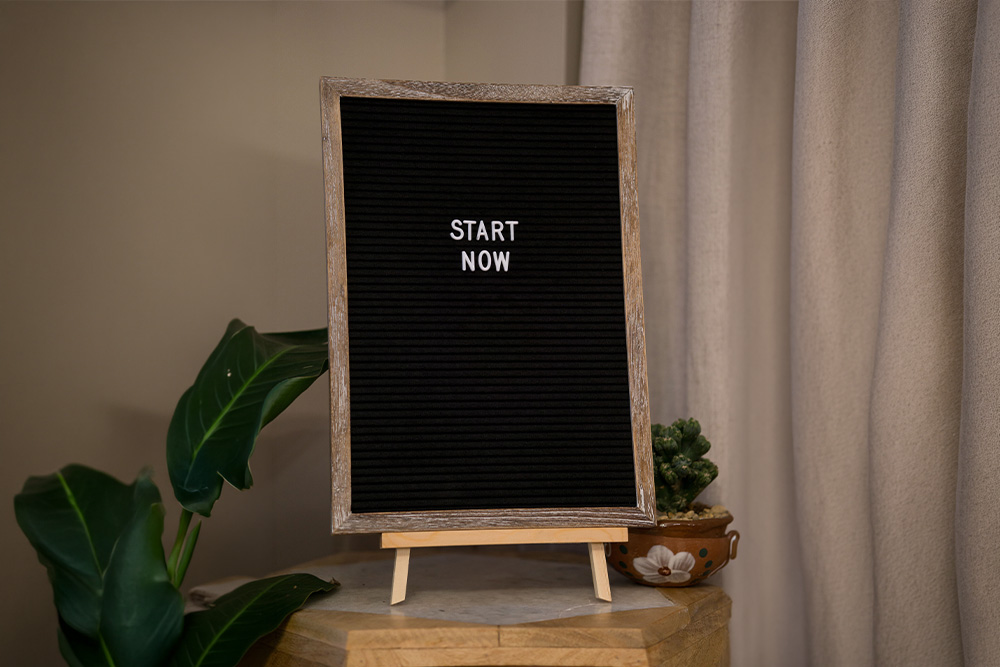




Have you ever found yourself staring at the blank page and waiting for the spark, but it doesn’t come? So you walk away, make a cup of tea, check your emails, and pretty soon the sun is setting on another day of no writing.
You try again tomorrow, but then tomorrow becomes next week. If anyone asks how the story is going, you say you’re “working on it.” This is not a character flaw, or evidence that you’re not a real writer. It’s what happens when you rely on waiting for an unreliable feeling to urge you onward.
Here’s the truth about writing motivation: it’s not something you need to wait for.
In this article, I’ll look at how motivation fades, what keeps writers going on the difficult days, and how to build a relationship with your work that doesn’t depend on feeling inspired. Lastly, I’ll give you a Story Weapon you can use the next time motivation is nowhere in sight.
Writing motivation isn’t a feeling to wait for — it’s a byproduct of showing up consistently, even when resistance shows up as fear rather than laziness. Small, achievable goals and a low-friction writing environment do more to sustain a project than large deadlines or waiting for inspiration to strike. When motivation genuinely disappears, committing to just five minutes at the page is often enough to get past the resistance and back into the work.
What gives you motivation?
Motivation based on your emotions is fleeting. You can feel it clearly when an idea is fresh in your mind, and the story feels so full of possibility. When the work becomes difficult, however — which it always does — that feeling fizzles away.
You can’t schedule motivation. You can’t summon it through force of will. And you can’t build a writing process on something so unpredictable.
What you can do is decide to show up. Not because it feels good. It won’t a lot of the time. But I’ve found it’s the best way to push past resistance and get your story on the page.

All of the writers whose books you love didn’t write their works on a sustained wave of creative excitement. They finished them by returning to the desk even on the days they didn’t want to, and doing the work anyway.
Your feelings and your writing goals don’t always move in the same direction. You can feel uncertain about a scene and still write it. You can feel tired and still jot down a paragraph. The blank page doesn’t require that you “feel good” about it. It only asks you to begin.
The most productive writers set small goals for themselves that they can achieve on the most resistant of days. They might have a small ritual to get the juices flowing: take a quick shower, get a cup of coffee, do a sudoku to relax, then write for one or two hours. Even if you can only get ten or twenty minutes of writing in, the consistency of that practice is what builds momentum, and momentum eventually turns into motivation.
What lies underneath resistance

When writers talk about losing motivation, they tend to blame themselves. They use words like “lazy,” “undisciplined,” or “not a real writer.” But what looks like a lack of motivation isn’t laziness. It’s fear.
Fear that what you are writing isn’t good enough. Fear that you don’t know what comes next. Fear that the story won’t work, and that the time and care you’ve put into it will be wasted. That fear does not always announce itself directly. It shows up as distraction, procrastination, or a sudden urgent need to dust your baseboards. Your resistance is the fear in motion.
There’s also a subtler fear that doesn’t get talked about enough: the fear of finishing. An unfinished story is still safe. It exists in potential, which means it can still be everything you hope it could be. The moment you complete it, someone might read it and find it wanting. Some writers spend years returning to the middle of their manuscript for exactly this reason, without ever quite acknowledging it to themselves.
Naming the fear doesn’t make it disappear. But it does diminish its authority.
When you can say clearly what you are actually afraid of, the resistance loses some of its power. You are no longer fighting something shapeless. You are facing something specific, and specific things can be worked with.
Small movement over large plans

Writers are drawn to large goals. Finish the novel by spring. Write fifty pages this month. Complete the first draft before the year is out. These goals are not “wrong” in any sense, but they can work against you if they keep the finish line so far in the distance that every single writing session feels inadequate in comparison.
If you’re struggling with motivation, focus on one scene, one page, one paragraph at a time to move your characters forward in some way, however small. The satisfaction of finishing something is real, and that satisfaction is what draws you back to the desk the following day. A writer who completes one rough page today has more forward motion than a writer who spent their time picking at the exact wording on their outline again and never opened the manuscript to actually start the first draft.
The 90-Day Novel, the 90-Day Memoir, and the 90-Day Screenplay are all built around this principle. You’ll have guidance in a daily letter from me, a manageable task or a new approach to consider, and a consistent structure that removes the question of “Where do I start today?” Giving structure to your writing process isn’t a constraint on creativity. It helps make creativity possible.
The environment you write in

Most writers think about motivation as an internal state and ignore the external conditions that help shape it. Where and how you write can matter more than most people think.
A writing environment filled with competing demands on your attention — a phone within reach, background noise, dozens of open browser tabs — divides your attention too much before you’ve written a single word. Your brain won’t easily switch off from those distractions when you open the document you’re working on either.
One of the most useful things you can do is to develop a small ritual that signals to your brain that it’s time to write. It doesn’t need to be elaborate. A specific playlist. A particular chair. A cup of something you only drink when you are at the desk perhaps. Over time, that ritual becomes a trigger, and the trigger begins to do some of the work that you relied on the whims of your emotions for previously.
You are essentially training yourself to enter the right state of mind through repetition, the same way an actor has a pre-performance routine with voice exercises that helps them get ready to work.
It also helps to reduce the friction between you and the page. If opening your document requires navigating through several folders and making several decisions along the way, you’re giving your resistance opportunities to talk you out of it before you even begin. Leave the document open. Leave yourself a note about where you are in the story and what the next scene needs to do. Make it as easy as possible to simply sit down and continue.
Going back to why

Somewhere in the middle of a long project, some writers lose touch with the reason they wanted to tell their story in the first place. The characters who once felt so alive might start to feel like chores to maintain.
When that happens, go back to what prompted you to write in the first place. What question were you trying to answer by writing this story? What did you hope it might do for your readers?
Reconnecting with that original spark often brings your motivation back faster than forcing yourself to push through. Because a story isn’t only fueled by discipline. It’s fueled by curiosity, too. And curiosity tends to last a lot longer than pressure does.
Here’s one practice that could help: write a short private letter to yourself about your story. Not for anyone else to read. Just note down a few honest lines about why this particular story, out of all the stories you could be telling, keeps coming back to you. Writers who try this often find a sentence that surprises them. That surprise is usually a sign that the story is still alive within you, buried under weeks of self-doubt and accumulated pressure.
Your story weapon: The five-minute door
If it feels like your motivation has completely disappeared, make an agreement with yourself. Write for five minutes. Keep a timer running and give yourself full permission to stop the moment it goes off.
This works because it removes two things that tend to stall your writing: the fear of an enormous task, and the pressure to produce something good. Five minutes is short enough that almost no one can talk themselves out of it. It only requires that you open the document and begin.
What almost always happens is that the timer goes off and you’re already inside the scene now, so you keep going. To stop writing feels harder now than continuing. That five minutes was never really the goal. It was the door, and you’re already through it.
On the days when five minutes is genuinely all you can give, that is still five minutes more than the blank page had before.
Do it consistently, and those five-minute sessions accumulate into pages. Those pages accumulate into drafts. And one day you’ll look up and realize that the story you couldn’t find the motivation to write somehow got written anyway, one small decision at a time.
Motivation may come and go, but a five minute contract is something you can actually keep. Do it again and again, and one day you’ll look up and realize your desire to evolve as a writer is what gives you true creative motivation.
A solid understanding of storytelling gives you something dependable to rely on. Developing your craft equips you to keep making meaningful progress, even on the most difficult writing days. Learn more about storytelling craft in The 90-Day Novel, The 90-Day Memoir, or The 90-Day Rewrite.