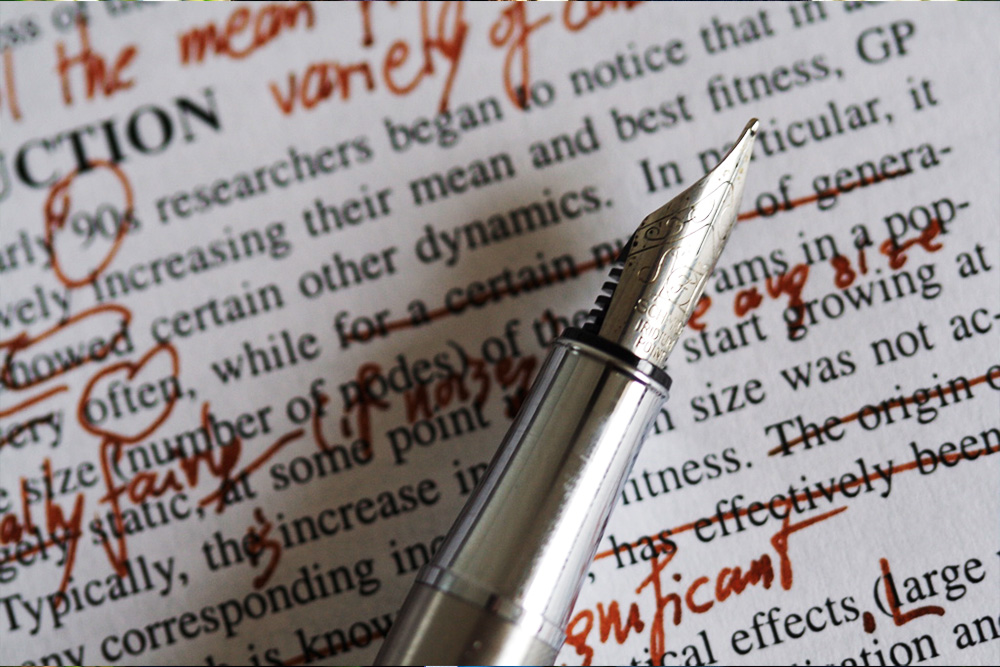


Copy editing is a specific type of editing that focuses on both the technical aspects of your writing and the overall flow: grammar, spelling, punctuation, accuracy, consistency, and clarity.
A proofreader will do a final pass on your manuscript to find any remaining typos, formatting issues, and other small fixes, while a copy editor will work more deeply with the text itself. They examine not just whether the words are grammatically correct, but whether they are doing the job you need them to do. They look at what could be clearer, more consistent, or more precise. A copy editor will notice when something in your second chapter contradicts chapter seven, when your character’s name changes spelling mid-manuscript, or when a sentence is technically correct but lands in a way that doesn’t match your voice.
In the rewrite stage, you would usually focus on big-picture edits for your characters, the plot, and the overall structure. It’s the copy editing stage that saves your words from the trap of simply being “close enough.”
Grammatical shortcuts can help immensely in getting an idea onto the page, and approximating how a passage is supposed to sound. As writers trying to reach numerous readers, however, we must also review our words through many lenses. One of these lenses is professionalism. Published works require the highest standard of writing, and copy editing helps put your best foot forward.
In this article, I will walk you through examples of Shakespeare’s use of grammar, some writers’ favorite shortcuts, and a few “rules” you’re allowed to bend. Lastly, I’ll leave you with a Story Weapon on knowing when to break the rules.
Copy editing is the “line judge” that ensures your creative ideas land within the lines of clarity and professionalism. By mastering the discipline of grammar — from avoiding overused em-dashes to knowing which “school rules” (like starting sentences with And or But) are okay to break — you can elevate your writing from “close enough” to truly polished.
Shakespeare and tennis
If writing were like tennis, it would be impressive to see a player fire off a 150 mph serve — but in order to actually win the point, it has to land within the lines. Writing is like that. There are guidelines — and so, just as in tennis, it’s no fun playing without a net.
Consider Shakespeare’s Sonnet 18: “Rough winds do shake the darling buds of May / And summer’s lease hath all too short a date.”
What impresses us about Shakespeare’s writing is not just the lyricism, but his precision of language. Shakespeare often flips sentences (inversion) to fit his meter, but the grammatical logic stays airtight. He takes no liberties with grammar or punctuation to achieve his ideas.
To make it even more impressive, he writes in iambic pentameter, essentially playing within a very small “court.” He doesn’t cheat by adding an extra syllable, or breaking a rule of grammar just to make a line sound right. He finds the exact right words that are both lyrical and technically “legal.”
Here’s another example, from Macbeth: “Is this a dagger which I see before me / The handle toward my hand?”
Another writer, struggling with the passage, might add extra words to make it feel more complete, such as: “…the handle pointing toward my hand?” Shakespeare forgoes the extra word, trusting the relationship between the noun (“handle”) and the preposition (“toward”) to do the work. The line is structurally tight — without a single wasted syllable — and still fits perfectly within the “court” of his meter.
The magic of great writing isn’t just in its creative flair, but in the discipline required to execute that flair within a rigid system of rules.
Common cut corners
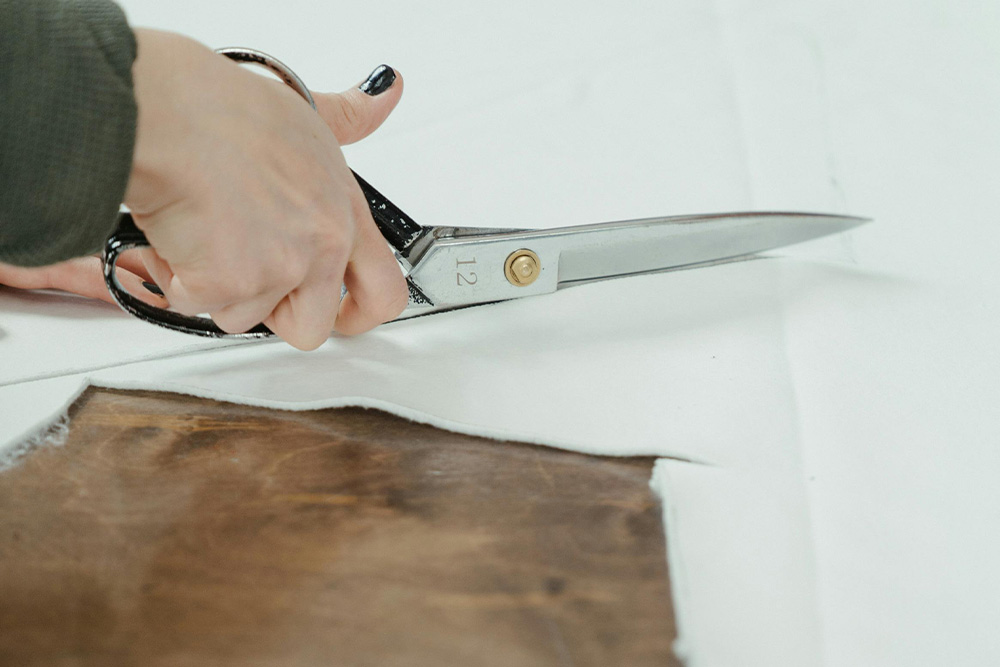
We all take liberties in the process of writing. If we’re being honest with ourselves, that “em dash” was probably unnecessary, and many of us could brush up on when a semicolon is actually needed.
The “em dash” in particular deserves our scrutiny when editing. It is the Swiss Army knife of punctuation: able to replace a comma, a colon, or parentheses. Because it’s so versatile, writers will often use it to tack on an afterthought that really should have been a new sentence.
When you’re copy editing your own em dashes, a simple test is to ask what the information really is:
- If it’s a clear, direct conclusion or explanation, a colon is usually better.
- If it’s an aside, parentheses might be stronger.
- If it’s a separate thought, it should be its own sentence.
For example: “He had only one goal — victory.” Here, the dash makes “victory” feel like an afterthought, even though it’s the point of the sentence.
“He had only one goal: victory.” Now, the emphasis lands cleanly. The colon delivers the idea instead of tossing it in at the end.
Or: “It was a long match — the sun was setting — and both players were exhausted.” Everything is glued together here, and the em dashes are doing too many jobs.

“It was a long match. The sun was setting, and both players were exhausted.” Separating the ideas into full sentences gives the passage more shape, and room to breathe.
Even if you are using em-dashes correctly, also use them sparingly. If a page has more than two or three, it can signal that you’re “gluing” thoughts together instead of building them more soundly.
Another common shortcut is the dangling participle. This happens when a sentence begins with a description that accidentally attaches to the wrong subject: “Approaching the ball machine, it started to buzz.”
This would be an easy mistake to skim past on the revision, but grammatically, it sounds as though the machine is approaching itself. A corrected version would be: “As I approached the ball machine, it started to buzz.”
Keep an eye out for “fuzzy” sentences that are almost grammatically correct, but take a small liberty that keeps them from landing within the lines.
Stylistic choices
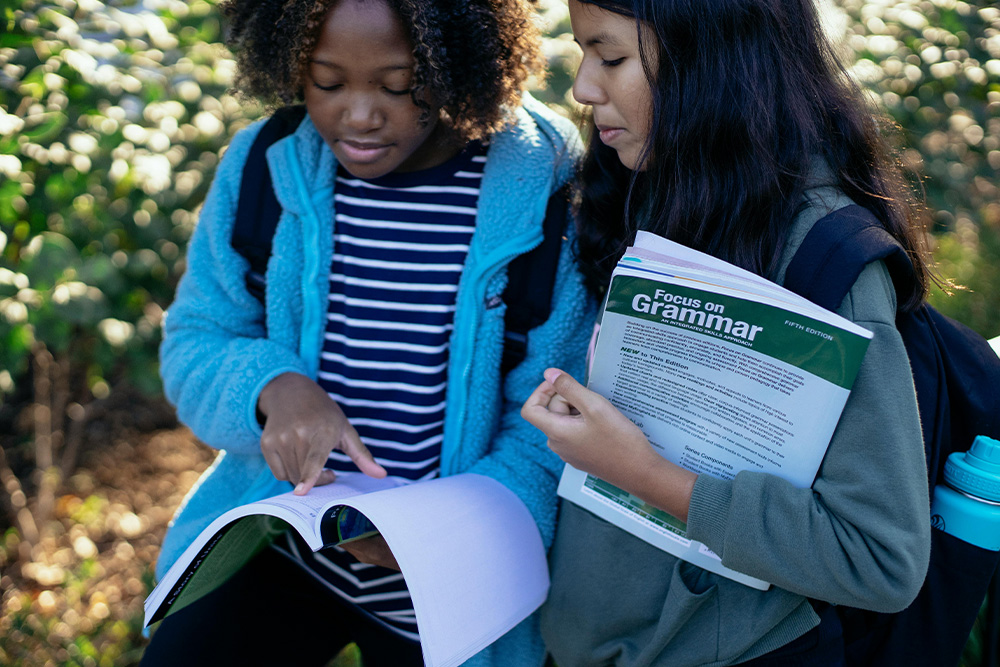
In school, many of us were armed with grammar “rules” that we still carry around. Many of them are solid, but some can be revisited.
For instance, teachers warned students for decades not to start a sentence with a conjunction like “And,” “But,” “So,” or “Because.” There is no actual rule in the English language that forbids this. Professional writers do it constantly, either as a stylistic choice or because it creates a rhythm that couldn’t otherwise be achieved.
Starting a sentence with a conjunction can create a punchier flow, and it can be a great way to inject emotion. It can represent a breakdown in the narrator’s grammar during a highly charged moment: simulating a shortness of breath, without actually breaking any grammatical rules.
Starting a sentence with “Then” can also be a helpful way to break up the flow, especially in an action‑heavy passage, or at a moment that requires a sudden tonal shift. Imagine a sequence where every sentence is long and fluid, building up with great momentum, and tension.
“Then came the silence.”
This kind of sentence can be useful for controlling the flow of a passage. You can think of it as a “drop shot” in tennis: an unexpected trick-shot landing just barely past the net. The analogy is apt in this instance. If you do it to score every point (while technically legal), the audience might begin to boo.
Your story weapon: When to break the rules
Returning to our tennis analogy: if a writer has a brilliant, “150 mph idea,” the copy editor acts as the line judge. Their job is to ensure that idea lands within the lines of grammar and clarity, so the player actually scores the point.
At the same time, language is an art form that allows for room to play around with the rules. Like Picasso, who presented new ideas for what could be considered a beautiful painting, you also get to contribute to the ongoing conversation about what can be effective writing. However, Picasso didn’t start by breaking the rules; he had to master them first.
Copy editing is where you practice that mastery: by learning which rules are structural, and when they can be bent. Once you master the difference, you can step outside the lines — not by accident, but because the risk is worth the shot.
Strong copy-editing sharpens your voice, strengthens clarity, and helps your writing reach readers with greater precision and confidence. If you’re preparing a manuscript for publication or looking to elevate your prose, explore our in-house copy editing services for thoughtful, detail-oriented support tailored to your work.