


While your Editing Checklist is about clarity and pacing, and your Rewrite is about adjusting the structure and polishing character development in your story, proofreading is the final pass. It’s when you (or a qualified editor) pull out a magnifying glass and fine-point tweezers to catch any last mistakes.
This is the stage where you make changes no one might even notice: extra spaces, the difference between “the” and “a,” the use of an em dash, or tweaking the placement of a single comma. Proofreading is also where you can easily become obsessed with the tiniest details that it actually disrupts the work. You can get lost in minutiae, toggling the same choices back and forth, and lose sight of the big picture.
To prepare you for this process, in this article I will share some smart changes to look out for, some pitfalls to avoid, and finally leave you with a Story Weapon on how to trade perfectionism for excellence.
Proofreading is the final editing stage where writers refine grammar, clarity, rhythm, and word choice to create a smoother reading experience. The article explains how effective proofreading improves reader engagement while warning against perfectionism, overediting, and starting revisions too early. Ultimately, proofreading is about honoring your story and giving it the strongest possible final polish.
Basic guide to proofreading
Beyond the obvious culprits such as typos and poor grammar, it’s worth checking for any redundancy.
In the rewrite stages, you’ll have rearranged parts of the story to remove unnecessary beats, making for a cleaner, more efficient read. Now, it’s time to apply that same logic on the line level, so the reader’s brain isn’t asked to do any unnecessary work.
With a full‑length book, your reader may follow this journey for hundreds of pages in 80,000 words or more. Your goal is to make that feel as light and frictionless as possible.
For example, the sentence, “He knelt down in front of me,” sounds fine, but the word “down” is technically redundant here. You could try: “He knelt in front of me.”

Likewise, “Then he stood back up again” can be tightened. The word “again” isn’t needed; it does the same job as “back.”
These are not changes a reader is likely to notice consciously. However, the cumulative effect contributes to the overall clarity of your work, and if left unchecked, it can start to feel like death by papercut. Plus, they’ll be able to read more pages in a single sitting, and more easily digest information as it’s presented.
There will also be moments when your story benefits from “filler” words that aren’t strictly necessary. For instance, “We found the room empty” and “We found the room was empty” are both grammatically correct, and usually interchangeable.
In general, it’s smart to avoid extra “to be” verbs in favor of tighter, more active writing. But sometimes, adding a small beat — “We found that the room was empty” — can serve a purpose. Maybe your ear tells you it sounds better, or that the slight lengthening slows the reader down, so they don’t slip past the moment too quickly. It might also help you land on a cleaner line break, especially if the surrounding paragraphs are only one or two lines long.
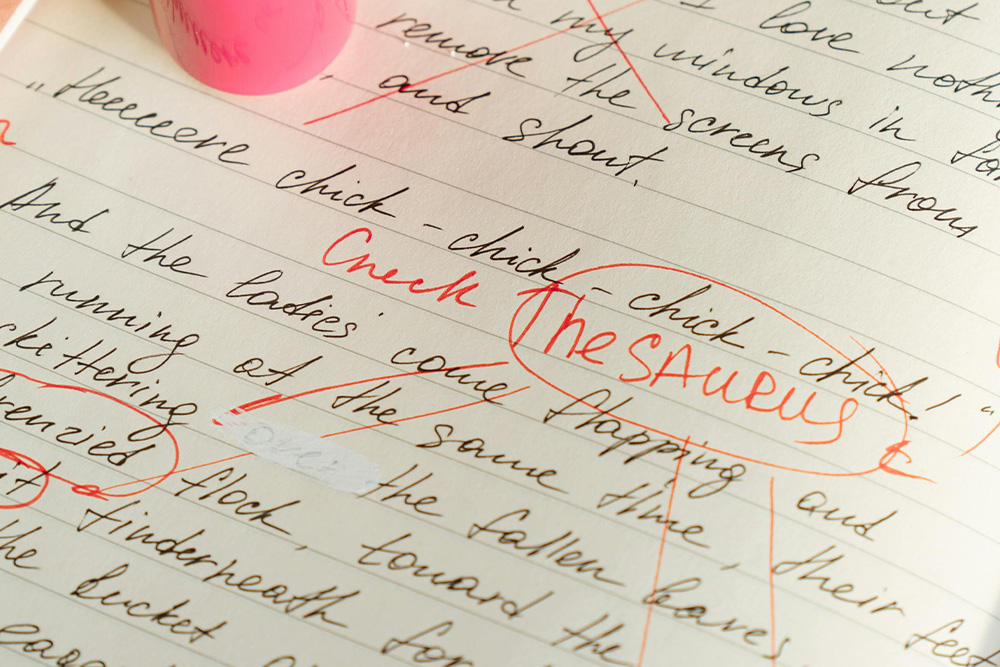
These kinds of subtle and subjective choices are the heart of proofreading. You may find yourself debating whether a character “closed” or “shut” their eyes — tiny word choices that may not objectively “improve” the writing, but still ask for your attention.
When you get stuck, simple rules of thumb can help:
- Less is more nudges you toward the simpler word
- Show, don’t tell points you toward the more concrete phrase
- Cut filter words removes barriers between the reader and the action
It can also help to use your document’s “Find” function (Ctrl. + F, or Find and Replace) to check how often a given word or phrase appears. If you discover that characters “shut their eyes” twelve times, but only “closed” them twice, you should probably balance that out more.
In long‑form writing, it’s almost impossible not to repeat such phrases. A broad search like this can help ensure you don’t lean on the same description too often. That’s not what should catch your reader’s attention.
You can think of proofreading as a statistics game. If one hundred readers open your book and it hasn’t been properly edited, a significant percentage are going to close the book before page fifty. Your job is to hedge those losses.
If smart proofreading lets you keep even ten percent of readers who would have otherwise closed the book and never returned — just for long enough to start caring about your characters, and connecting with your story — then you will have succeeded.
Pitfalls to avoid

Elegant variation
This is the overuse of synonyms to avoid repetition.
When proofreading, you may notice the same word used in two nearby paragraphs or sentences. It’s a good instinct to want variety, but changing a clear, simple word to a fancier synonym can sometimes backfire. It can call attention to itself, and potentially make the reader wonder if you’re talking about something different.
Proofreading too early
Don’t start proofreading before you’ve finished the rough draft. When you’re writing, you may feel like Orpheus leaving the underworld, tempted to look back at the pages you’ve just written to see if they’re “good enough.”
The problem is that writing and editing require two different modes. To write is to let your creativity flow, while editing is almost destructive. You will be picking your story apart, and taking a sledgehammer to certain pages. Switching between those modes can dull your ability to keep the story moving forward. Silence your inner critic until it’s the right time.
Getting stuck in the edits
This is when you’ve stopped making the work better, and are only making it different. If you’re shy about sharing your writing, or especially sensitive to criticism, it can feel safer to keep tweaking endlessly, trying to remove anything that might stick out, or possibly receive criticism.
While it’s noble, and often beneficial, to take a fine‑toothed comb to your story, it’s also easy for that to shift into overworking the text. As you chase perfection with each pass, you may be losing something crucial: the way the story originally wanted to sound.
Always save the original copy of your manuscript, and compare your edits to it later. With time and distance, you may choose to revert to an earlier version of certain sections that better retain your voice. Avoid polishing the life out of your work.
Your story weapon: Excellence vs. perfectionism
A quote attributed to Leonardo da Vinci goes: “Art is never finished, only abandoned.”
You can use this as a mantra when you feel yourself getting caught in a loop, changing the same word back and forth, unsure which version will finally make the story perfect.
Perfection is not in the words on the page; those will never be “perfect.” Your story exists somewhere between your heart and the reader’s mind. If you’ve done your work properly and engaged with the proofreading process, maybe not perfectly but perfectly enough, then it is time to let it go.
Here is how you know when that moment has arrived. You are no longer finding things that genuinely improve the work. You are finding things that are simply different. At that point, the endless tweaking is not about the story anymore. It is about fear. Fear that it isn’t good enough, that you aren’t good enough, that once it leaves your hands it will be judged and found wanting. That fear is understandable. Every writer knows it. But it is not a reason to hold the story hostage.
The proofreading process exists to make your work cleaner, clearer, and more likely to hold your reader’s attention through to the last page. It is not a guarantee of safety. No amount of polishing will protect you from criticism, and no manuscript, however carefully combed, will be received exactly as you intended by every reader. That is the nature of putting work into the world.
What you can control is the integrity of the process. Read it through one final time with fresh eyes. Trust the instincts that have carried you this far. Then save the document, close the laptop, and let the story be what it is. The next story is already waiting, and that one needs your attention now.
Proofreading is not about achieving perfection, but about honoring the work you have already done and giving it the best chance you can.
If you are ready to strengthen every stage of your writing process — from first draft to final polish — and to do so within a structured and supportive environment, join one of my next workshops: The 90-Day Novel, The 90-Day Memoir, Rewrite Master Class.