


Okay, perhaps you’ve been filling pages with scattered notes, and now there’s a growing sense you have a story that wants to be told.
So, now what?
In this article, I’ll walk you through the process of starting your novel. And then I’ll give you a Story Weapon to help carry you through to the end.
To understand how to start a novel, you must first capture your initial creative seeds through daily stream-of-consciousness writing exercises before imposing any strict plot rules. Once your protagonist’s inner world begins to emerge, organize your writing schedule around an experiential story outline, which provides the necessary structural momentum to write a messy first draft without stopping to rewrite.
Getting started
Believe it or not, your primary job as a novelist is not to summon a compelling story, but rather, to stay connected to that ineffable impulse that got you started. It is important to understand that you are not actually the author, but the channel for the story that wants to be told through you.
Have you ever wondered where your idea came from? Perhaps you were awakened at three in the morning with a scenario that wouldn’t let you go back to sleep, or you were driving and suddenly a character appeared that now just won’t seem to leave you alone, or maybe you have a memory of an incident from your past that has a hold on you, and you must to get to the heart of what it means. Wherever your story idea came from, it didn’t come from you — at least not from your conscious mind.
In other words . . . you are not the primary author. You are the channel for the story that wants to be told through you. When you accept this truth, you realize that you are actually a co-creator for the story, and you begin to relax and trust that the story lives fully and completely within your subconscious, and your job is to allow yourself to be guided through the process.
The process
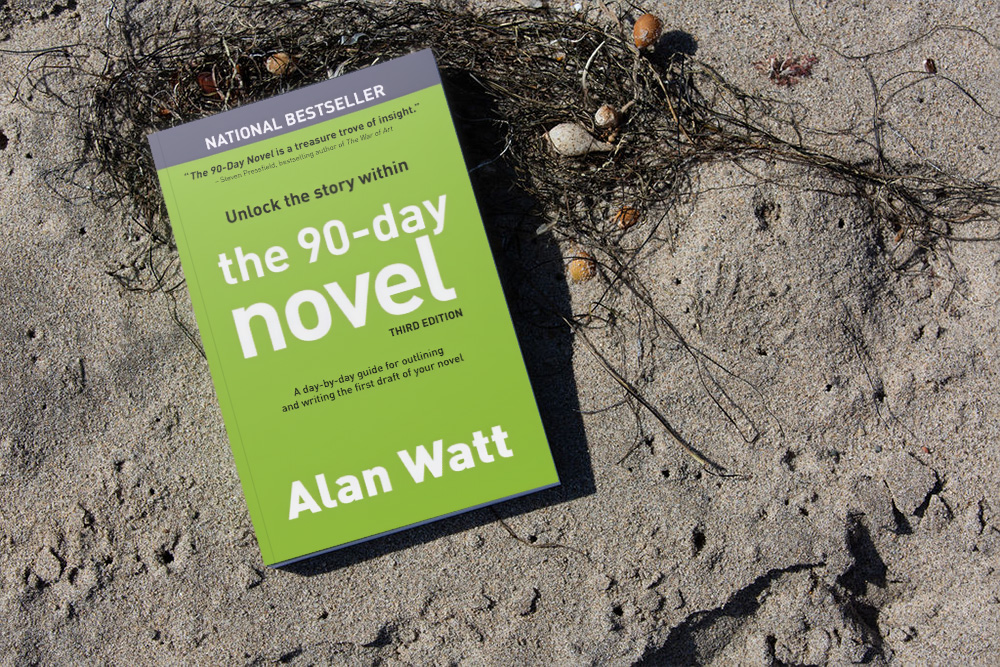
In my 90-Day Novel workshop, I teach a process of marrying the wildness of your imagination to the rigor of structure. The key in the beginning is to remain curious, listen, and explore. In fact, the first week of the workshop is solely dedicated to stream-of-consciousness writing exercises where we allow the characters to come to life without limiting any of your ideas by imposing plot.

Here’s the idea expressed beautifully by music producer Rick Rubin:
We’re searching for potential starting points that, with love and care, can grow into something beautiful. At this stage, we are not comparing them to find the best seed. We simply gather them. A seed for a song could be a phrase, a melody, a bass line, or a rhythmic feel. For a written piece, it may be a sentence, a character sketch, a setting, a thesis, or a plot point.
This means you want to develop a regular practice, spending time at your desk, in solitude, simply exploring. Here’s some free stream-of-consciousness writing prompts that will help you discover the inner life of your protagonist. Write on each of these prompts for five minutes, and you will begin to notice your protagonist and their world coming to life.
The process of starting a novel is about going from the general to the specific. As images, ideas, scenes, fragments of dialogue begin to emerge, it is time to begin exploring a structure.
Story structure

After you’ve collected some seeds, you’ll be ready to till the soil and plant. You’ll know when the time is right. In my workshop, we start exploring an outline on day eight. We spend the next three weeks working with the structure questions and allowing an outline to emerge.
Let’s break down the process further.
Story structure is typically taught by story analysts as a conceptual model — something to be figured out. But the truth is, this is virtually impossible to do, which is why so many writers struggle and get stuck.
Einstein says, “You can’t solve a problem at the same level of consciousness that created the problem.” And since every story begins with a dramatic problem, when you try to figure out your protagonist’s solution to their problem, you will inevitably get stuck.
But when you explore story structure as an experiential model, you begin to see that your protagonist tends to go through a series of experiences that leads them inexorably toward their transformation. Story is non-linear, and so, by exploring your story as a series of inner experiences that your protagonist goes through, you begin to see that character suggests plot, and you loosen your grip on your idea of how you think your story ought to go. In this way, your story is able to move in directions that you might not otherwise have considered.
Remember, if you are surprising yourself, then you will be surprising your readers.
Also, sketching out a plan for your story helps you organize your writing days. The irony is that an outline allows you to veer off plan with confidence, because you now have a sense of where the story wants to go.
The goal is to give yourself a doable writing schedule and a sense of where the story will end up. You can choose any story structure model to help with this (I highly recommend the Three-Act Structure).
“The idea for a novel is like a little tiny fire in a dark night. And, one by one, the characters come and stand around it and warm their hands.”
– Stephen King
Showing up

Once you’ve got an outline, show up as often as you can — even when it feels frustrating. Give yourself short breaks when the words aren’t flowing. Don’t be precious with the language in your first draft; that can always be polished later. It’s about getting words on paper and keeping the pace as you progress through the plan you set for your story. The key for the first draft is to not go back and rewrite.
The rewrite
When you’ve finished your first draft, it’s time to start winnowing the grain. If you’ve got, say, 300 pages in your first draft, perhaps only about two-thirds or half of those pages will make it through the next draft. The rest is chaff. These may be the story beats that don’t quite work, but you needed to explore them to know that for sure.
The next step is to do a new outline as if you did not write your first draft. I know this sounds counter-intuitive, but now that you have written your first draft, you understand your story in a fuller way. By giving your subconscious the freedom to explore, you will begin to see your story in a more dynamic and compelling way.
Make notes on what works for you in the first draft and what doesn’t, but keep it simple. Don’t get too granular with your prose at this point. Focus on the story and move the boulders before you concentrate on the pebbles.

This process might seem intimidating, but rest assured that none of your favorite stories were written to perfection in their first drafts. The most seasoned writers give themselves time to work out details and polish language to their satisfaction, but only after they begin to have clarity on the narrative. It’s only after strengthening your story structure that you want to refine your prose, and this is where your voice truly becomes clear and strong.
At this point, you can ask beta readers to read your work as well. It can be helpful to receive feedback and some encouragement after spending so long at your desk, but you also have to prepare yourself to handle critiques.
You can continue to refine the story as much as you like. You’ll know when there’s no work left to be done and it needs to be passed on to someone else for final edits. This whole process can take a few months, or even a few years. It’s about making the practice of writing a healthy part of your life. With patience and consistency, you’ll have your finished novel.
Your story weapon: Passion and commitment
Though I’ve spent a lot of time in this article focusing on the technical aspect of writing a novel, we can’t forget that there is magic in this process.
Let’s borrow some words from the poet, Mary Oliver:
The part of the psyche that works in concert with consciousness and supplies a necessary part of the poem—the heat of a star as opposed to the shape of a star, let us say—exists in a mysterious, unmapped zone: not unconscious, not subconscious, but cautious. It learns quickly what sort of courtship it is going to be. Say you promise to be at your desk in the evenings, from seven to nine. It waits, it watches. If you are reliably there, it begins to show itself—soon it begins to arrive when you do. But if you are only there sometimes and are frequently late or inattentive, it will appear fleetingly, or it will not appear at all. Why should it? It can wait. It can stay silent a lifetime.
I’ve given you a method for approaching the craft, but there’s no manual for the other part of the process: passion and commitment.
You must trust that what you have to express is valid. And while it might yet only exist at the edges of your consciousness, you alone are uniquely qualified to get down on the page this thing that wants to be expressed.
The desire to write is really the desire to evolve by resolving something you are seeking to understand. Trust your passion. Use the stream-of-consciousness writing prompts and structure questions to build a framework for your novel, and then surrender to your passion and trust that you are a channel for the story that wants to be told through you.
Starting a novel is about committing to the process of discovery, one page at a time. If you’re ready to turn inspiration into a finished manuscript, join my next 90-Day Novel workshop and develop the structure, discipline, and creative momentum needed to bring your story fully to life.