



In a previous article, I went over formatting requirements for screenplays. These techniques can also help set up a sound foundation for other forms of scriptwriting.
In this article, I’ll look at how scripts are formatted for television shows and the stage, as those are the closest to the DNA of a feature length screenplay. And I’ll offer you a Story Weapon to find the formatting tool that best suits your needs.
Script format is the professional blueprint that adapts your story to its respective medium — whether that’s for film, television, stage, or another medium. The format ensures clarity, collaboration, and production readiness. Understanding these structural differences allows you to communicate effectively with the teams who will bring your stories to life.
What is script format?
“Script format” is the umbrella term that covers all types of formatted scripts across various mediums.
A screenplay manuscript is only one type of script format that is made for feature films.
Other types of scripts include:
- Television (TV) scripts: for television studios, actors, and television production teams.
- Stage play scripts: for stage actors, directors, and stage production team members.
- Video game scripts: for video game studios, voice actors, and digital production teams.
- Radio show scripts: for a radio host and radio production team.
- Comic book scripts: for a comic book artist and editor.
A script’s format is a blueprint to bring your story to the hands and minds of the various people involved in making it come to life. It has to meet the needs of the people who will be working with the script in its respective medium. This goes for television scripts, which are seen by a similar sized team to a feature film, all the way to a comic book script that will only be seen by a small handful of talented people.
Core difference between script formats
The fundamental difference between the formats comes down to the purpose of the script, and the scope of what the format includes.
To quickly recap, screenplay format uses the traditional courier 12 pt. font with standard margins to follow a one-page-per-minute standard. The scene headings indicate information like interior (INT.) or exterior (EXT.), location, time of day, etc.
All of this serves to give the film production team as much information as they need to budget, schedule, and guide the overall production process.
Television and stage scripts also have to account for things like recurring roles, live performance constraints, audience breaks, and collaborative rehearsal processes, which all influence how scenes are structured and information is presented on the page.

Television Script Format
For screenwriters, television writing is a natural and common avenue of work. It’s a career path that many enter as opportunities, staffing needs, and creative momentum may align. Differentiating the slight formatting differences between feature film screenplays and different types of tv scripts is important.
For instance, scripts for network television will often include act breaks to help set times for commercials. These are usually moments of heightened tension or minor revelations designed to hold the audience’s attention and make them want to come back for more after the cut to ads. Cliffhangers, reversals, or emotional beats help shape the pacing across the hour or half-hour episodes.
Let’s take a look at two different types of TV script formats.
Multi-Cam Sitcom Format
This subtype includes many classic shows like The Big Bang Theory, How I Met Your Mother, and, of course, Friends. The format for these scripts are quite distinct in that they’re actually a little closer to a script made for the stage rather than a screenplay for film.
Formatting differences to note:
- Action lines and scene descriptions are in ALL CAPS
Action lines describe what the audience can see and hear as the story plays out on screen. They’re written in present tense, left aligned, and limited to concrete, observable details.
In screenplays only specific words are in all caps to highlight key aspects, but in TV scripts it’s all capitalized to make it easily readable for the more fast-paced production.
- Double-spaced dialogue
While dialogue is single-spaced in feature film screenplays, it is sometimes double-spaced for (again) ease of reading in multi-cam sitcom TV scripts. It also leaves room for any last-minute revisions or hand-written notes often required on a TV set.
This format doesn’t follow the same rule as feature length screenplays where one page of the script needs to closely translate to one minute of screen time. Sitcoms usually end up at about 30-45 seconds of screen time per page, depending on if it’s more dialogue-heavy or describing quick-paced action scenes.
- Parentheticals are more common in TV scripts
Parentheticals are lowercase side notes placed between character names and dialogue to indicate emotions such as (angrily) or (laughing), actions (grabs the cash), or to clarify who specific actions or lines are being directed toward (on walkie talkie) or (to Andrea).
While these should be used sparingly to keep from cluttering up the script, they are used a little more frequently in TV scripts than in film scripts to more easily direct the emotion and intent of certain scenes.
Script example
Here’s an example from an episode of The Big Bang Theory.
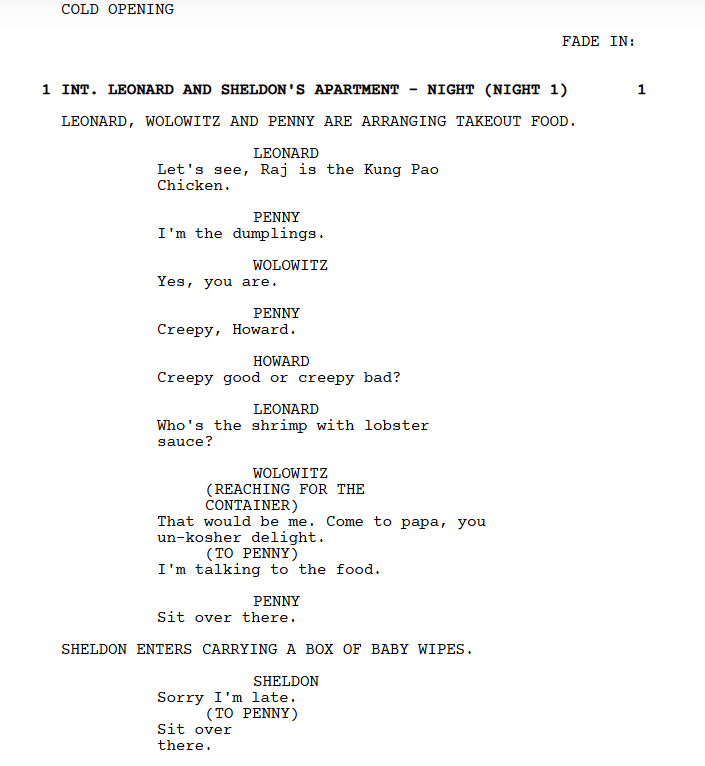
These formatting needs all point to one major difference: faster paced production.
Even if productions are not performed in front of a live studio audience, like How I Met Your Mother, the scripts are still tailored for a fast-paced live audience environment.
One-Hour Drama Format
This style of script format is much closer to the conventional film screenplay layout. One-hour dramas include the likes of Breaking Bad, Andor, and Game of Thrones.
Each episode is practically structured the same as a feature film with a clear setup, confrontation, and resolution. And, these days, the budget for a single episode can even rival that of a feature film, further blurring the line between the two formats.
Distinct features for TV dramas
- Typically follows an act structure with a teaser followed by four or five acts to allow time for commercial breaks with about 40-45 minutes of content
- Includes scene numbering in the margins that is not typically seen in feature film screenplay formats.
- Features 3-5 episodic storylines running simultaneously to track different character arcs
- Designed for faster production schedules where there is not much time for multiple takes as opposed to feature films.
Stage Play Script Format
In this case, the format of your script is aimed towards theater production (a completely different animal to that of a television or film production). It’s in the nature of plays that it is on a smaller scale compared to feature film productions.
Stage plays use some basic formatting steps: 12 pt courier font, 1-inch margins with 1.5-inches on the left for binding, character names centered in ALL CAPS with dialogue below.
Scene headings are capitalized. Stage directions are indented, usually in parentheses and/or italicized, with names in ALL CAPS.
Key differences
- Character names are either centered, or left-justified
- When character names are centered, the dialogue can span across the entire page whereas it’s usually indented for screenplays.
- Much looser formatting with simpler headings that indicate scene number, followed by a quick write-up on location details.
- More notes are often included on stage direction, blocking, and dialogue, either in parentheticals or indented and italicized.
Script example
Here’s a sample from a play adaptation of Agatha Christie’s “The Murder of Roger Ackroyd” by Lee Wilson:
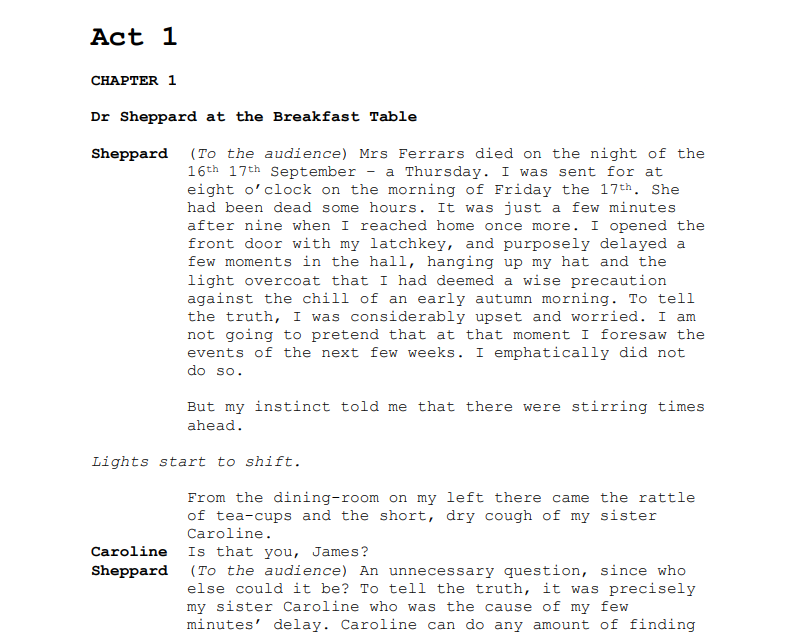
Modern stage play scripts also include:
- A title page indicating the play’s title, its writer, and their contact details (or an agent’s).
- A character list containing a brief description of every character, their age, role in the story, and their defining traits.
- And a setting description that tells the where and when of the story.
As you can likely tell, the goal of the stage play’s script is quite different from that of a screenplay. It’s designed to very quickly showcase everything theater productions need to know in the beginning.

The playwright’s rights
Here the writer is just as important as the story being told. This is to the point that the playwright’s contact details are commonly included in modern scripts, for both easier facilitation of production rights as well as story communication.
Unlike screenwriting, where writers often sell their copyright and see their work altered, playwrights generally hold the legal power over their script, often retaining rights of approval over creative changes.
The playwright’s voice is almost dogmatic in a sense from a stage production’s perspective. Depending on the terms agreed upon, liberties concerning script changes are much fewer and far between compared to screenplays.
Even though a play is operating on a smaller scale, there’s more pressure on the playwright than the screenwriter in this sense. A weak script limits what the director and actors can do to make a good production. They can’t create depth where it doesn’t exist.
Your story weapon: Script formatting tools
The good news is that there are lots of great tools out there. Software exists from various companies that help you format your script to whatever medium you’re writing for. Below is a list of popular programs used by writers around the world:
- Final Draft (I highly recommend this one)
- Writerduet
- Highland Pro
- WriterSolo
- Celtx
The script format serves the medium, and if you want to seriously enter the industry you must learn the rules and follow them to remove any barriers that would keep a production team from making your story come to life. But remember, at the end of the day, your story is all we really care about, so while there are many apps and software out there to help you with the script format, they are all simply tools to support you in your story creation.
To strengthen your command of professional storytelling standards or if you’re looking for more support, consider joining one of my workshops and continue developing your craft with guided instruction and practical application.