



When writing a screenplay, there often comes a point where you start to imagine you’re in charge of the entire production.
Perhaps you’ve written a scene and thought, “The cinematographer should use a blue gel to capture the mysterious quality of my protagonist’s first appearance,” and you add that as a note in the description. Or maybe you’re stuck on a line of dialogue, wondering if the actor will comprehend the subtext, so you write a paragraph explaining it. But this is a role better entrusted to the director.
Whatever the case, the impulse for a screenwriter to wear several “hats” is hard to resist. It’s your story after all. But filmmaking is a collaborative process, and there’s a balance you need to achieve in order to respect your fellow artists.
In this article, I’ll explore the trope of wearing “too many hats” as a screenwriter, and what it can cost you. Finally, I’ll offer you a Story Weapon so you can become a screenwriter others will want to work with.
Wearing too many hats as a screenwriter overcomplicates a script and slows down production momentum by cross-contaminating the roles of the director, producer, and cinematographer. When a writer tries to micromanage camera angles, enforce strict costume design, or obsess over unvetted budget constraints, the screenplay becomes rigid and over-described, stifling the collaborative imagination required to bring the story to life.
A screenwriter with too many hats
With regards to this filmmaking trope, a “hat” is a role you assume. Whether you’re an actor, producer, director, or another crew member, everyone has individual responsibilities in the filmmaking process. That means you have specializations that allow you to do your job without interference from others.
A screenwriter who steps beyond their role and offers uninvited direction to an actor, advice to the costume department, or shows up on the set to block a scene, will quickly incur the wrath of the production.
There are some well known filmmakers out there who have done work as writer, director, and even sometimes as the lead actor. Think of Charlie Chaplin, Orson Welles, or Woody Allen. But it is important to note that each of these roles is independent of the other.

Why do screenwriters want to direct their own scripts?
The short answer is control. I once had the opportunity to have lunch with one of my heroes, the screenwriter Paul Schrader, who wrote Taxi Driver and Raging Bull.
We were on the set of his film, Autofocus, and he told me why he now prefers to direct his own scripts. “Screenwriters only get to have half the fun,” he said.
As you write your screenplay, you’ll spend months if not years building your own world and becoming absorbed in the lives of your characters. Becoming the director and taking charge of every detail of your screenplay may seem logical at first. After all, who could do it better?
The truth is that not everyone is cut out to wear both hats. It’s possible to be a brilliant writer, but not have the necessary skills of a director such as the ability to communicate effectively with actors, knowing how to frame a shot, or having the ability to create image systems that will dramatize the underlying theme.
Common traps
Let me show you a few examples of what wearing too many hats may look like.
1. Over-describing characters

Overselling the details when you introduce your characters and scrutinizing over the smallest descriptions can be a form of overstepping your role.
Keep descriptions specific where specificity reveals character, and loose where it does not. The detail that tells us something true about how this person moves through the world belongs in the screenplay. The detail that is really just a vision of a particular actor in the role does not.
Casting isn’t your job as the screenwriter. Producers have access to portfolios of actors that you may never have seen before. Directors and the costume crew will change the look of stylized characters to fit the visual identity of the film crafted during pre-production.
As a screenwriter, your job is to keep descriptions simple and clear. Your focus should be on driving the story forward and leave the rest to the casting department
2. Budget concerns

One issue that might hinder your imagination is the idea of production scale. As you write your screenplay, you might find yourself overly worried about the practicalities of your screenplay’s production.
That is a lethal burden to lay on your creativity. While budget is always a concern, don’t write a screenplay shackled by what you think is possible. You never know who will be reading your screenplay, or what resources they have access to. Your job is to write the best version of the story, not a version that has already been compromised by a budget that doesn’t yet exist.
3. You are not the cinematographer

The most common sin screenwriters commit is trying to direct the camera.
As a screenwriter, it’s normal to think like a filmmaker. You are seeing the movie in your mind, and translating it to the page. Yes, your screenplay is a blueprint for the movie, but in the same way an architect creates a blueprint for a house, this blueprint rarely includes all of the specific building materials.
It is not your job to offer ideas on how to shoot the film — camera angles, lenses, tracking shots, etc. These are the domain of the cinematographer and the director, and if you start including shots in your script (unless you are the director) then you are announcing yourself as a novice.
The negative effect of too many hats

The root cause of these issues is often a writer who lost sight of the story and started thinking about everything surrounding it instead.
When you are writing with one eye on the budget, worrying about whether a location is feasible or whether a particular actor could convincingly play the role, the screenplay starts to choke. Scenes that should breathe start to feel managed. Choices that should feel inevitable start to feel overly cautious. The writing becomes practical at the expense of being alive, and a practical screenplay is rarely a compelling one.
The opposite problem is just as damaging. When a writer tries to accommodate too many ideas, too many subplots, too many tonal registers, too many characters who each demand their own arc and resolution, the screenplay loses the thread. The reader keeps waiting for the story to declare itself, to commit to what it is actually about, and that declaration never quite arrives.
Scenes that belong to different films sit next to each other without connecting. The protagonist gets lost in the noise. What began as ambition starts to feel like confusion, and the reader (whether they’re an agent, a producer, or eventually an audience) will feel that confusion long before they can name it. I’ve explored this aspect of having “too many hats” in a screenplay further here.
The muted screenplay and the excessive one are mirror images of the same problem. One is a writer who did not trust their imagination enough to follow it. The other is a writer who followed too many imaginations at once and never chose between them. In both cases, the story paid the price for a decision that should have been made before the first scene was written.
Your story weapon: Wear the hats that serve the story
The goal is not to stop thinking like a director or a producer completely. The goal is to think in service to your story. There is a meaningful difference between a screenwriter who understands how a camera works and uses that understanding to write more precisely, and a screenwriter who is so busy blocking out shots that the story underneath never gets fully developed. The first is a craftsperson with a broad vocabulary. The second is a writer who has left the story behind.
So here is the question worth asking before you put on any hat other than your own: does this serve the dilemma? Every choice in a screenplay, whether it is a camera direction, a character description, a location, or a piece of dialogue, should be in service of the central conflict. If a specific shot earns its place because no other shot could carry the same emotional weight at that moment, write it.
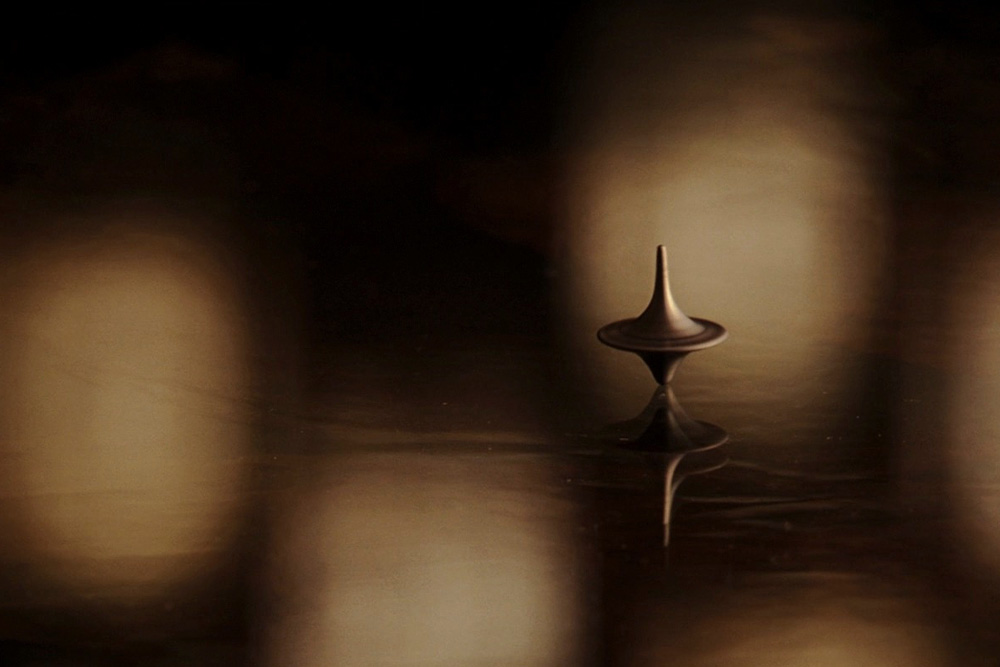
The closing shot of Inception, a slow pan toward Cobb’s spinning top while he walks away with his family, could not have been replaced by a different image without losing the entire meaning of the film. That shot is not a director’s note. It is the story’s final argument. A screenwriter who understood that put it on the page, and rightly so.
The broader skill being developed here is perspective. A screenwriter who understands something about directing will write scenes that are more visually intelligent. A screenwriter who understands something about production will make choices that are purposeful rather than arbitrary. A screenwriter who understands something about performance will write dialogue that actors can more easily inhabit. None of this means doing those jobs. It means knowing enough about them to make your own job richer.
Think of it less as wearing many hats and more as knowing what each hat is for. You reach for the director’s hat when you need to understand how a moment will land visually. You reach for the producer’s hat when you need to ask whether a scene is carrying its weight in the larger structure. You reach for the actor’s hat when a line of dialogue is not quite landing and you need to understand why. Then you put each one back and return to the writer’s chair, which is the only one that belongs to you throughout the entire process.
The screenwriter who does this well is not a writer who wants to control everything. It is a writer who wants to best serve the production by focusing on the one thing they are actually responsible for: the story on the page.
FREE STORY STRUCTURE GUIDE! Are you struggling with your outline and looking for support? My FREE Story Structure Guide will lead you through the process of marrying the wildness of your imagination to the rigor of structure to unlock your story within.