



You’ve set a deadline. You know the story you want to tell. It should be easy — just get to your desk, open a vein and pour your vulnerability onto the page. Every day. No matter the weather or the number of dishes in the sink. It’s pretty cut and dry, right?
So, why doesn’t pure desire get your novel to the finish line?
Because you’re in the middle. You’re in the Nafud desert, the sun’s anvil, where even the winds are tortured. Hope is a mirage. Finishing seems like a miracle. You know these winds will transform you. You know your hero is staring into the face of change. This is exactly where you’re supposed to be, and yet it feels like your skin is being turned inside out. How are you going to survive?

You can give a helluva pep talk to your writer friends. Now it’s time to give it to yourself with four things to remember.
1. Let it be messy
Writing a novel is a lot like giving birth — the story is a fine damn mess that has to exist before it can be shaped into a tidy swaddle. We all want the easy story, the easy birthing time, but none of us escapes the shit and the blood and the tears. And it should be a mess. In fact, the mess is the thing. The mess is a miracle of creation.
First, there’s the blank page then there are words, thoughts, the beginnings of a story. It’s beautiful and wild and full of unexplored territory that makes your eyes light with the fire of a thousand quivering arrows.
How messy is messy enough, and what do we mean when we talk about “messy”?

If we tap into our inner child, we know what the right amount of mess is. It’s the blanket fort with every pillow from the couch (especially the nice ones you’re forbidden to use), plus the snacks you half-ate and discarded on the side table. It’s the paper strewn on the kitchen floor with the markers uncapped beside them, because your drawings came to your mind in a flurry and had to be captured right then. It’s the precarious building+ship+rocket you built with Magnetiles and then filled with every stuffed animal you could find. It’s the beautiful chaos before someone (your adult self?) stepped in to tell you exactly what was wrong with so much mess — now you have to clean it up.

And everyone knows cleaning up is No Fun, No Fair, the time when parents yell and cajole and curse. It’s the tearing down of the very fabric of your imagination. You feel it viscerally.
Let the mess stand, your child self yells! Who cares that no one can sit on the couch or cross the floor without imminent danger to their person? A child knows the mess has to be lived in and embodied. Celebrated. But sometimes, the mess becomes too much. The idea of the fort isn’t the same as the reality of dusty pillows and a heavy blanket. The pillows will not hold the blankets and none of it survives you crawling through like a piece of undigested meat in a dinosaur’s gullet.
Stay with me here.
We love the mess, and we hate the mess. It’s great when we’re exploring possibilities — our characters are so exquisite, so absolutely imperfect — and it’s terrifying when we realize the story is going to take everything we’ve got to write.
We face this challenge in childhood, and we face it again and again in our writing. Everything in us begs to be thrown on the floor, crying and gnashing, to tear down the fort, or rip the drawing to shreds, or take to the streets like the Ancient Mariner, pulling at the sleeves of anyone who will listen, and if we do, that’s fine, that’s Life. But what if we took another look at the mess? What if the mess is actually the very thing that will get us to the finish line?
We know it is, yet we panic anyway.
Everyone panics. You’re not alone.
2. Don’t panic
Writing takes no small amount of courage. We may fumble, lose our thoughts, forget our words, and then we find them again in remarkable ways that bring energy to the page.
The thing you have to do — the thing we all have to do — is remain calm.
Let’s try an experiment. Write the cruddy draft of a sentence. It’s bland. It doesn’t even come close to interesting. Good. Now, write another. And another. Soon you have a paragraph that gives you a general idea of your scene. You might even have discovered something profound—some detail that shines, an action that surprises you.
Your next step? Move on. Do not linger in self-doubt.
Let the messes stand where they are. You’re building one helluva fort here, a paragraph at a time.
Remember: each paragraph you write gets you closer to a finished scene. And each scene is only today’s version. It’s not set in stone. In fact, the ugly scene is where the fun is.
Easy for me to say, right?

Some days, the burden is too much. You’ve done everything you can to revive the flailing pieces of your novel. They feel, quite literally, dead, or terribly misaligned. At any rate, the jig is up. No one can save you. You’re convinced it would be better to go into business, rather than finish this novel, because maybe you could even make money! (Heaven forfend.)
But you aren’t business-minded, and anyway, not inclined to learn right this second, and what’s to become of you now that you can’t even crawl your way out of the sewer that is your novel? The state it’s in! It’s not just a shitty first draft, it’s a shitty second or third draft! You’re in a maze you can’t find your way out of, and it’s hell. (Why can’t you be the kind of writer who enjoys reading her own work? The one who readily admits to Writing a Novel because their belief in themselves is rock solid?)
Go ahead and let it rip. I don’t mean the writing. I mean the tears. Give it a good cry. Are you in public? Your favorite coffee shop, perhaps?
3. Cry in the coffeeshop
You’ll have situated yourself in a corner to write, or against the bank of windows facing outside, anyway, so who’s to see you. Cry it out. The frustration, the fear, the self-pity — no one’s more pitiful than a writer who has lost her way.
And if they do see you? People will think you’re a tragic figure, someone whose girlfriend has left, or whose dog has died. They will never, in a hundred years, believe a grown adult will cry tears of frustration in public over a story. Let it flow. Those are sacred tears. The stifled sobs of someone about to transform. No butterfly ever becomes beautiful before first struggling to lose the cocoon on its own.

What you should know is this: if you’re crying, the story ain’t finished yet. You’re still in it. Those tears are meant to remind you what life is.
If we think of writing a novel as a long dive into deeper and deeper waters till you find the coral, or the shipwreck, or the treasure you seek, then crying is your body’s way of rising back to the surface, taking a breath. It’s your right to breathe, and once you’ve caught your breath, it’s your right to dive back in, for the sheer pleasure of knowing what’s down there is alive. Do we call shipwrecks a mess when we’re the first person to discover them? I hope not. I like to think of them as locations where discovery is possible.
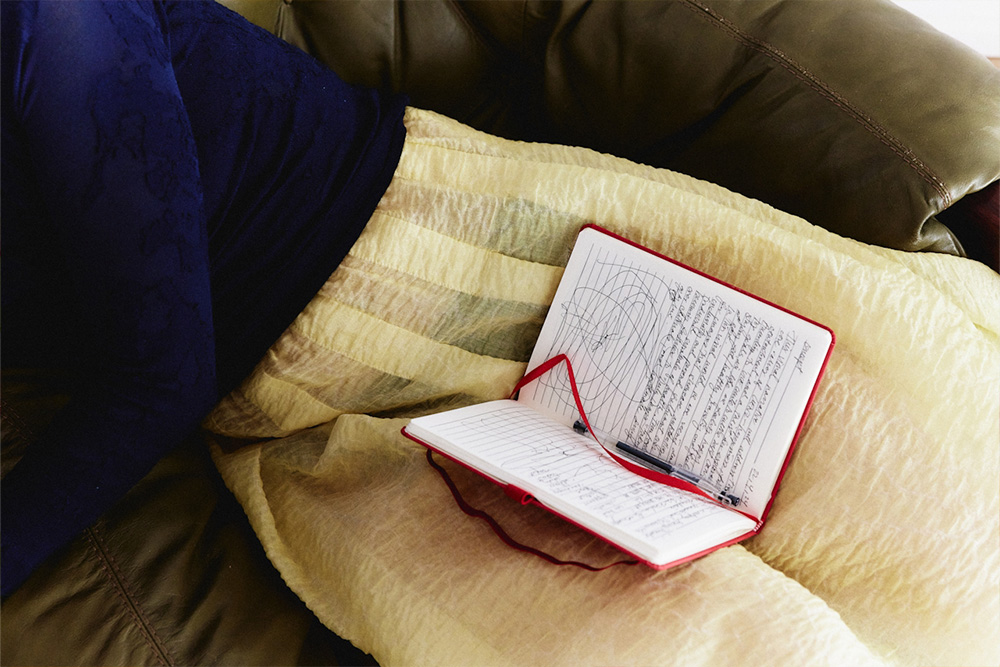
So, go ahead and cry. Close your notebook, or your laptop. Take yourself on a nature walk and remember what it is to breathe in the world. You need this now more than you know.
If you are like me, stubborn and prone to a certain chicken-like perspective of the sky falling, go ahead and keep crying. Let the entire morning be awash in tears. This will only refine your face. The wisdom. You will look as beautiful and sculpted with wrinkles as Georgia O’Keefe, may she guide us. Just know that if you are crying and in a panic about the story, you’re not done. It’s not done with you. And if it’s not done yet, there’s still time to make it what you would dearly love for it to be.
4. Keep going
You are a writer, and it’s your job to write. Freak out all you want, because in the end, it will all be fodder for your story. If it’s too scary to see the end from where you are, you’re still in the thick of discovery. Enjoy right where you are, and trust that you will find your way.
Thanks for the great tips, Monica! Take this moment as a commitment to your own process. Accept the mess, move through resistance with steadiness, and continue writing even when the path ahead feels uncertain. If you’re ready to carry that commitment forward, join one of my next workshops: The 90-Day Novel, The 90-Day Memoir, Story Day.