Are all endings inevitably set by their beginnings, or do things occur at random? This question is, in part, answered by the principle of Chekhov’s Gun. In this article, I will explore this form of foreshadowing through some examples, and give you a Story Weapon with some tips on how to employ this tool in your own writing.
Chekhov’s Gun is the principle that anything introduced in a story must matter later, and anything that matters later must be introduced early on. This creates endings that feel both surprising and inevitable. By planting meaningful details, you can craft climaxes that deliver an emotional impact.
What is the “law” of Chekhov’s Gun?
The idea comes from Anton Chekhov, a Russian playwright and author of short stories. Though it’s been paraphrased many ways, the essence of the rule is:
“If there’s a gun on the wall in Act One, you must fire the gun by Act Three. If you fire a gun in Act Three, you must see the gun on the wall in Act One.”
The idea plays on our understanding of expectation and causality. For an ending to be satisfying to the audience, we usually want to introduce the means of that ending right at the top of the story. It’s also a guideline for brevity. Why include random props in your story if they have no meaning? By cutting down to the essentials, we’re left with only what really matters in the story and, with that skeleton, there’s room in your draft for more essential ingredients.
“In layman’s terms, this law [Chekhov’s Gun] states that some things simply have to happen. If there’s a red button on a console with the words don’t push taped above it, someone will push it. If there’s a gun hanging conspicuously above Chekhov’s fireplace, someone is going to end up shooting it (probably at Nietzsche).”
– Brandon Sanderson
Examples of Chekhov’s Gun
To better understand Chekhov’s Gun, let’s take a look at an example of its use, an example of its inversion, and an example of its extension.
“No Capes!”
Almost every action movie you can think of makes use of Chekhov’s Gun in some way; we’re used to it by now. It shows up in The Shawshank Redemption, Alien, and Austin Powers, just to name a few. For the sake of this post, let’s take a look at how Chekhov’s Gun is used in The Incredibles, written and directed by Brad Bird in 2004. Surely Anton Chekhov would look at the world of Pixar with some envy; nothing but classics there.
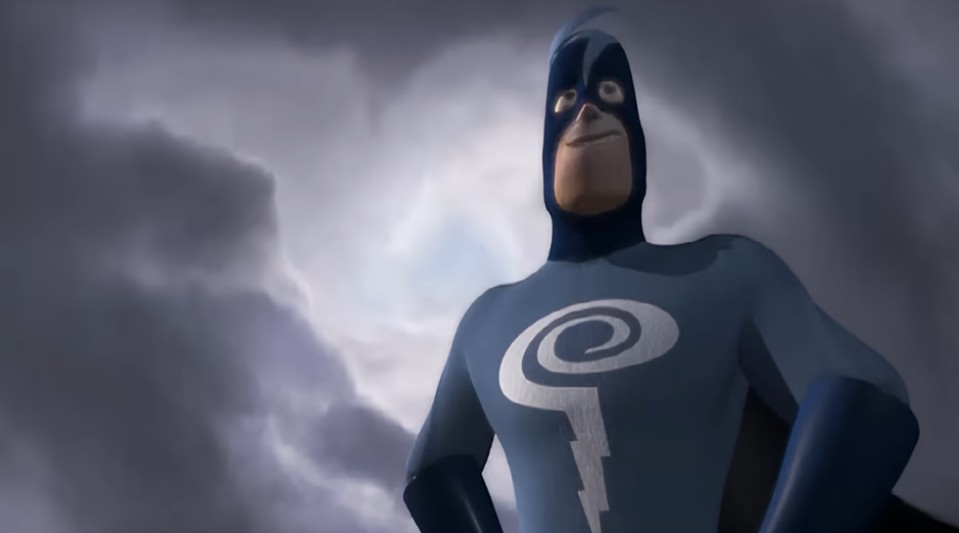
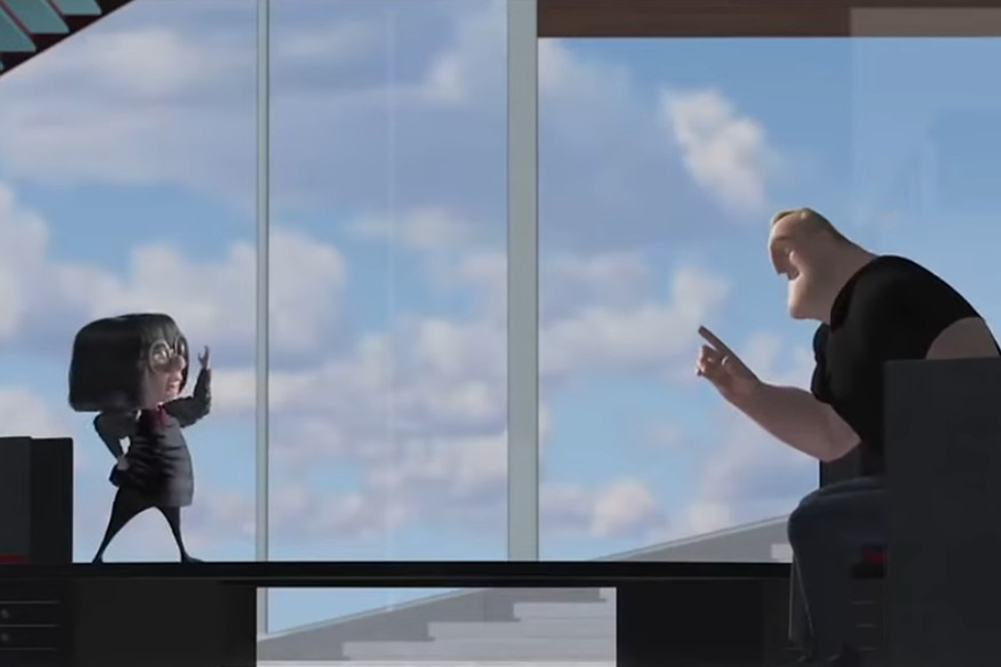
The “gun” in The Incredibles is the cape, that little touch of vanity in the costume of a superhero or supervillain.
The first example of the danger of the cape shows up early in the movie, too early for most of the audience to apprehend how it’ll show up later. This is a key part of using Chekhov’s Gun; by the time we reach the end, we’ve hopefully forgotten its first mention. It exists only in our subconscious then. In the very first sequence of the film, the French villain Bomb Voyage attaches a bomb to Buddy’s cape. Buddy, of course, is a young Syndrome, the main antagonist of the movie. That leads to Mr. Incredible wasting time saving Buddy and the villain escapes, at least temporarily.
About thirty minutes (or pages of the script) later, the danger of capes comes up again. This time we hear it from Edna, who takes us through a montage of superheroes doomed by the awkward design of the cape. Despite Mr. Incredible’s request, he does not get a cape. Instead, he’s left with Edna’s hard and fast rule: “NO CAPES.” On a rewatch (or a hundredth rewatch if you have kids), that’s like saying to the audience: “This gun will for sure show up later.”
And it does! In the climax of the movie, the last few minutes of action, Syndrome is sucked into the turbine of an airplane by his cape. He’s defeated by the Manta Jet, an inanimate object, though the Incredibles family certainly did a number on him as well. It’s such a silly way to go that, despite how gory that would actually be, it plays as a greatly satisfying end to the antagonist of a movie made for children.
Why does it work? We’ve been warned, over and over again throughout the movie, to not stick a cape onto a costume. Syndrome’s death could even be a bit of hubris; thinking he could be the exception to Edna Mode’s golden rule.
Inverting expectations
A great example of an inversion of Chekhov’s Gun shows up in No Country for Old Men, written and directed by Coen brothers. Too well-read to not know the rule and too clever to satisfy an audience’s expectation, the Coen brothers use the audience’s anticipation to surprise us with the ending. Spoilers ahead, in case you haven’t seen this modern classic yet.
The victim of the “gun” in this case is, fittingly, named Anton Chigurh. He’s the movie’s main antagonist of the film and has an interesting relationship with fate. We watch him toy with a store owner early in the story by flipping a coin to decide if they will live or die. The store proprietor refuses, at first to call it:
PROPRIETOR
Well — we need to know what it is we’re callin’ for here.
CHIGURH
You need to call it. I can’t call it for you. It wouldn’t be fair. It wouldn’t even be right.
PROPRIETOR
I didn’t put nothin’ up.
CHIGURH
Yes, you did. You been putting it up your whole life. You just didn’t know it. You know what date is on this coin?
PROPRIETOR
No.
CHIGURH
1958. It’s been traveling twenty-two years to get here. And now it’s here. And it’s either heads or tails, and you have to say. Call it.
Like all serial killers, Anton Chigurh has an odd moral code. He refuses to call the coin for the proprietor and seems to view his own actions as the inevitable hand of destiny. When he kills someone, it’s like he’s only the messenger of their death. Everything is ordained and, just like that coin that’s been bouncing around pockets for 22 years to show up in that scene, so have the victim and the killer been travelling their whole lives to show up there.
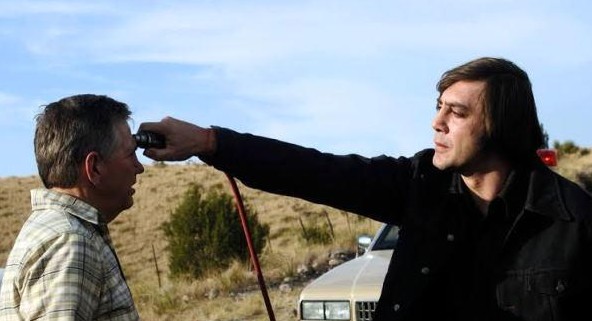
Anton Chigurh spends most of the movie escaping arrest and dodging bullets, mostly shot at him by the protagonist. None of them hit him and none of them can; it’s not his fate. As audience members, we watch the heroes get killed and we wait on tenterhooks to see if Chigurh will get away with it. Finally, in the penultimate scene of the movie, Chigurh is calmly driving away from the scene of his last murder when he’s T-boned by a car. His bone pops out and his arm is completely shattered. He limps away with a make-shift sling, having been delivered some of the pain he gave to others.
Why is this an inversion of Chekhov’s Gun? The moment plays as a completely random event after a movie full of dramatic events that seem to have been divinely orchestrated. The antagonist’s share of injury isn’t delivered to him by his odd oxygen-tank weapon or by one of the heroes. It’s delivered at random, by a complete stranger. It’s a wonderful twist on the idea of fate and only serves to emphasize one of the central questions in that movie: was that random or was that just one of the bullets shot at Anton Chigurh in a different form?
Timshel
The last example we’ll explore is a story in which Chekhov’s Gun isn’t a gun or even an object — it’s a word. This example is from John Steinbeck’s East of Eden, a masterpiece by any metric. The themes of this novel are staggering in scope; it meditates on faith, family, and how generations of people turn over the same land, the same sins.
The word timshel shows up first in a conversation between two characters discussing different translations of the Bible. Lee, who is Chinese and newer to Western models of faith, tells Samuel about the conclusions his elders came in analyzing the text. It all centers around the idea of timshel:
The American Standard translation orders men to triumph over sin, and you can call sin ignorance. The King James translation makes a promise in ‘Thou shalt,’ meaning that men will surely triumph over sin. But the Hebrew word, the word timshel — ‘Thou mayest’ — that gives a choice. It might be the most important word in the world. That says the way is open. That throws it right back on a man. For if ‘Thou mayest’ — it is also true that ‘Thou mayest not…’
Now, there are many millions in their sects and churches who feel the order, ‘Do thou,’ and throw their weight into obedience. And there are millions more who feel predestination in ‘Thou shalt.’ Nothing they may do can interfere with what will be. But “Thou mayest’! Why, that makes a man great, that gives him stature with the gods, for in his weakness and his filth and his murder of his brother he has still the great choice. He can choose his course and fight it through and win.
In short, this describes both the ending of the book and the way it started. The story of Cain and Abel referenced by Lee in this passage plays out in the text as well. The character Adam has a brother named Charles, who is physically marked like Cain. The story ends with Adam being bedridden and barely able to speak. Adam’s son, Caleb, has sent his other son Aaron to enlist in the army and, in doing so, sealed Aaron’s fate. Aaron dies in the war.
At the end, Lee brings Caleb to Adam’s bedside and begs for Adam’s forgiveness. He begs Adam to free Caleb from the generational curse, to lift his burden and his self-hatred. Adam delivers the final blow and ends the novel. All he can say is: Timshel.
By the time the book ends, that word rings out like a gunshot. Steinbeck delivers on the themes of the book and hits us with an ending using a tool we’ve seen before. There is no way for Adam to lift Caleb from his sin; he’ll have to do that himself.
Your story weapon: Tips to use Chekhov’s Gun in your story
Just like there’s no way for Adam to live Caleb’s journey for him, there’s no way for me to tell you exactly how to use Chekhov’s Gun. I’ve shown you an example of its use in a classical sense, an example where it was deliberately inverted, and one where the “gun” is a metaphor. It’s a good guideline to be mindful of but, as always, the gun is yours. You can load it, shoot it, or put it away altogether. Just remember where you left it.
Chekov’s gun is a powerful story weapon. Pun intended. Let’s explore how you can use this device to strengthen your story by creating an ending that delivers a powerful impact.
Consider the following:
- The purpose of story is to reveal a transformation for your protagonist.
- Transformation is dramatized at the climax of your story by having your protagonist make a difficult choice that they could not possibly have made in Act One.
- Consider the difficult choice your protagonist makes at the end.
- Now see if you can connect this choice to your protagonist’s unwillingness to do so in Act One.
- By noticing your protagonist’s choice at the end and reverse engineering it to discover how to contextualize this choice in the beginning, you will have provided your reader with context for the climax, thus creating an ending that is both a total surprise, and yet utterly inevitable.
To effectively use foreshadowing in your story, you need to have a sense of the overall structure. Join my next Story Day or 30-Day Outline workshop.