
The idea of a Muse, inspiration, spirit, or genius, is present in any civilization in which great literature exists. When we read something worth recording in the history of storytelling, we get the sense that it came from somewhere else.
“Invoking the Muse” is the notion of somehow tapping into a higher source than the hands that transcribed it onto paper. We can trace it back to Homer’s epic poem, The Odyssey, which opens with him doing exactly that: “Sing in me, Muse, and through me tell the story.” in this article, I will explore what the Muse is, how to spark that connection in your work, and give you a Story Weapon to keep in mind as you write.
The “Muse” represents the mysterious, inspired force behind meaningful creativity. It’s something writers can court through humility, rituals, and joy rather than sheer effort or ego. By nurturing a playful, receptive mindset, you can build a relationship with your Muse and invite genuine inspiration into your work.
What is the “Muse”?
Defining the Muse, or limiting it by definition, is an act of immaturity. Far be it from us to tell you what your Muse is, but we can tell you a little bit about how other people have described their experiences.
In the time of Homer, it was believed that people were not geniuses, but that they had geniuses. These were essentially idea fairies or higher spirit guides, who, if courted and respected, would deign to tell their story through your work. The work of the artist, then, was to work on their craft until it was worthy of the stories they could be given. The act of writing was a meditation and a prayer, in which the story would appear through inspiration. We’ve all felt it from time to time, when a character is suddenly moving our pens for us or the next line of dialogue appears before we get the chance to think about it.
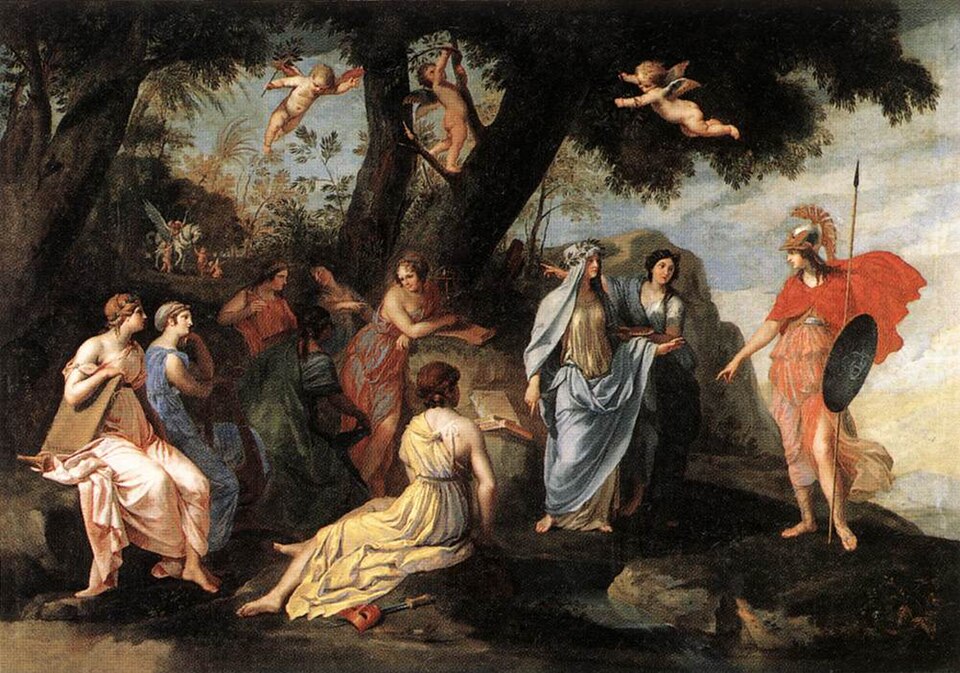
Various cultures have imagined the Muse or Muses in every way imaginable. In some pantheons, there’s a Muse for music and a different one for literature. In some, these are manifestations of the same essence. In yet others, the Muse is a fragment of our higher selves and the act of creativity is a conversation between you and your soul.
Not only are you welcome to think about this relationship between you and your Muse however you like, you must do it in your own way. This is the part of writing that no one can teach you. This is the part where magic occurs.
In Plato’s words: “The man who arrives at the doors of artistic creation with none of the madness of the Muses would be convinced that technical ability alone was enough to make an artist . . . what that man creates by means of reason will pale before the art of inspired beings.”
We hear often among artists that another person was their muse, often feminine in nature. Picasso had his muses and Frida Kahlo was her own muse. We might think of a human muse as someone who, because of their inner or outer beauty (or some other quality), is able to personify that spirit. When anyone is looked at with love, the light of their being emerges and that alone can be the inspiration we need.
How do you invoke the Muse?
This is the question that haunts artists. How many people have sat at their writing desks only to find nothing emerges from their pens? There are countless works of writing that, lacking inspiration, are not literature. Perhaps they’re written with a certain cynicism or with profit at the center of the mind. Perhaps there’s an immaturity of technique or an unripe wisdom, and the artist is not yet ready for the work that will set the world alight.
Rituals to establish your mindset
When invoking the Muse, it’s common to turn to ritual. In Homer’s work, that ritual takes the form of a verbal prayer. By starting his work with the earnest invitation to inspiration, he reminds his own ego that the story of The Odyssey is not coming from his Earthly mind. Instead, he frames his own voice as the instrument of the Muse. That act of humility is key for invoking the Muse.
Though we certainly don’t need to make animal sacrifices or throw ourselves at the feet of inspiration, there is a freedom in remembering that it’s not all up to us. To write with abandon is to forget oneself and be lost in the work. That requires the temporary loss of our ego — and the relief of that is one of the best things about writing. We’re temporarily lifted from our circumstances and invited to dine with the Muse, where we watch the empires rise and fall. As Ray Bradbury puts it in Zen and the Art of Writing:
You must stay drunk on writing so reality cannot destroy you. I have learned, on my journeys, that if I let a day go by without writing, I grow uneasy. Two days and I am in tremor. Three and I suspect lunacy. Four and I might as well be a hog, suffering the flux in a wallow. An hour’s writing is tonic.
You get to choose any ritual you like. It’s worth remembering, however, why ritual exists. Any set of steps, whether it’s clicking your heels three times or walking around the house in a certain pattern, is a pathway between you and the realm of imagination.
We use rituals because they focus the mind and allow for a transition from our Earthly responsibilities to our palace of play. When choosing your rituals, allow them to be as simple as you need and as complex as you like. They should make writing a joy and not a hassle.
“Cheat your landlord if you can – and must – but do not try to shortchange the Muse.”
– William S. Burroughs
Entertain the notion that the Muse is not an alien entity, but instead a part of yourself that you’re either close to or estranged from. You can relax a little. Make the ritual something that nourishes your being and your body. Maybe it’s a nice stretch or a warm bath. It might be feeding the birds outside or spending a luxurious amount of time making a cup of tea.
No matter what your ritual is, spend the time surrendering to the activity and focus your attention on the thought of the Muse. In this way, you slowly build that relationship.
Working with your Muse
Eventually, you and your Muse get to be best friends. That friendship might manifest as that series of mystery novels you’ve been trying to write forever. It might be something softer, like a joyous practice of scribbling poems for yourself to process your emotions. Whether or not someone else sees them is up to you and your Muse.
When we appreciate that everyone has access to inspiration and we’re welcome to it when we choose to knock on that door, we apprehend the beauty of the realms in which the Muses dance. The Buddhist version of this is articulated beautifully by Chogyam Trungpa:
When you express gentleness and precision in your environment, then real brilliance and power can descend onto that situation. If you try to manufacture that presence out of your own ego, it will never happen. You cannot own the power and the magic of this world. It is always available, but it does not belong to anyone.

Invoking the Muse is no more than an invitation for joy to enter a situation. The way that you write and decorate that invitation is entirely up to you and, in fact, a wonderful chance to flesh out your personal style.
Are you a dramatic personage who enjoys lighting a candle, dimming the lights, and playing classical music when you court the Muse? Go for it.
Are you a lover of nature and a patron of simplicity? Sit in the garden and trust that the Muse will join you.
Are you a scientist, a lover of efficiency? Make yourself a potion (read: coffee) and meditate until the cacophony of mental activity subsides.
Then, click your heels three times and sneeze until the Nobel Prize of Literature is yours.
Your story weapon: Let go of the result

To become the writer you want to be, it’s important that you enjoy writing and not having written.
A good way to begin courting the Muse is to take care of your inner child. The feeling of delight and wonder that is the inheritance of children is still in you, you only have to open yourself up to it.
Once the page is your playground, there will be little need to invoke the Muse through complex rituals. The Muse will come to you, drawn to the joy of your being.
If you make the journey more important than the destination, and possess a curiosity greater than your fear, you will inevitably start to have insights and breakthroughs. Join one of my next workshops: The 90-Day Novel, The 90-Day Memoir, Story Day