
Rhetorical choices shape not just what we say, but how we make people feel and think. Every speech, story, or written argument carries decisions about which techniques to use, how to structure them, and which emotions to evoke.
In this article, we’ll explore rhetorical choices—the actions writers and speakers take with language to persuade, move, and connect with their audience—and I will give you a story weapon to understand how these choices can elevate your own writing.
Rhetorical choices are the deliberate actions writers and speakers take with language to influence how an audience feels and thinks. By consciously setting limits, studying admired techniques, and aligning your choices with a purpose and voice, you can create more powerful, intentional, and authentic work.
What’s the difference between rhetorical devices and rhetorical choices?
Technically, rhetorical devices are the various techniques writers use to persuade (such as metaphors, hyperbole, repetition), while rhetorical choices are the actions that authors and orators take as they write with those techniques (compares, exaggerates, repeats).
When you’re analyzing a speech’s structure to determine how the speaker is affecting a crowd through their rhetorical choices, the main question to ask is “What are they doing to fulfill their goal?” Think in terms of action verbs, such as: contradicting, challenging, balancing, reconciling, persuading, insisting, etc.
When a writer sets out to create a piece of rhetoric, they choose (either consciously or subconsciously) their preferred rhetorical and literary devices to fulfill their goal.
“The rhetoric is the key to the character. It’s the verbal music of the piece.”
– Peter Shaffer
Exploring rhetorical choices
Let’s create a speech example and analyze the rhetorical choices made to appeal to people’s pathos. Imagine a community leader speaking after a devastating local flood:
Last night, many of us watched our neighbors climb onto rooftops, clutching their children as the water swallowed their homes. I saw Mrs. Alvarez carrying her elderly father through knee-deep currents because the rescue boats hadn’t arrived yet. And I’ll never forget the look on eight-year-old Mina’s face when she asked if her dog would know how to swim. These families aren’t strangers—they’re us. They are the beating heart of this town, and they need us now more than ever.
What rhetorical choices were made to appeal to pathos here?
- Paints vivid scenes of suffering (imagery: rooftops, rising water, carrying a parent).
- Narrates specific personal stories, using anecdotes to humanize the crisis and create emotional connection.
- Appeals to empathy by focusing on a child (“eight-year-old Mina asking if her dog could swim”).
- Includes unifying language (“our neighbors,” “they’re us”) to reinforce shared identity.
- Adopts an emotional, compassionate tone to stir urgency and moral concern.
Many writers make these choices subconsciously. Even the most genre-specific writers, like R.L. Stine and Ray Bradbury, incorporate numerous elements of writing and the resulting mix is their own unique voice. For our favorite writers, we’re accustomed to their style and preferred rhetorical devices; we can practically hear them reading the work to us. That said, there are benefits to making a more intentional choice with your devices.

Setting parameters for yourself
By making a list of the rhetorical devices to which you’ll limit yourself or the list of devices you’d like to try, you’re allowing yourself to be creative with the technique of writing and not just the content of your writing. These creative “boxes” can be incredibly helpful.
On a practical level, they force you to entertain the logical aspect of your mind and get out of the untamed creativity of your brain’s artistic aspect. Shakespeare did very well within the limits of iambic pentameter.
This is an echo of one of Susan Sontag’s points in her brilliant essay, “On Style.”
If art is the supreme game which the will plays with itself, ‘style’ consists of the set of rules by which this game is played. And the rules are always, finally, an artificial and arbitrary limit, whether they are rules of form (like terza rima or the twelve-tone row or frontality) or the presence of a certain ‘content.’
The rhetorical choices you make characterize the “game” of your story. It structures the difference between a brutal book series like Game of Thrones and the comparatively softer tone of the works of Marilynne Robinson.
The tools used to create your art affect the art itself. If you had access to infinite ideas and infinite canvasses, you very likely might become overwhelmed. By limiting yourself or defining the tools, you are creating a sandbox within which to create.
Your story weapon: Mimicry only gets you so far
When choosing your rhetorical devices, it can be helpful to see what other writers have used, but don’t fall into the pit of comparing your writing to others. This is easier said than done.
It’s only natural for the novice writer to mimic the style of an author they admire. We might keep mimicking until, out of the combination of their voices and our thankfully poor attempts to recreate them, we accidentally run into our own voice. All of a sudden, the writing sounds like you. But it can take a while to get to that point.
To the best of your ability, get out of your own way. Here is a helpful example, told by Bill Hader (SNL alumnus and the writer/director/star/probably boom operator on Barry) on his audition for SNL:
I actually went up the elevator with Andy Samberg, that was when we met. We’re going into our audition. Andy had a backpack on with tons of props and I was looking at him going ‘Oh no, I don’t have any props. Oh man, that guy’s got props.’ And he was looking at me going: ‘That guy doesn’t have any props. He doesn’t even need props. Why do I have props?’
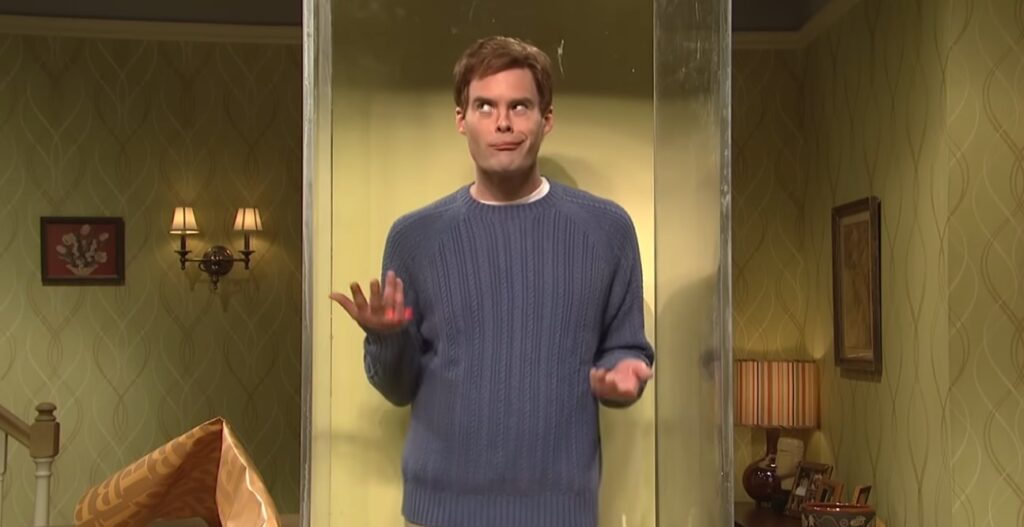
Needless to say, they both performed their auditions to the best of their abilities in spite of that momentary imposter syndrome and became stars in their own right.
The goal is to be more like yourself.
So when you’re writing that next great monologue or that speech that’ll get your character into office, take a look at the rhetoric you admire and make note of the tools they chose to use. You can try to limit the devices you make available to yourself, or try to push yourself into new territory by using tools that are unfamiliar to you.
When you finish, read the work aloud and notice the cadence of the piece. Does it flow like a river, easy and pleasing to the ear? Is it syncopated and stilted, in the voice of someone who isn’t used to the podium? Which is appropriate for the piece and the character? Entertaining these questions and answering them is the first step to working on your rhetorical choices.
Dig deep into the primal desires driving your protagonist and antagonist(s). Join one of my workshops to find out more: The 90-Day Novel, The 90-Day Memoir, Story Day