




For writers, implying subtext can be difficult, but it is also essential. The challenge lies in knowing what needs to be said and what can be left unsaid.
A scene that completely explains itself tends to be dull, and even confusing. Subtext requires that you trust your reader to pick up on various clues. When it works, that level of participation is invaluable and helps your reader keep turning the pages.
In this article, I’ll explore subtext and unpack an example from To Kill a Mockingbird. Lastly, I’ll give you a story weapon to add layers of subtext to your own story.
To craft compelling subtext, you must intentionally divide a scene into two distinct layers: what is openly stated on the surface and what is avoided underneath. By establishing an urgent obstacle and allowing unspoken desires to bleed through body language, loaded glances, and social constraints, you invite readers to read between the lines and actively discover the deeper meaning of your narrative.
Subtext defined
Subtext is the underlying meaning of something said or written. Usually this implicit meaning is conveyed through a person’s body language, tone, or a given context. This is what “reading between the lines” means.
It is what a character communicates without saying, what a scene implies without stating, what the reader understands without being told. When someone says they are fine and every detail in the scene tells you they are not, that gap is subtext.
The simplest example is a euphemism. We do not announce that we are going to the bathroom. We powder our nose, visit the loo, step away for a moment. The meaning is understood without being spoken. Subtext operates on the same principle with higher stakes.
Situations for subtext
When would a narrator or a character use subtext rather than simply saying what they mean? Here are some fitting scenarios.

Social necessity
You’ll find the works of Jane Austen, Emily Bronte, and Marcel Proust rife with subtext. Their stories take place in high society, where it’s too crass to say you love or hate someone directly. Emotions are expressed through indirection, through the loaded glance, the carefully chosen word, the pointed silence. There’s a popular joke about these types of romances:
In a proper British romance, the hero and heroine never declare their love. They exchange meaningful glances, misunderstand each other completely, and die quietly, having never said a word.
It’s all in the longing, not the having.
The restraint these characters are forced to exercise creates a tension that direct declaration would destroy. When Elizabeth Bennet and Mr. Darcy finally understand each other, the release is enormous because so much has been withheld for so long.
When you are writing a character whose background, class, or culture shapes what they are permitted to say openly, let that pressure show in how they speak. What they cannot say directly will tell the reader more about who they are than any confession ever could.
“The ostensible subject of my photographs may be motion, but the subtext is time. A dancer’s movements illustrate the passage of time, giving it a substance, materiality, and space. In my photographs, time is stopped, a split second becomes an eternity, and an ephemeral moment is solid as sculpture.”
– Lois Greenfield
Veil a bitter message

Sometimes the only way to say a dangerous truth is to say it sideways.
George Orwell understood this with particular precision. Animal Farm is, on its surface, a story about pigs overthrowing a farmer and running a rural estate. It is also a precise and devastating analysis of how revolutionary movements corrupt themselves, how the language of equality becomes the instrument of oppression, and how ordinary people find themselves living under a tyranny they helped to build.
Orwell could not have written his analysis as a political essay and reached the same audience with the same force. The story was the delivery mechanism. The subtext was the message.
Arthur Miller did the same thing with The Crucible. The play is set in 17th century Salem during the witch trials, and yet it’s all about the McCarthy era Red Scare of the 1950s. The climate of accusation, reputations destroyed on the basis of fear and social pressure, the cowardice of institutions that should have known better. Miller could not say these things directly in the political climate of the time. So he said them through a moment in history, and the subtext landed harder than any direct statement could have.
This is what subtext can do for your story that nothing else can. It adds a second layer of meaning that a reader can access without being directed to it, and that discovery, the moment a reader realizes what the story is really about, is one of the most satisfying experiences fiction can produce.
Worked Example
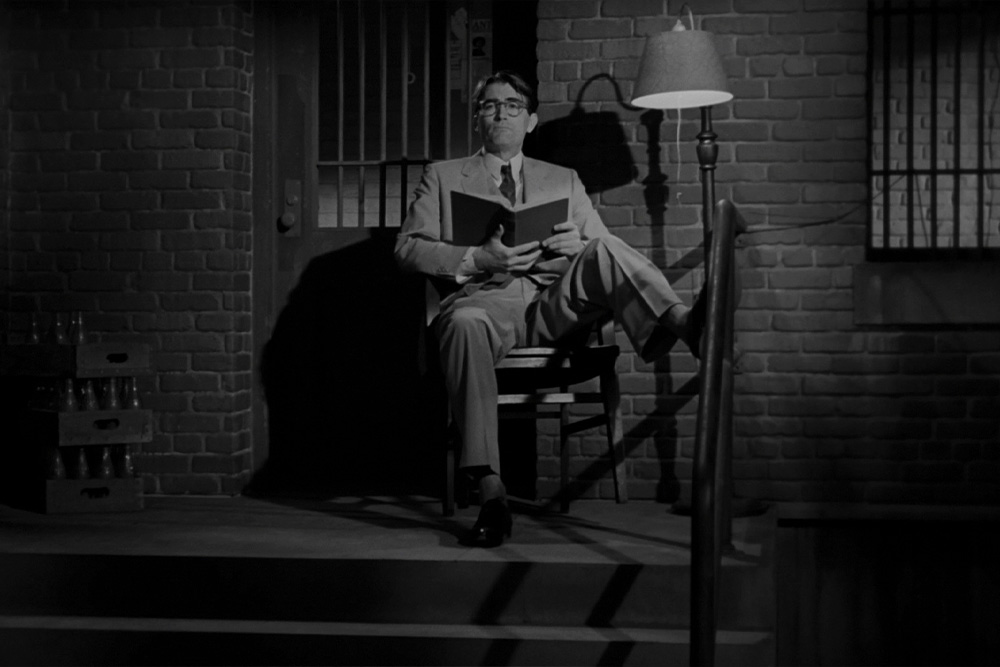
Let’s unpack an example from a classic work of literature: Harper Lee’s To Kill a Mockingbird.
The story explores racial politics and violence in the South, all told through the lens of a child. The narrator is Scout Finch, who starts the book at about 6 years old. There’s a lot of subtext here — much of which escapes Scout’s notice even though she’s the narrator, but the reader can still glean what’s happening.
Here’s an example, in which her father Atticus is talking about their neighbor Mrs. Dubose. After destroying Mrs. Dubose’s flower bushes, Jem was punished by having to read aloud to her. When she passes away from a terminal illness, Atticus subtly explains her morphine addiction and withdrawals to Scout and her brother Jem, and how she used Jem’s reading sessions as a distraction from her symptoms to break her addiction.
Son, I told you that if you hadn’t lost your head I’d have made you go read to her. I wanted you to see something about her — I wanted you to see what real courage is, instead of getting the idea that courage is a man with a gun in his hand. It’s when you know you’re licked before you begin but you begin anyway and you see it through no matter what. You rarely win, but sometimes you do. Mrs. Dubose won, all ninety-eight pounds of her. According to her views, she died beholden to nothing and nobody. She was the bravest person I ever knew.
There are a couple things going on here. For one, the text itself is important. Even just on the surface, Atticus is giving his kids a powerful lesson. It takes some adults their whole life to learn what he’s saying.
The subtext adds another layer. In the book, Atticus is defending an innocent black man in a rape case. He knows that he’ll lose the case and that he’s taken on a hopeless endeavor. Nonetheless, it’s the right thing to do.
In this passage, Atticus is gently warning his children that he might lose in court but it’s still worth the fight. They don’t know it yet, but the lesson here will serve them well later in the book. The subtext is essential here because he’s explaining something complicated to people too young to understand it consciously, but he trusts that the lesson will hold when the right moment comes.
Your story weapon: Three keys to subtext
Every scene in your story has two versions. The first is the version on the surface: what is said, what happens, what the characters do. The second is the version underneath: what is felt, what is avoided, what nobody in the scene is willing to say out loud. Your job as a writer is to write both at the same time, while only putting one of them on the page.
When you approach a scene, ask yourself these three questions:
- What do my characters want in this scene?
- What is standing in their way?
- How is it urgent?
By exploring these three elements, you will invariably be forced to explore the subtext. You will discover that while your character wants something, there is invariably something standing in their way, and if there isn’t, you need to explore the obstacle standing in their way, as this is how meaning gets conveyed.
For example, take two characters who have been in love for years and have been too afraid to tell each other, perhaps for fear of rejection. Now, let’s say that you want to explore this question. How might you do this?
Well, what if one of them announced that they were moving away, or getting engaged. Suddenly, you have a scene. One of them has always wanted to express their love for the other, but fear of rejection is standing in their way. The moment they receive the news that the object of their affection is moving, or is engaged, or whatever else you choose to create urgency, the scene comes alive. Now, suddenly, everything that is said is fraught with subtext. They might be discussing something entirely ordinary, the weather, a shared errand, an upcoming event, but the scene is vibrating with the urgent question of whether or not their love will be requited.

What you will find, if you hold the subtext clearly in your own mind while you write, is that it begins to bleed through in unexpected ways. A pause that goes on a beat too long. One word or thought abandoned for a safer one. A moment where one of them almost says the real thing and pulls back.
Subtext is not something you add to a scene after the fact. It is something you carry into the scene from the beginning. If you know what your character cannot say, that knowledge will shape every line of dialogue, every stage direction, every small physical detail you choose to include. The scene will mean more than it appears to mean, and the reader will lean in without quite knowing why.
The best subtext leaves the reader with the feeling that they understood something the characters did not.
Learning to write with subtext allows your scenes to carry emotional weight long after the dialogue ends, inviting readers to participate in the meaning beneath the surface. To deepen your understanding of layered storytelling and emotional resonance, join one of my next workshops: The 90-Day Novel, The 90-Day Memoir, Story Day.