
Internal conflict is the first step toward a character’s transformation.
Every story involves conflict. This conflict can occur between lovers, neighbors, families, and even nations. For the protagonist, however, the central conflict is within. This is their internal conflict — the painful dissonance of contradicting ideas in their psyche.
Their quest to relieve this internal tension is what provides fuel for their story arc. As the world around them changes, they change too. This features heavily in stories that focus on exploring “Character vs Self.”
In this article I’ll explore how to dramatize internal conflict, and then review some examples from literature and film. Lastly, I’ll give you a Story Weapon to help you find the internal conflict driving your characters.
A protagonist’s internal conflict serves as the essential engine for transformation by pitting their deeply held false beliefs against a changing world. To resolve this psychological dissonance, the character must face a dilemma that forces a fundamental shift in perception rather than a simple external solution.
A disconnect
For tension to exist, you need dissonance.

In music theory, it’s common to hear notes with some dissonance. For example, a chord progression might include notes that are less than harmonious, or the various instruments in a piece of music might conspire to create a dark, even jarring sound. This gives the listener something to resolve, so they experience satisfaction when the final chord arrives or the instruments come back into rhythm.
The same is true for your characters.

When you’re creating internal conflict, look for a clash of beliefs, goals, desires, or ideas within the mind of your protagonist.
Your protagonist may believe something that their environment doesn’t support, or perhaps they’re being forced to do something that pushes them to reframe their understanding of the world. Without this pressure there would be no drama – in fact, it is this pressure that forces them to act. It is the escalating tension between your protagonist’s actions and your antagonists’ responses that provide your story with its plot.
“I hope I can settle my internal conflicts without bloodshed.”
– Ashleigh Brilliant
Let’s consider an example from Shakespeare.
Hamlet, prince of Denmark, displays a classic case of internal conflict. His world is shattered with the death of his father and seeing his father’s ghost certainly doesn’t help either. His mother marries his uncle, who turns out to be his father’s murderer. That’s enough to throw anyone for a loop.

Where does the internal conflict come in? This external conflict breaks Hamlet’s worldview and causes internal contradictions. His sense of duty to his father and his moral qualms about acting against his uncle clash. His sanity is in question, as he doubts the sincerity of those around him and the validity of his visions. Pretty soon, he’s wondering if he himself should be or not be.
The play takes us through Hamlet’s spiral into madness. Because this is Shakespeare, it doesn’t turn out too well. He ends up becoming a killer, and causes the death of a few others, including his lover Ophelia.
Hamlet’s attempts to reconcile his internal conflict lead him increasingly into self-doubt. This madness spills out around him. He kills his uncle and ends up losing his own life. The dissonance between the seemingly serene life of being the prince of Denmark and the prison of his own mind forces him into action, and that action leads to tragedy.
As Hamlet says: “O God, I could be bounded in a nutshell and count myself a king of infinite space, were it not that I have bad dreams.”
Transformation
Just as Hamlet transforms from young royalty to a spirit of vengeance, your protagonist chooses how they react in response to their inner conflict. While we may hope for happy endings, transformation can also be a fall from grace or a descent into darkness. Hamlet is unable to triumph over the black hole that emerges in his heart. His death is the only thing that can bring peace.
Let’s take a look at an example of another prince fighting an internal battle: Prince Zuko of the Fire Nation from Avatar: The Last Airbender.
As the crown prince of a violent empire, he starts the story keen on hunting down the young Avatar to return to a position of glory in his father’s eyes. The more he explores the outside world, however, the more his beliefs clash with what he sees. Zuko begins to notice the horrors that the Fire Nation has enacted. The influence of his more gentle and wise Uncle Iroh gradually seeps into his consciousness. Eventually, after much pain and wandering, something has to change.
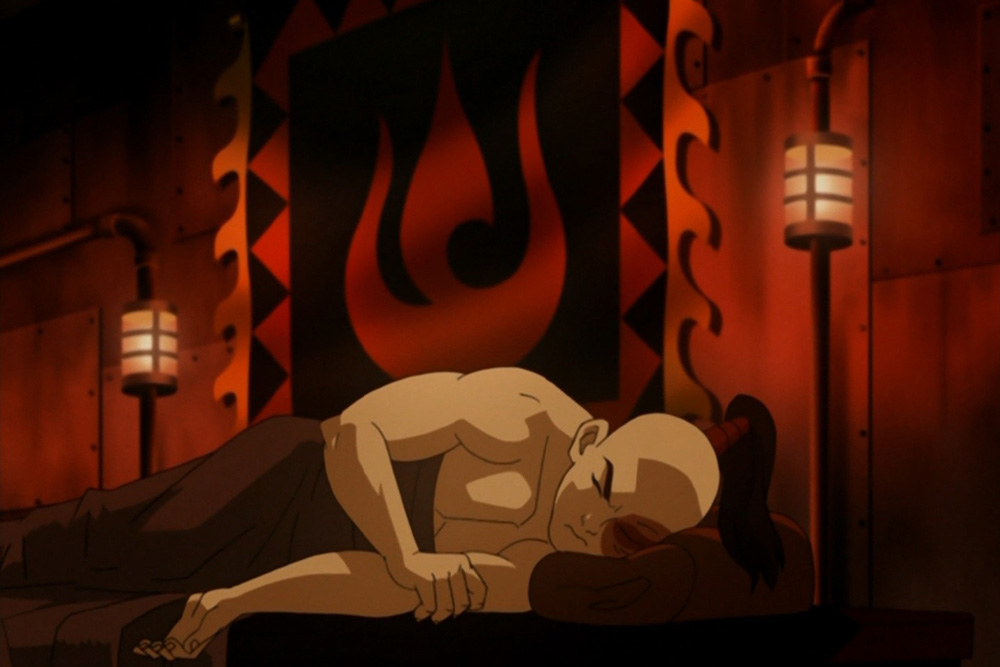
In a moment of transformation, Zuko makes a new choice. He frees Appa, a sky bison and the Avatar’s familiar. After doing so, he collapses. Zuko suffers from a fever and a series of bad dreams where his whole being is thrown into turmoil. During this fever, he has the following exchange with Uncle Iroh:
Iroh: “You should know that this is not a natural sickness, but that shouldn’t stop you from enjoying tea.”
Zuko: “What’s happening?”
Iroh: “Your critical decision. What you did beneath that lake. It was in such conflict with your image of yourself that you are now at war within your own mind and body.”
Zuko: “What’s that mean?”
Iroh: “You are going through a metamorphosis, my nephew. It will not be a pleasant experience, but when you come out of it, you will be the beautiful prince you were always meant to be.”
This is by no means the end of Zuko’s inner conflict, but it marks a turning point that leads to his inevitable transformation. Eventually, his uncle proves to be correct. Zuko joins the side of the resistance and eventually joins the invasion of the Fire Nation.
And thus, he grows into the person he was destined to be. His sense of justice was in direct conflict with his internal belief that the Fire Nation was acting justly. This tension created his pain, which created his choices, which eventually gave us a transformed Zuko and a transformed Fire Nation in the resolution.
Your story weapon: Find the dilemma
Your protagonist has a dilemma. Always. It is not a question of whether or not your protagonist has a dilemma (they do, trust me), it is the specificity with which you have explored it. (To be human is to struggle with a dilemma, and your characters are either human, or they are a metaphor for what it means to be human.)
A dilemma is a problem that cannot be solved without creating a new problem.
There are two ingredients to a dilemma.
- A powerful desire
- A false belief
The dilemma is how your protagonist’s internal conflict gets dramatized. When you connect to your protagonist’s dilemma, you are connecting to the source of your story.
Here are some examples of themes, and their underlying dilemma.
Faith: When I get proof, then I will believe.
Freedom: When I escape, then I will be free.
Justice: When I exact revenge, then justice will be done.
Validation: When I get the promotion, then I will be validated.
Notice that what your protagonist is seeking is always outside of themselves, while what they actually need is always within.
✒️ Writing Exercise
In order to create a powerful engine for your protagonist’s internal conflict, write for five minutes exploring the dilemma besetting your protagonist. Notice that their internal conflict is literally impossible to solve, thus necessitating a transformation.
Remember this: problems are solved, while dilemmas can only be resolved through a shift in perception.
Good work!
By exploring your protagonist’s dilemma, you will naturally be led to their internal conflict, which can only be resolved at the end of the story when your protagonist makes a difficult choice.
If you are ready to refine your understanding of character, structure, and transformation, and to apply these principles within your own work, join one of my workshops: The 90-Day Novel, The 90-Day Memoir, Story Day.